


Page 555 - Hematology_ Basic Principles and Practice ( PDFDrive )
P. 555
470    Part V  Red Blood Cells


                                     Iron-deficient cells              Iron-replete cells

                                          Ferritin                    IRP1 4Fe-4S
                                         Ferroportin1                                IRP2
                               IRP1/2     eALAS
                                         m-Aconitase
                                          HIF-2α
                               5                        3      5                         3
                                    Translational repression        Translational activation

                                                                                   IRP2

                                                                    IRP1 4Fe-4S
                                            IRP1/2
                                      TfRI                                            RNase
                                     DMT1
                               5                        3      5                         3
                                     mRNA stabilization               mRNA degradation

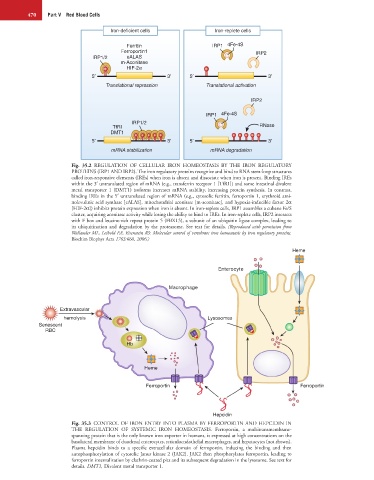
                        Fig.  35.2  REGULATION  OF  CELLULAR  IRON  HOMEOSTASIS  BY  THE  IRON  REGULATORY
                        PROTEINS (IRP1 AND IRP2). The iron regulatory proteins recognize and bind to RNA stem-loop structures
                        called iron-responsive elements (IREs) when iron is absent and dissociate when iron is present. Binding IREs
                        within the 3′ untranslated region of mRNA (e.g., transferrin receptor 1 [TfR1]) and some intestinal divalent
                        metal transporter 1 (DMT1) isoforms increases mRNA stability, increasing protein synthesis. In contrast,
                        binding IREs in the 5′ untranslated region of mRNA (e.g., cytosolic ferritin, ferroportin 1, erythroid ami-
                        nolevulinic acid synthase [eALAS], mitochondrial aconitase [m-aconitase], and hypoxia-inducible factor 2α
                        [HIF-2α]) inhibits protein expression when iron is absent. In iron-replete cells, IRP1 assembles a cubane Fe/S
                        cluster, acquiring aconitase activity while losing the ability to bind to IREs. In iron-replete cells, IRP2 interacts
                        with F box and leucine-rich repeat protein 5 (FBXL5), a subunit of an ubiquitin ligase complex, leading to
                        its ubiquitination and degradation by the proteasome. See text for details. (Reproduced with permission from
                        Wallander ML, Leibold EA, Eisenstein RS: Molecular control of vertebrate iron homeostasis by iron regulatory proteins.
                        Biochim Biophys Acta 1763:668, 2006.)
                                                                                                 Heme


                                                                        Enterocyte


                                                        Macrophage


                     Extravascular
                      hemolysis                                      Lysosomes
              Senescent
                RBC

                                          Hb


                                                Heme


                                                 Ferroportin                                       Ferroportin


                                                                       Hepcidin
                        Fig. 35.3  CONTROL OF IRON ENTRY INTO PLASMA BY FERROPORTIN AND HEPCIDIN IN
                        THE  REGULATION  OF  SYSTEMIC  IRON  HOMEOSTASIS.  Ferroportin,  a  multitransmembrane-
                        spanning protein that is the only known iron exporter in humans, is expressed at high concentrations on the
                        basolateral membrane of duodenal enterocytes, reticuloendothelial macrophages, and hepatocytes (not shown).
                        Plasma  hepcidin  binds  to  a  specific  extracellular  domain  of  ferroportin,  inducing  the  binding  and  then
                        autophosphorylation of cytosolic Janus kinase 2 (JAK2). JAK2 then phosphorylates ferroportin, leading to
                        ferroportin internalization by clathrin-coated pits and its subsequent degradation in the lysosome. See text for
                        details. DMT1, Divalent metal transporter 1.

