


Page 559 - Hematology_ Basic Principles and Practice ( PDFDrive )
P. 559
474    Part V  Red Blood Cells


                                            Tf
                                                                               Heme–hemopexin

                           Fe 2 Tf                           Mitochondria
                                                                             CD91
                                                                        Heme
                                              TFR1
                                        TFR1
                                                                     HO-1
                                                3+
                     Non–transferrin-         Fe       Cytoplasmic
                       bound iron                       iron pool                            Bile
                         (NTBI)      STEAP3  Fe 2+                                           secretion
                                Ferrireductase                                     Lysosomes
                           Fe 3+
                                                DMT1

                            Fe 2+                              Ferritin
                                ? DMT1                                    Endosomes
                                ? ZIP14
                                                 Ferroportin
                                                              LRP,
                                Ceruloplasmin                 RHL-1
                                                  Fe 3+  Tf
                                          Fe 2+                     Lactoferrin

                                                            Fe 2 Tf
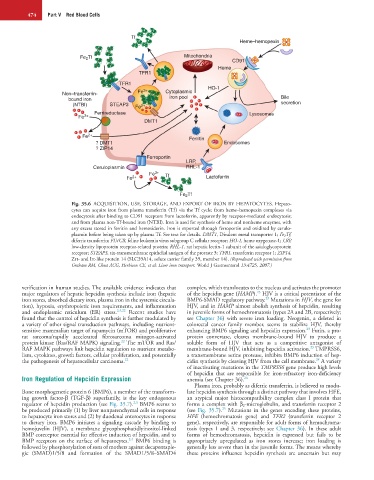
                        Fig. 35.6  ACQUISITION, USE, STORAGE, AND EXPORT OF IRON BY HEPATOCYTES. Hepato-
                        cytes can acquire iron from plasma transferrin (Tf) via the Tf cycle; from heme–hemopexin complexes via
                        endocytosis after binding to CD91 receptors from lactoferrin, apparently by receptor-mediated endocytosis;
                        and from plasma non-Tf-bound iron (NTBI). Iron is used for synthesis of heme and nonheme enzymes, with
                        any excess stored in ferritin and hemosiderin. Iron is exported through ferroportin and oxidized by cerulo-
                        plasmin before being taken up by plasma Tf. See text for details. DMT1, Divalent metal transporter 1; Fe 2Tf,
                        diferric transferrin; FLVCR, feline leukemia virus subgroup C cellular receptor; HO-1, heme oxygenase-1; LRP,
                        low-density lipoprotein receptor-related protein; RHL-1, rat hepatic lectin-1 subunit of the asialoglycoprotein
                        receptor; STEAP3, six-transmembrane epithelial antigen of the prostate 3; TFR1, transferrin receptor 1; ZIP14,
                        Zrt- and Irt-like protein 14 (SLC39A14, solute carrier family 39, member 14). (Reproduced with permission from
                        Graham RM, Chua ACG, Herbison CE, et al: Liver iron transport. World J Gastroenterol 13:4725, 2007.)


        verification in human studies. The available evidence indicates that   complex, which translocates to the nucleus and activates the promoter
                                                                                     23
        major regulators of hepatic hepcidin synthesis include iron (hepatic   of the hepcidin gene (HAMP).  HJV is a critical potentiator of the
                                                                                        23
        iron stores, absorbed dietary iron, plasma iron in the systemic circula-  BMP6-SMAD regulatory pathway.  Mutations in HJV, the gene for
        tion), hypoxia, erythropoietic iron requirements, and inflammation   HJV, and in HAMP almost abolish synthesis of hepcidin, resulting
        and  endoplasmic  reticulum  (ER)  stress. 2,4,22   Recent  studies  have   in juvenile forms of hemochromatosis (types 2A and 2B, respectively;
        found that the control of hepcidin synthesis is further modulated by   see  Chapter  36)  with  severe  iron  loading.  Neogenin,  a  deleted  in
        a variety of other signal transduction pathways, including nutrient-  colorectal  cancer  family  member,  seems  to  stabilize  HJV,  thereby
                                                                                                     23
        sensitive mammalian target of rapamycin (mTOR) and proliferative   enhancing BMP6 signaling and hepcidin expression.  Furin, a pro-
        rat  sarcoma/rapidly  accelerated  fibrosarcoma  mitogen-activated   protein  convertase,  cleaves  membrane-bound  HJV  to  produce  a
                                         22
        protein kinase (Ras/RAF MAPK) signaling.  The mTOR and Ras/  soluble  form  of  HJV  that  acts  as  a  competitive  antagonist  of
                                                                                                       23
        RAF MAPK pathways link hepcidin regulation to nutrient metabo-  membrane-bound HJV, inhibiting hepcidin activation.  TMPRSS6,
        lism, cytokines, growth factors, cellular proliferation, and potentially   a transmembrane serine protease, inhibits BMP6 induction of hep-
                                                                                                        24
        the pathogenesis of hepatocellular carcinoma. 22      cidin synthesis by cleaving HJV from the cell membrane.  A variety
                                                              of inactivating mutations in the TMPRSS6 gene produce high levels
                                                              of  hepcidin  that  are  responsible  for  iron-refractory  iron-deficiency
        Iron Regulation of Hepcidin Expression                anemia (see Chapter 36). 24
                                                                 Plasma iron, probably as diferric transferrin, is believed to modu-
        Bone morphogenetic protein 6 (BMP6), a member of the transform-  late hepcidin synthesis through a distinct pathway that involves HFE,
        ing  growth  factor-β  (TGF-β)  superfamily,  is  the  key  endogenous   an  atypical  major  histocompatibility  complex  class  I  protein  that
                                             2,4
        regulator of hepcidin production (see Fig. 35.7).  BMP6 seems to   forms a complex with β 2-microglobulin, and transferrin receptor 2
                                                                          25
        be produced primarily (1) by liver nonparenchymal cells in response   (see  Fig.  35.7).   Mutations  in  the  genes  encoding  these  proteins,
        to hepatocyte iron stores and (2) by duodenal enterocytes in response   HFE  (hemochromatosis  gene)  and  TFR2  (transferrin  receptor  2
        to  dietary  iron.  BMP6  initiates  a  signaling  cascade  by  binding  to   gene), respectively, are responsible for adult forms of hemochroma-
        hemojuvelin  (HJV),  a  membrane  glycophosphatidlyinositol-linked   tosis  (types  1  and  3,  respectively;  see  Chapter  36).  In  these  adult
        BMP coreceptor essential for effective induction of hepcidin, and to   forms  of  hemochromatosis,  hepcidin  is  expressed  but  fails  to  be
                                           2,4
        BMP  receptors  on  the  surface  of  hepatocytes.   BMP6  binding  is   appropriately  upregulated  as  iron  stores  increase;  iron  loading  is
        followed by phosphorylation of sons of mothers against decapentaple-  generally less severe than in the juvenile forms. The means whereby
        gic  (SMAD)1/5/8  and  formation  of  the  SMAD1/5/8–SMAD4   these  proteins  influence  hepcidin  synthesis  are  uncertain  but  may

