


Page 556 - Hematology_ Basic Principles and Practice ( PDFDrive )
P. 556
Chapter 35  Pathophysiology of Iron Homeostasis  471


                                           Tf


                          Fe 2 Tf                                                      FLVCR
                                                                  Mitochondria


                                     TFR1    Fe 3+
                                                                      Protoporhyrin IX     Globin
                                    STEAP3             Mitoferrin
                                             Fe 2+                                  ?
                                                                           Heme                  Hb
                                              DMT1
                                                      Fe 2+             Krebs cycle   Hemoproteins
                                                                         enzymes      Cytochromes
                                     Cytoplasm
                                                                                 CI
                                                                   [Fe-S]
                                                                               CIII  Respiratory chain
                                                                                      enzymes
                                                                       ABC7

                                              Ferroportin
                                                                   [Fe-S]
                                                                    IRP1


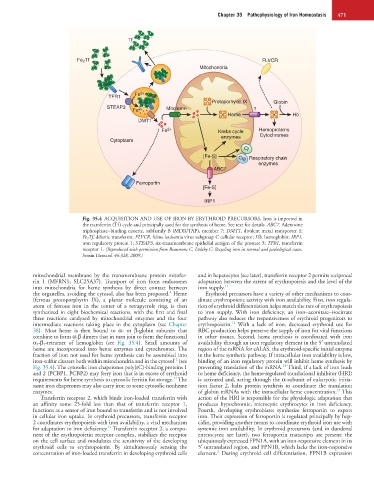
                            Fig. 35.4  ACQUISITION AND USE OF IRON BY ERYTHROID PRECURSORS. Iron is imported in
                            the transferrin (Tf) cycle and principally used for the synthesis of heme. See text for details. ABC7, Adenosine
                            triphosphate−binding cassette, subfamily B (MDR/TAP), member 7; DMT1, divalent metal transporter 1;
                            Fe 2 Tf, diferric transferrin; FLVCR, feline leukemia virus subgroup C cellular receptor; Hb, hemoglobin; IRP1,
                            iron regulatory protein 1; STEAP3, six-transmembrane epithelial antigen of the prostate 3; TFR1, transferrin
                            receptor 1. (Reproduced with permission from Beaumont C, Delaby C: Recycling iron in normal and pathological states.
                            Semin Hematol 46:328, 2009.)


            mitochondrial  membrane  by  the  transmembrane  protein  mitofer-  and in hepatocytes (see later), transferrin receptor 2 permits reciprocal
            rin  1  (MFRN1;  SLC25A37).  Transport  of  iron  from  endosomes   adaptation between the extent of erythropoiesis and the level of the
            into  mitochondria  for  heme  synthesis  by  direct  contact  between   iron supply. 11
                                                         4
            the organelles, avoiding the cytosol, also has been proposed.  Heme   Erythroid precursors have a variety of other mechanisms to coor-
            (ferrous  protoporphyrin  IX),  a  planar  molecule  consisting  of  an   dinate erythropoietic activity with iron availability. First, iron regula-
            atom  of  ferrous  iron  in  the  center  of  a  tetrapyrrole  ring,  is  then   tion of erythroid differentiation helps match the rate of erythropoiesis
            synthesized in eight biochemical reactions, with the first and final   to  iron  supply.  With  iron  deficiency,  an  iron−aconitase−isocitrate
            three  reactions  catalyzed  by  mitochondrial  enzymes  and  the  four   pathway also reduces the responsiveness of erythroid progenitors to
                                                                             12
            intermediate  reactions  taking  place  in  the  cytoplasm  (see  Chapter   erythropoietin.   With  a  lack  of  iron,  decreased  erythroid  use  for
            38).  Most  heme  is  then  bound  to  α-  or  β-globin  subunits  that   RBC production helps preserve the supply of iron for vital functions
            combine to form α-β dimers that in turn join to form the functional   in  other  tissues.  Second,  heme  synthesis  is  coordinated  with  iron
            α 2 -β 2 -tetramer  of  hemoglobin  (see  Fig.  35.4).  Small  amounts  of   availability through an iron regulatory element in the 5′ untranslated
            heme  are  incorporated  into  heme  enzymes  and  cytochromes. The   region of the mRNA for eALAS, the erythroid-specific initial enzyme
            fraction of iron not used for heme synthesis can be assembled into   in the heme synthetic pathway. If intracellular iron availability is low,
                                                          12
            iron-sulfur clusters both within mitochondria and in the cytosol  (see   binding of an iron regulatory protein will inhibit heme synthesis by
                                                                                             14
            Fig. 35.4). The cytosolic iron chaperones poly(rC)-binding proteins 1   preventing translation of the mRNA.  Third, if a lack of iron leads
            and 2 (PCBP1, PCBP2) may ferry iron that is in excess of erythroid   to heme deficiency, the heme-regulated translational inhibitor (HRI)
                                                          13
            requirements for heme synthesis to cytosolic ferritin for storage.  The   is activated and, acting through the α-subunit of eukaryotic initia-
            same iron chaperones may also carry iron to some cytosolic nonheme     tion  factor  2,  halts  protein  synthesis  to  coordinate  the  translation
                                                                                                               15
            enzymes.                                              of globin mRNAs with the intracellular heme concentration.  This
              Transferrin receptor 2, which binds iron-loaded transferrin with   action of the HRI is responsible for the physiologic adaptation that
            an  affinity  some  25-fold  less  than  that  of  transferrin  receptor  1,   produces  hypochromic,  microcytic  erythrocytes  in  iron  deficiency.
            functions as a sensor of iron bound to transferrin and is not involved   Fourth,  developing  erythroblasts  synthesize  ferroportin  to  export
            in cellular iron uptake. In erythroid precursors, transferrin receptor   iron. Their expression of ferroportin is regulated principally by hep-
            2 coordinates erythropoiesis with iron availability, a vital mechanism   cidin, providing another means to coordinate erythroid iron use with
                                    11
            for adaptation to iron deficiency.  Transferrin receptor 2, a compo-  systemic iron availability. In erythroid precursors (and in duodenal
            nent of the erythropoietin receptor complex, stabilizes the receptor   enterocytes;  see  later),  two  ferroportin  transcripts  are  present:  the
            on the cell surface and modulates the sensitivity of the developing   ubiquitously expressed FPN1A, with an iron-responsive element in its
            erythroid  cells  to  erythropoietin.  By  simultaneously  sensing  the   5′ untranslated region, and FPN1B, which lacks the iron-responsive
                                                                        2
            concentration of iron-loaded transferrin in developing erythroid cells   element.   During  erythroid  cell  differentiation,  FPN1B  expression

