


Page 590 - Hematology_ Basic Principles and Practice ( PDFDrive )
P. 590
Chapter 38  Heme Biosynthesis and Its Disorders  505


                                                                   Pseudoporphyria and Renal Dialysis
                                                                   The  term  pseudoporphyria  has  been  used  to  describe  a  bullous
                                                                   dermatosis associated with a number of dermatologic conditions that
                                                                   bear some resemblance to porphyria. 114  This photosensitivity is often
                                                                   induced  by  drugs  such  as  the  tetracyclines,  naproxen,  furosemide,
                                                                   voriconazole, oxaprozin, and many others. In these conditions, there is
                                                                   no alteration in porphyrin metabolism or excretion. It is therefore incor-
                                                                   rect to name any of them porphyria; the term pseudoporphyria should
                                                                   not be applied to them, but only to conditions in which alterations of
                                                                   porphyrin metabolism can be found, such as the bullous dermatosis
                                                                   of hemodialysis. 113
                                                                    Patients  with  renal  failure  can  present  with  many  biochemical
                                                                   features of porphyria before hemodialysis. These abnormalities normal-
                                                                   ize  after  dialysis,  especially  when  electrolyte  abnormalities  such  as
                                                                   zinc deficiency are also corrected. 115  In a considerable proportion of
                                                                   patients with chronic renal failure, skin changes resembling porphyria
                                                                   cutanea tarda (PCT) develop some months to years after the onset of
                                                                   maintenance hemodialysis. In a minor proportion, genuine PCT can be
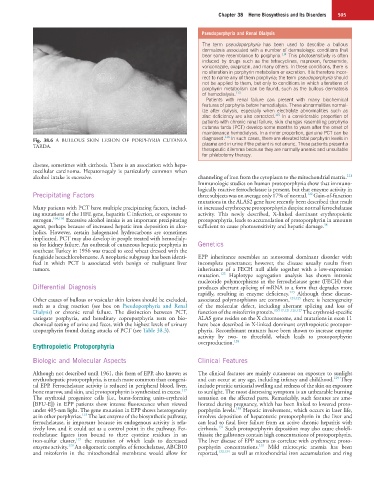
            Fig.  38.6  A  BULLOUS  SKIN  LESION  OF  PORPHYRIA  CUTANEA   diagnosed. 116  In such cases, there are elevated total porphyrin levels in
            TARDA.                                                 plasma and in urine if the patient is not anuric. These patients present a
                                                                   therapeutic dilemma because they are normally anemic and unsuitable
                                                                   for phlebotomy therapy.
            disease, sometimes with cirrhosis. There is an association with hepa-
            tocellular  carcinoma.  Hepatomegaly  is  particularly  common  when
                                                                                                                  121
            alcohol intake is excessive.                          channeling of iron from the cytoplasm to the mitochondrial matrix.
                                                                  Immunologic studies on human protoporphyria show that immuno-
                                                                  logically reactive ferrochelatase is present, but that enzyme activity in
            Precipitating Factors                                 three subjects was on average only 17% of normal.  Gain-of-function
                                                                                                      122
                                                                  mutations in the ALAS2 gene have recently been described that result
            Many patients with PCT have multiple precipitating factors, includ-  in increased erythrocyte protoporphyrin despite normal ferrochelatase
            ing mutations of the HFE gene, hepatitis C infection, or exposure to   activity.  This  newly  described,  X-linked  dominant  erythropoietic
            estrogen. 104,105  Excessive alcohol intake is an important precipitating   protoporphyria, leads to accumulation of protoporphyrin in amounts
            agent, perhaps because of increased hepatic iron deposition in alco-  sufficient to cause photosensitivity and hepatic damage. 34
            holics.  However,  certain  halogenated  hydrocarbons  are  sometimes
            implicated. PCT may also develop in people treated with hemodialy-
            sis for kidney failure. An outbreak of cutaneous hepatic porphyria in   Genetics
            southeast Turkey in 1956 was traced to seed wheat dressed with the
            fungicide hexachlorobenzene. A neoplastic subgroup has been identi-  EPP  inheritance  resembles  an  autosomal  dominant  disorder  with
            fied  in  which  PCT  is  associated  with  benign  or  malignant  liver   incomplete  penetrance;  however,  the  disease  usually  results  from
            tumors.                                               inheritance  of  a  FECH  null  allele  together  with  a  low-expression
                                                                         123
                                                                  mutation.   Haplotype  segregation  analysis  has  shown  intronic
                                                                  nucleotide polymorphisms in the ferrochelatase gene (FECH) that
            Differential Diagnosis                                produces aberrant splicing of mRNA to a form that degrades more
                                                                                                123
                                                                  rapidly,  resulting  in  enzyme  deficiency.   Although  these  disease-
            Other causes of bullous or vesicular skin lesions should be excluded,   associated polymorphisms are common, 124,125  there is heterogeneity
            such  as  a  drug  reaction  (see  box  on  Pseudoporphyria  and  Renal   of  the  molecular  defect,  including  aberrant  splicing  and  loss  of
            Dialysis)  or  chronic  renal  failure.  The  distinction  between  PCT,   function of the mitoferrin protein. 19,117,121,126,127  The erythroid-specific
            variegate  porphyria,  and  hereditary  coproporphyria  rests  on  bio-  ALAS gene resides on the X chromosome, and mutations in exon 11
            chemical testing of urine and feces, with the highest levels of urinary   have been described in X-linked dominant erythropoietic protopor-
            uroporphyrin found during attacks of PCT (see Table 38.3).  phyria. Recombinant mutants have been shown to increase enzyme
                                                                  activity  by  two-  to  threefold,  which  leads  to  protoporphyrin
                                                                              128
            Erythropoietic Protoporphyria                         overproduction.

            Biologic and Molecular Aspects                        Clinical Features

            Although not described until 1961, this form of EPP, also known as   The clinical features are mainly cutaneous on exposure to sunlight
                                                                                                              129
            erythrohepatic protoporphyria, is much more common than congeni-  and can occur at any age, including infancy and childhood.  They
            tal EPP. Ferrochelatase activity is reduced in peripheral blood, liver,   include pruritic urticarial swelling and redness of the skin on exposure
                                                            117
            bone marrow, and skin, and protoporphyrin is synthesized in excess.    to sunlight. The most distressing symptom is an unbearable burning
            The  erythroid  progenitor  cells  (i.e.,  burst-forming  units-erythroid   sensation on the affected parts. Remarkably, such features are ame-
            [BFU-E]) in EPP patients show intense fluorescence when viewed   liorated during pregnancy, which has been linked to lowered proto-
                                                                              130
            under 405-nm light. The gene mutation in EPP shows heterogeneity   porphyrin levels.  Hepatic involvement, which occurs in later life,
                            118
            as in other porphyrias.  The last enzyme of the biosynthetic pathway,   involves deposition of hepatotoxic protoporphyrin in the liver and
            ferrochelatase, is important because its endogenous activity is rela-  can lead to fatal liver failure from an active chronic hepatitis with
                                                                        131
            tively low, and it could act as a control point in the pathway. Fer-  cirrhosis.  Such protoporphyrin deposition may also cause choleli-
            rochelatase  ligates  iron  bound  to  three  cysteine  residues  in  an   thiasis; the gallstones contain high concentrations of protoporphyrin.
                          119
            iron-sulfur  cluster,   the  mutation  of  which  leads  to  decreased   The liver disease of EPP seems to correlate with erythrocyte proto-
                       120
                                                                                      132
            enzyme activity.  An oligomeric complex of ferrochelatase, ABCB10   porphyrin  concentrations.   Mild  microcytic  anemia  has  been
            and  mitoferrin  in  the  mitochondrial  membrane  would  allow  for   reported, 133,134  as well as mitochondrial iron accumulation and ring

