


Page 594 - Hematology_ Basic Principles and Practice ( PDFDrive )
P. 594
Chapter 38  Heme Biosynthesis and Its Disorders  509


                                                                  sideroblasts. TRMA presents with early-onset megaloblastic anemia,
             Therapy for Hereditary Sideroblastic Anemia
                                                                  diabetes mellitus, and sensorineural deafness, which respond variably
             A trial of pyridoxine (100–200 mg/day taken orally) is indicated for 3   to thiamine treatment.
             months for all patients with hereditary sideroblastic anemia. Response   Missense and nonsense mutations in the PUS1 gene coding for
             is variable and ranges from complete correction of hemoglobin levels   pseudouridine synthase-1 cause the rare autosomal recessive disease,
             to  no  effect.  Even  when  pyridoxine  completely  corrects  the  anemia   myopathy, lactic acidosis, and sideroblastic anemia (MLASA). 192–195
             (Fig.  38.10),  the  increase  in  mean  corpuscular  volume  (MCV)  may   Mitochondrial and cytoplasmic transfer RNAs (tRNAs) from affected
             not reach normal values, and a population of hypochromic, microcytic   patients lack tRNA pseudouridylation at sites normally modified by
             cells remains.                                       PUS1;  however,  the  mechanism  by  which  this  affects  oxidative
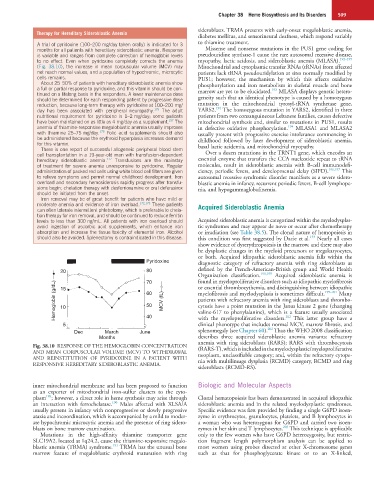
              About 25–50% of patients with hereditary sideroblastic anemia show   phosphorylation and iron metabolism in skeletal muscle and bone
             a full or partial response to pyridoxine, and this vitamin should be con-  marrow are yet to be elucidated.  MLASA displays genetic hetero-
                                                                                          193
             tinued on a lifelong basis in the responders. A lower maintenance dose
             should be determined for each responding patient by progressive dose   geneity such that an identical phenotype is caused by a homozygous
             reduction, because long-term therapy with pyridoxine at 100–200 mg/  mutation  in  the  mitochondrial  tyrosyl-tRNA  synthetase  gene,
                                                                        194
             day  has  been  associated  with  peripheral  neuropathy. 175   The  adult   YARS2.  The homozygous mutation in YARS2, identified in three
             nutritional  requirement  for  pyridoxine  is  1–2 mg/day;  some  patients   patients from two consanguineous Lebanese families, causes defective
             have been maintained on as little as 4 mg/day as a supplement. 157  The   mitochondrial synthesis and, similar to mutations in PUS1, results
                                                                                               194
             anemia of thiamine-responsive megaloblastic anemia usually improves   in  defective  oxidative  phosphorylation.   MLASA1  and  MLASA2
             with  thiamine  25–75 mg/day. 176   Folic  acid  supplements  should  also   usually present with progressive exercise intolerance commencing in
             be administered because the erythroid hyperplasia increases demand   childhood  followed  by  later  development  of  sideroblastic  anemia,
             for this vitamin.                                    basal lactic acidemia, and mitochondrial myopathy.
              There is one report of successful allogeneic peripheral blood stem
             cell transplantation in a 19-year-old man with transfusion-dependent   Over a dozen mutations in the TRNT1 gene, which encodes an
             hereditary  sideroblastic  anemia. 177   Transfusions  are  the  mainstay   essential enzyme that transfers the CCA nucleotide repeat to tRNA
             of  treatment  for  severe  anemia  unresponsive  to  pyridoxine.  Regular   molecules,  result  in  sideroblastic  anemia  with  B-cell  immunodefi-
             administration of packed red cells using white blood cell filters are given   ciency, periodic fevers, and developmental delay (SIFD). 196,197  This
             to relieve symptoms and permit normal childhood development. Iron   autosomal recessive syndromic disorder manifests as a severe sidero-
             overload and secondary hemosiderosis rapidly progress after transfu-  blastic anemia in infancy, recurrent periodic fevers, B-cell lymphope-
             sions begin; chelation therapy with desferrioxamine or oral deferasirox   nia, and hypogammaglobulinemia.
             should be initiated from the onset.
              Iron removal may be of great benefit for patients who have mild or
             moderate anemia and evidence of iron overload. 172,173  These patients   Acquired Sideroblastic Anemia
             can often tolerate intermittent phlebotomy, which is preferable to chela-
             tion therapy for iron removal, and should be continued to reduce ferritin
             levels to less than 300 ng/mL. All patients with iron overload should   Acquired sideroblastic anemia is categorized within the myelodysplas-
             avoid  ingestion  of  ascorbic  acid  supplements,  which  enhance  iron   tic syndromes and may appear de novo or occur after chemotherapy
             absorption and increase the tissue toxicity of elemental iron. Alcohol   or irradiation (see Table 38.5). The clonal nature of hemopoiesis in
                                                                                                      153
             should also be avoided. Splenectomy is contraindicated in this disease.  this condition was first suggested by Dacie et al.  Nearly all cases
                                                                  show evidence of dyserythropoiesis in the marrow, and there may also
                                                                  be dysplastic changes in the myeloid precursors or megakaryocytes,
                                                                  or  both.  Acquired  idiopathic  sideroblastic  anemia  falls  within  the
                                                 Pyridoxine       diagnostic  category  of  refractory  anemia  with  ring  sideroblasts  as
                     20                          80               defined  by  the  French-American-British  group  and  World  Health
                                                                                      198,199
                                                                  Organization  classification.    Acquired  sideroblastic  anemia  is
                                                                  found in myeloproliferative disorders such as idiopathic myelofibrosis
                                                 70
                   Hemoglobin (g/dL)  15         60   MCV (fL)    myelofibrosis and myelodysplasia is sometimes difficult. 199–201  Many
                                                                  or essential thrombocythemia, and distinguishing between idiopathic
                                                                  patients with refractory anemia with ring sideroblasts and thrombo-
                                                 50
                                                                  cytosis have a point mutation in the Janus kinase 2 gene (changing
                     10
                                                                  valine-617  to  phenylalanine),  which  is  a  feature  usually  associated
                                                                                              202
                                                                  clinical phenotype that includes normal MCV, marrow fibrosis, and
                      5                          40               with  the  myeloproliferative  disorders.   This  latter  group  have  a
                                                                                         202
                         Dec       March       June               splenomegaly (see Chapter 60).  Thus the WHO 2008 classification
                                 Months                           describes  three  acquired  sideroblastic  anemia  variants:  refractory
                                                                  anemia with ring sideroblasts (RARS); RARS with thrombocytosis
            Fig. 38.10  RESPONSE OF THE HEMOGLOBIN CONCENTRATION   (RARS-T), which is included in the myelodysplastic/myeloproliferative
            AND MEAN CORPUSCULAR VOLUME (MCV) TO WITHDRAWAL       neoplasm, unclassifiable category; and, within the refractory cytope-
            AND  REINSTITUTION  OF  PYRIDOXINE  IN  A  PATIENT  WITH   nia with multilineage dysplasia (RCMD) category, RCMD and ring
            RESPONSIVE HEREDITARY SIDEROBLASTIC ANEMIA.
                                                                  sideroblasts (RCMD-RS).
            inner mitochondrial membrane and has been proposed to function   Biologic and Molecular Aspects
            as  an  exporter  of  mitochondrial  iron-sulfur  clusters  to  the  cyto-
                189
            plasm ; however, a direct role in heme synthesis may arise through   Clonal hematopoiesis has been demonstrated in acquired idiopathic
                                      190
            an  interaction  with  ferrochelatase.   Males  affected  with  XLSA/A   sideroblastic anemia and in the related myelodysplastic syndromes.
            usually present in infancy with nonprogressive or slowly progressive   Specific evidence was first provided by finding a single G6PD isoen-
            ataxia and incoordination, which is accompanied by a mild to moder-  zyme in erythrocytes, granulocytes, platelets, and B lymphocytes in
            ate hypochromic microcytic anemia and the presence of ring sidero-  a woman who was heterozygous for G6PD and carried two isoen-
                                                                                              203
            blasts on bone marrow examination.                    zymes in her skin and T lymphocytes.  This technique is applicable
              Mutations  in  the  high-affinity  thiamine  transporter  gene   only to the few women who have G6PD heterozygosity, but restric-
            SLC19A2, located at 1q24.2, cause the thiamine-responsive megalo-  tion  fragment  length  polymorphism  analysis  can  be  applied  to
                                      191
            blastic anemia (TRMA) syndrome.  TRMA has the unusual bone   most  women  using  probes  directed  at  other  X-chromosome  genes
            marrow  feature  of  megaloblastic  erythroid  maturation  with  ring   such  as  that  for  phosphoglycerate  kinase  or  to  an  X-linked,

