


Page 591 - Hematology_ Basic Principles and Practice ( PDFDrive )
P. 591
506    Part V  Red Blood Cells


                              A                               B

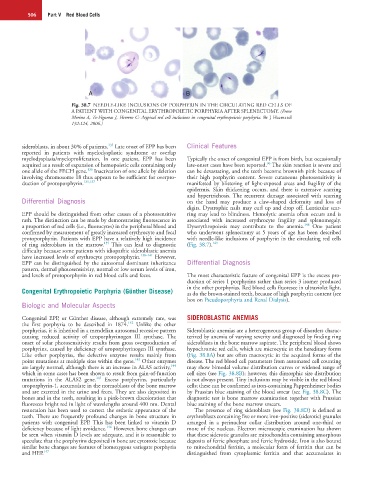
                        Fig. 38.7  NEEDLE-LIKE INCLUSIONS OF PORPHYRIN IN THE CIRCULATING RED CELLS OF
                        A PATIENT WITH CONGENITAL ERYTHROPOIETIC PORPHYRIA AFTER SPLENECTOMY. (From
                        Merino A, To-Figueras J, Herrero C: Atypical red cell inclusions in congenital erythropoietic porphyria. Br J Haematol
                        132:124, 2006.)


                                    135
        sideroblasts, in about 30% of patients.  Late onset of EPP has been   Clinical Features
        reported  in  patients  with  myelodysplastic  syndrome  or  overlap
        myelodysplasia/myeloproliferation.  In  one  patient,  EPP  has  been   Typically the onset of congenital EPP is from birth, but occasionally
                                                                                        96
        acquired as a result of expansion of hemopoietic cells containing only   late-onset cases have been reported.  The skin reaction is severe and
                              136
        one allele of the FECH gene.  Inactivation of one allele by deletion   can be devastating, and the teeth become brownish pink because of
        involving chromosome 18 thus appears to be sufficient for overpro-  their  high  porphyrin  content.  Severe  cutaneous  photosensitivity  is
        duction of protoporphyrin. 135,137                    manifested  by  blistering  of  light-exposed  areas  and  fragility  of  the
                                                              epidermis.  Skin  thickening  occurs,  and  there  is  extensive  scarring
                                                              and  hypertrichosis. The  recurrent  damage  associated  with  scarring
        Differential Diagnosis                                on  the  hand  may  produce  a  claw-shaped  deformity  and  loss  of
                                                              digits. Dystrophic nails may curl up and drop off. Lenticular scar-
        EPP should be distinguished from other causes of a photosensitive   ring may lead to blindness. Hemolytic anemia often occurs and is
        rash. The distinction can be made by demonstrating fluorescence in   associated  with  increased  erythrocyte  fragility  and  splenomegaly.
                                                                                                     148
        a proportion of red cells (i.e., fluorocytes) in the peripheral blood and   Dyserythropoiesis  may  contribute  to  the  anemia.   One  patient
        confirmed by measurement of greatly increased erythrocyte and fecal   who  underwent  splenectomy  at  5  years  of  age  has  been  described
        protoporphyrin. Patients with EPP have a relatively high incidence   with needle-like inclusions of porphyrin in the circulating red cells
                                   135
        of  ring  sideroblasts  in  the  marrow.  This  can  lead  to  diagnostic   (Fig. 38.7). 149
        difficulty because some patients with idiopathic sideroblastic anemia
        have increased levels of erythrocyte protoporphyrin. 138–141  However,
        EPP  can  be  distinguished  by  the  autosomal  dominant  inheritance   Differential Diagnosis
        pattern, dermal photosensitivity, normal or low serum levels of iron,
        and levels of protoporphyrin in red blood cells and feces.  The most characteristic feature of congenital EPP is the excess pro-
                                                              duction of series 1 porphyrins rather than series 3 isomer produced
        Congenital Erythropoietic Porphyria (Günther Disease)  in the other porphyrias. Red blood cells fluoresce in ultraviolet light,
                                                              as do the brown-stained teeth, because of high porphyrin content (see
                                                              box on Pseudoporphyria and Renal Dialysis).
        Biologic and Molecular Aspects

        Congenital  EPP,  or  Günther  disease,  although  extremely  rare,  was   SIDEROBLASTIC ANEMIAS
                                           142
        the  first  porphyria  to  be  described  in  1874.   Unlike  the  other
        porphyrias, it is inherited in a mendelian autosomal recessive pattern   Sideroblastic anemias are a heterogeneous group of disorders charac-
        causing  reduced  activity  of  uroporphyrinogen  III  synthase.  The   terized by anemia of varying severity and diagnosed by finding ring
        onset of solar photosensitivity results from gross overproduction of   sideroblasts in the bone marrow aspirate. The peripheral blood shows
        porphyrins, caused by deficiency of uroporphyrinogen III synthase.   hypochromic red cells, which are microcytic in the hereditary forms
        Like  other  porphyrias,  the  defective  enzyme  results  mainly  from   (Fig. 38.8A) but are often macrocytic in the acquired forms of the
                                             143
        point mutations at multiple sites within the gene.  Other enzymes   disease. The red blood cell parameters from automated cell counting
                                                         144
        are largely normal, although there is an increase in ALAS activity,    may show bimodal volume distribution curves or widened range of
        which in some cases has been shown to result from gain-of-function   cell sizes (see Fig. 38.8B); however, this dimorphic size distribution
                                145
        mutations  in  the  ALAS2  gene.   Excess  porphyrins,  particularly   is not always present. Tiny inclusions may be visible in the red blood
        uroporphyrin-1, accumulate in the normoblasts of the bone marrow   cells; these can be confirmed as iron-containing Pappenheimer bodies
        and are excreted in the urine and feces. They are also deposited in   by Prussian blue staining of the blood smear (see Fig. 38.8C). The
        bones and in the teeth, resulting in a pink-brown discoloration that   diagnostic test is bone marrow examination together with Prussian
        fluoresces bright red in light of wavelengths around 400 nm. Dental   blue staining of the bone marrow smears.
        restoration has been used to correct the esthetic appearance of the   The presence of ring sideroblasts (see Fig. 38.8D) is defined as
        teeth. There are frequently profound changes in bone structure in   erythroblasts containing five or more iron-positive (siderotic) granules
        patients  with  congenital  EPP. This  has  been  linked  to  vitamin  D   arranged  in  a  perinuclear  collar  distribution  around  one-third  or
                                    146
        deficiency because of light avoidance.  However, bone changes can   more of the nucleus. Electron microscopic examination has shown
        be seen when vitamin D levels are adequate, and it is reasonable to   that these siderotic granules are mitochondria containing amorphous
        speculate that the porphyrins deposited in bone are cytotoxic because   deposits of ferric phosphate and ferric hydroxide. Iron is also bound
        similar bone changes are features of homozygous variegate porphyria   to mitochondrial ferritin, a molecular form of ferritin that can be
        and HEP. 147                                          distinguished  from  cytoplasmic  ferritin  and  that  accumulates  in

