


Page 592 - Hematology_ Basic Principles and Practice ( PDFDrive )
P. 592
Chapter 38  Heme Biosynthesis and Its Disorders  507


                                             Number of cells


                                               0   50   100  150  200
            A                               B      Cell volume (fL)   C                 D
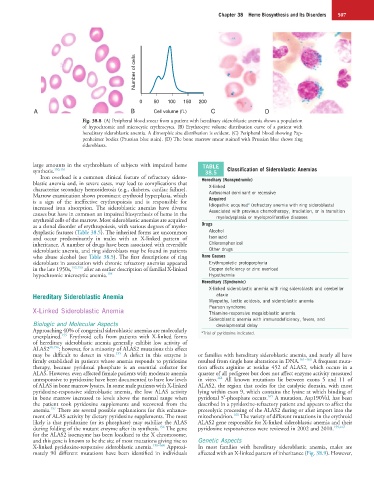
                            Fig. 38.8  (A) Peripheral blood smear from a patient with hereditary sideroblastic anemia shows a population
                            of hypochromic and microcytic erythrocytes. (B) Erythrocyte volume distribution curve of a patient with
                            hereditary sideroblastic anemia. A dimorphic size distribution is evident. (C) Peripheral blood showing Pap-
                            penheimer bodies (Prussian blue stain). (D) The bone marrow smear stained with Prussian blue shows ring
                            sideroblasts.


            large amounts in the erythroblasts of subjects with impaired heme   TABLE
            synthesis. 150,151                                      38.5   Classification of Sideroblastic Anemias
              Iron overload is a common clinical feature of refractory sidero-
            blastic anemia and, in severe cases, may lead to complications that   Hereditary (Nonsyndromic)
            characterize secondary hemosiderosis (e.g., diabetes, cardiac failure).   X-linked
            Marrow examination shows prominent erythroid hyperplasia, which   Autosomal dominant or recessive
            is  a  sign  of  the  ineffective  erythropoiesis  and  is  responsible  for   Acquired  a
            increased  iron  absorption.  The  sideroblastic  anemias  have  diverse   Idiopathic acquired  (refractory anemia with ring sideroblasts)
            causes but have in common an impaired biosynthesis of heme in the   Associated with previous chemotherapy, irradiation, or in transition
            erythroid cells of the marrow. Most sideroblastic anemias are acquired   myelodysplasia or myeloproliferative diseases
            as a clonal disorder of erythropoiesis, with various degrees of myelo-  Drugs
            dysplastic features (Table 38.5). The inherited forms are uncommon   Alcohol
            and  occur  predominantly  in  males  with  an  X-linked  pattern  of   Isoniazid
            inheritance. A number of drugs have been associated with reversible   Chloramphenicol
            sideroblastic anemia, and ring sideroblasts may be found in patients   Other drugs
            who  abuse  alcohol  (see Table  38.5). The  first  descriptions  of  ring   Rare Causes
            sideroblasts in association with chronic refractory anemias appeared   Erythropoietic protoporphyria
            in the late 1950s, 152,153  after an earlier description of familial X-linked   Copper deficiency or zinc overload
            hypochromic microcytic anemia. 154                       Hypothermia
                                                                   Hereditary (Syndromic)
                                                                     X-linked sideroblastic anemia with ring sideroblasts and cerebellar
            Hereditary Sideroblastic Anemia                             ataxia
                                                                     Myopathy, lactic acidosis, and sideroblastic anemia
                                                                     Pearson syndrome
            X-Linked Sideroblastic Anemia                            Thiamine-responsive megaloblastic anemia
                                                                     Sideroblastic anemia with immunodeficiency, fevers, and
            Biologic and Molecular Aspects                              developmental delay
            Approaching 40% of congenital sideroblastic anemias are molecularly   a Trial of pyridoxine indicated.
                     155
            unexplained.   Erythroid  cells  from  patients  with  X-linked  forms
            of  hereditary  sideroblastic  anemia  generally  exhibit  low  activity  of
            ALAS2 30,156 ; however, for a minority of ALAS2 mutations this effect
                                       155
            may  be  difficult  to  detect  in  vitro.   A  defect  in  this  enzyme  is   or families with hereditary sideroblastic anemia, and nearly all have
            firmly established in patients whose anemia responds to pyridoxine   resulted from single base alterations in DNA. 161–163  A frequent muta-
            therapy,  because  pyridoxal  phosphate  is  an  essential  cofactor  for   tion  affects  arginine  at  residue  452  of  ALAS2,  which  occurs  in  a
            ALAS. However, even affected female patients with moderate anemia   quarter of all pedigrees but does not affect enzyme activity measured
                                                                        164
            unresponsive to pyridoxine have been documented to have low levels   in  vitro.   All  known  mutations  lie  between  exons  5  and  11  of
            of ALAS in bone marrow lysates. In some male patients with X-linked   ALAS2, the region that codes for the catalytic domain, with most
            pyridoxine-responsive  sideroblastic  anemia,  the  low  ALAS  activity   lying within exon 9, which contains the lysine at which binding of
                                                                                         165
            in  bone  marrow  increased  to  levels  above  the  normal  range  when   pyridoxal 5′-phosphate occurs.  A mutation, Asp190Val, has been
            the  patient  took  pyridoxine  supplements  and  recovered  from  the   described in a pyridoxine-refractory patient and appears to affect the
                  157
            anemia.  There are several possible explanations for this enhance-  proteolytic processing of the ALAS2 during or after import into the
                                                                             166
            ment of ALAS activity by dietary pyridoxine supplements. The most   mitochondrion.  The variety of different mutations in the erythroid
            likely is that pyridoxine (or its phosphate) may stabilize the ALAS   ALAS2 gene responsible for X-linked sideroblastic anemia and their
                                                     156
            during folding of the mutant enzyme after its synthesis.  The gene   pyridoxine responsiveness were reviewed in 2002 and 2010. 159,167
            for the ALAS2 isoenzyme has been localized to the X chromosome,
            and this gene is known to be the site of most mutations giving rise to   Genetic Aspects
            X-linked pyridoxine-responsive sideroblastic anemia. 158–160  Approxi-  In  most  families  with  hereditary  sideroblastic  anemia,  males  are
            mately  90  different  mutations  have  been  identified  in  individuals   affected with an X-linked pattern of inheritance (Fig. 38.9). However,

