


Page 614 - Hematology_ Basic Principles and Practice ( PDFDrive )
P. 614
Chapter 39  Megaloblastic Anemias  523


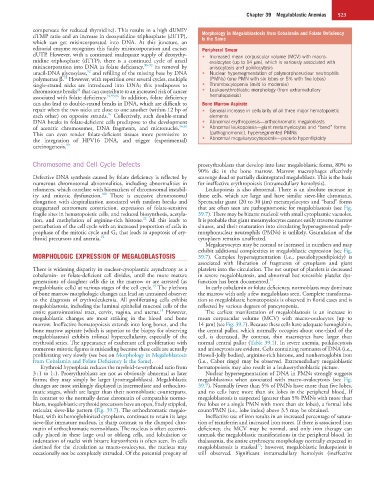
            compensate for reduced thymidine). This results in a high dUMP/  Morphology in Megaloblastosis from Cobalamin and Folate Deficiency
            dTMP ratio and an increase in deoxyuridine triphosphate (dUTP),   Is the Same
            which  can  get  misincorporated  into  DNA.  At  this  juncture,  an
            editorial enzyme recognizes this faulty misincorporation and excises   Peripheral Smear
            dUTP. However, with a continued inadequate supply of deoxythy-  •  Increased mean corpuscular volume (MCV) with macro-
            midine  triphosphate  (dTTP),  there  is  a  continued  cycle  of  uracil   ovalocytes (up to 14 µm), which is variously associated with
            misincorporation into DNA in folate deficiency, 90–92  its removal by   anisocytosis and poikilocytosis
                              92
            uracil-DNA glycosylase,  and refilling of the missing base by DNA   •  Nuclear hypersegmentation of polymorphonuclear neutrophils
                      93
            polymerase β.  However, with repetition over several cycles, multiple   (PMNs) (one PMN with six lobes or 5% with five lobes)
            single-strand  nicks  are  introduced  into  DNA;  this  predisposes  to   •  Thrombocytopenia (mild to moderate)
                          94
            chromosome breaks  that can contribute to an increased risk of cancer   •  Leukoerythroblastic morphology (from extramedullary
            associated with folate deficiency. 91,95,96  In addition, folate deficiency   hematopoiesis)
            can also lead to double-strand breaks in DNA, which are difficult to   Bone Marrow Aspirate
            repair when the two nicks are close to one another (within 12 bp of   •  General increase in cellularity of all three major hematopoietic
                                    97
            each other) on opposite strands.  Collectively, such double-strand   elements
            DNA breaks in folate-deficient cells predispose to the development   •  Abnormal erythropoiesis—orthochromatic megaloblasts
            of  acentric  chromosomes,  DNA  fragments,  and  micronuclei. 94,98    •  Abnormal leukopoiesis—giant metamyelocytes and “band” forms
            This  can  even  render  folate-deficient  tissues  more  permissive  to     (pathognomonic), hypersegmented PMNs
            the  integration  of  HPV16  DNA,  and  trigger  (experimental)   •  Abnormal megakaryocytopoiesis—pseudo hyperdiploidy
            carcinogenesis. 99

            Chromosome and Cell Cycle Defects                     proerythroblasts that develop into later megaloblastic forms, 80% to
                                                                  90%  die  in  the  bone  marrow.  Marrow  macrophages  effectively
            Defective DNA synthesis caused by folate deficiency is reflected by   scavenge dead or partially disintegrated megaloblasts. This is the basis
            numerous  chromosomal  abnormalities,  including  abnormalities  in   for ineffective erythropoiesis (intramedullary hemolysis).
            telomeres, which correlate with biomarkers of chromosomal instabil-  Leukopoiesis is also abnormal. There is an absolute increase in
                                  100
            ity  and  mitotic  dysfunction.   There  is  excessive  chromosomal   these  cells,  which  are  large  and  have  similar  sieve-like  chromatin.
            elongation with despiralization associated with random breaks and   Spectacular giant (20 to 30 µm) metamyelocytes and “band” forms
            exaggerated  centromere  constriction,  expression  of  folate-sensitive   that are often seen are pathognomonic for megaloblastosis (see Fig.
            fragile sites in hematopoietic cells, and reduced biosynthesis, acetyla-  39.7). There may be bizarre nucleoli with small cytoplasmic vacuoles.
                                                22
            tion,  and  methylation  of  arginine-rich  histone.   All  this  leads  to   It is probable that giant metamyelocytes cannot easily traverse marrow
            perturbation of the cell cycle with an increased proportion of cells in   sinuses, and their maturation into circulating hypersegmented poly-
            prophase of the mitotic cycle and G 2  that leads to apoptosis of ery-  morphonuclear neutrophils (PMNs) is unlikely. Granulation of the
            throid precursors and anemia. 22                      cytoplasm remains unaffected.
                                                                    Megakaryocytes may be normal or increased in numbers and may
                                                                  exhibit additional complexities in megaloblastic expression (see Fig.
            MORPHOLOGIC EXPRESSION OF MEGALOBLASTOSIS             39.7).  Complex  hypersegmentation  (i.e.,  pseudohyperdiploidy)  is
                                                                  associated  with  liberation  of  fragments  of  cytoplasm  and  giant
            There is widening disparity in nuclear-cytoplasmic asynchrony as a   platelets into the circulation. The net output of platelets is decreased
            cobalamin-  or  folate-deficient  cell  divides,  until  the  more  mature   in severe megaloblastosis, and abnormal but reversible platelet dys-
            generations of daughter cells die in the marrow or are arrested (as   function has been documented. 22
                                                   15
            megaloblastic cells) at various stages of the cell cycle.  The plethora   In early cobalamin or folate deficiency, normoblasts may dominate
            of bone marrow morphologic changes can lead an untrained observer   the marrow with only a few megaloblasts seen. Complete transforma-
            to  the  diagnosis  of  erythroleukemia.  All  proliferating  cells  exhibit   tion to megaloblastic hematopoiesis is observed in florid cases and is
            megaloblastosis, including the luminal epithelial mucosal cells of the   reflected by various degrees of pancytopenia.
                                                     15
            entire  gastrointestinal  tract,  cervix,  vagina,  and  uterus.   However,   The  earliest  manifestation  of  megaloblastosis  is  an  increase  in
            megaloblastic  changes  are  most  striking  in  the  blood  and  bone   mean  corpuscular  volume  (MCV)  with  macro-ovalocytes  (up  to
            marrow. Ineffective hematopoiesis extends into long bones, and the   14 µm) (see Fig. 39.7). Because these cells have adequate hemoglobin,
            bone marrow aspirate (which is superior to the biopsy for observing   the central pallor, which normally occupies about one-third of the
            megaloblastosis)  exhibits  trilineal  hypercellularity,  especially  of  the   cell,  is  decreased.  By  contrast,  thin  macrocytes  have  larger  than
            erythroid series. The appearance of exuberant cell proliferation with   normal central pallor (Table 39.1). In severe anemia, poikilocytosis
            numerous mitotic figures is misleading because these cells are actually   and anisocytosis are evident. Cells containing remnants of DNA (i.e.,
            proliferating very slowly (see box on Morphology in Megaloblastosis   Howell-Jolly bodies), arginine-rich histone, and nonhemoglobin iron
            from Cobalamin and Folate Deficiency Is the Same).    (i.e.,  Cabot  rings)  may  be  observed.  Extramedullary  megaloblastic
              Erythroid hyperplasia reduces the myeloid-to-erythroid ratio from   hematopoiesis may also result in a leukoerythroblastic picture.
            3 : 1 to 1:1. Proerythroblasts are not as obviously abnormal as later   Nuclear hypersegmentation of DNA in PMNs strongly suggests
            forms; they may simply be larger (promegaloblasts). Megaloblastic   megaloblastosis  when  associated  with  macro-ovalocytosis  (see  Fig.
            changes are most strikingly displayed in intermediate and orthochro-  39.7). Normally fewer than 5% of PMNs have more than five lobes,
            matic stages, which are larger than their normoblastic counterparts.   and  no  cells  have  more  than  six  lobes  in  the  peripheral  blood.  If
            In contrast to the normally dense chromatin of comparable normo-  megaloblastosis is suspected (greater than 5% PMNs with more than
            blasts, megaloblastic erythroid precursors have an open, finely stippled,   five lobes or a single PMN with more than six lobes), a formal lobe
            reticular, sieve-like pattern (Fig. 39.7). The orthochromatic megalo-  count/PMN (i.e., lobe index) above 3.5 may be obtained.
            blast, with its hemoglobinized cytoplasm, continues to retain its large   Ineffective use of iron results in an increased percentage of satura-
            sieve-like immature nucleus, in sharp contrast to the clumped chro-  tion of transferrin and increased iron stores. If there is associated iron
            matin of orthochromatic normoblasts. The nucleus is often eccentri-  deficiency,  the  MCV  may  be  normal,  and  only  iron  therapy  can
            cally  placed  in  these  large  oval  or  oblong  cells,  and  lobulation  or   unmask the megaloblastic manifestations in the peripheral blood. In
            indentation of nuclei with bizarre karyorrhexis is often seen. In cells   thalassemia, the entire erythrocyte morphology normally expected in
                                                                                     15
            destined  for  the  circulation  as  macro-ovalocytes,  the  nucleus  may   megaloblastosis  is  masked ;  however,  megaloblastic  leukopoiesis  is
            occasionally not be completely extruded. Of the potential progeny of   still  observed.  Significant  intramedullary  hemolysis  (ineffective

