


Page 701 - Hematology_ Basic Principles and Practice ( PDFDrive )
P. 701
Chapter 42  Sickle Cell Disease  593


            Anticoagulation or Antiplatelet Therapy

            Although  there  is  clear  evidence  of  activation  of  the  coagulation
            system  in  SCD,  the  role  of  thrombogenesis  in  vasoocclusive  crisis
                        109
            remains unclear.  Similarly, there have been no thorough evaluations
            of the role of antiplatelet or antithrombotic agents for the treatment
            of SCD. D-dimer levels (a degradation product of cross-linked fibrin)
            increase during acute vasoocclusive crisis. 110
              Minidose heparin, 5000 to 7500 units every 12 hours, adminis-
            tered  to  four  patients  for  2–6  years  reduced  hospitalization  and
            emergency  department  time  by  75%,  and  pretreatment  pain  fre-
                                                 111
            quency  recurred  after  heparin  was  discontinued.   Larger  clinical
            studies will be required to better understand the risks and benefits of
            heparin therapy for acute vasoocclusive crisis in SCD. Heparin has
            not been studied for acute arterial stroke in patients with SCD but
                                                         112
            has a role in SCD-associated dural venous sinus thrombosis.  The
            management of stroke is fully discussed under Specific Complications
            and Their Management.
              Acenocoumarol  was  administered  in  low  doses  that  achieved  a
            mean international normalized ratio (INR) of 1.64 and reduced the
            elevated levels of prothrombin activation fragment (fragment 1+2) to
                                113
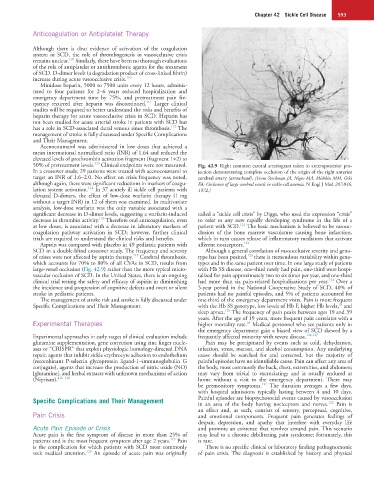
            50% of pretreatment levels.  Clinical endpoints were not measured.   Fig. 42.9  Right common carotid arteriogram taken in anteroposterior pro-
            In a crossover study, 29 patients were treated with acenocoumarol to   jection demonstrating complete occlusion of the origin of the right anterior
            target an INR of 1.6–2.0. No effect on crisis frequency was noted,   cerebral artery (arrowhead). (From Stockman JA, Nigro MA, Mishkin MM, Oski
            although again, there were significant reductions in markers of coagu-  FA: Occlusion of large cerebral vessels in sickle-cell anemia. N Engl J Med 287:846,
                              114
            lation system activation.  In 37 acutely ill sickle cell patients with   1972.)
            elevated  D-dimers,  the  effect  of  low-dose  warfarin  therapy  (1 mg
            without a target INR) in 12 of them was examined. In multivariate
            analysis, low-dose warfarin was the only variable associated with a
            significant decrease in D-dimer levels, suggesting a warfarin-induced   called a “sickle cell crisis” by Diggs, who used the expression “crisis”
                                 110
            decrease in thrombin activity.  Therefore oral anticoagulation, even   to  refer  to  any  new  rapidly  developing  syndrome  in  the  life  of  a
                                                                                121
            at low doses, is associated with a decrease in laboratory markers of   patient with SCD.  The basic mechanism is believed to be vasooc-
            coagulation  pathway  activation  in  SCD;  however,  further  clinical   clusion  of  the  bone  marrow  vasculature  causing  bone  infarction,
            trials are required to understand the clinical risks and benefits.  which in turn causes release of inflammatory mediators that activate
              Aspirin was compared with placebo in 49 pediatric patients with   afferent nociceptors. 122
            SCD in a double-blind crossover study. The frequency and severity   Although a general correlation of vasoocclusive severity and geno-
                                                                                  123
                                             115
            of crises were not affected by aspirin therapy.  Cerebral thrombosis,   type has been posited,  there is tremendous variability within geno-
            which accounts for 70% to 80% of all CVAs in SCD, results from   types and in the same patient over time. In one large study of patients
            large-vessel occlusion (Fig. 42.9) rather than the more typical micro-  with Hb SS disease, one-third rarely had pain, one-third were hospi-
            vascular occlusion of SCD. In the United States, there is an ongoing   talized for pain approximately two to six times per year, and one-third
                                                                                                             124
            clinical trial testing the safety and efficacy of aspirin in diminishing   had more than six pain-related hospitalizations per year.  Over a
            the incidence and progression of cognitive defects and overt or silent   5-year period in the National Cooperative Study of SCD, 40% of
            stroke in pediatric patients.                         patients had no painful episodes, and 5% of patients accounted for
              The management of stroke risk and stroke is fully discussed under   one-third of the emergency department visits. Pain is more frequent
                                                                                                                28
            Specific Complications and Their Management.          with the Hb SS genotype, low levels of Hb F, higher Hb levels,  and
                                                                           125
                                                                  sleep apnea.  The frequency of pain peaks between ages 19 and 39
                                                                  years. After the age of 19 years, more frequent pain correlates with a
            Experimental Therapies                                higher mortality rate.  Medical personnel who see patients only in
                                                                                  28
                                                                  the emergency department gain a biased view of SCD skewed by a
            Experimental approaches in early stages of clinical evaluation include   frequently affected minority with severe disease. 126,127
            glutamine supplementation, gene correction using zinc finger nucle-  Pain  may  be  precipitated  by  events  such  as  cold,  dehydration,
            ases or “CRISPR” that exploit physiologic homology-directed DNA   infection, stress, menses, and alcohol consumption. Any underlying
            repair, agents that inhibit sickle erythrocyte adhesion to endothelium   cause  should  be  searched  for  and  corrected,  but  the  majority  of
            (recombinant  P-selectin  glycoprotein  ligand-1–immunoglobulin  G   painful episodes have no identifiable cause. Pain can affect any area of
            conjugate), agents that increase the production of nitric oxide (NO)   the body, most commonly the back, chest, extremities, and abdomen;
            [glutamine], and herbal extracts with unknown mechanisms of action   may  vary  from  trivial  to  excruciating;  and  is  usually  endured  at
            (Niprisan). 116–118                                   home  without  a  visit  to  the  emergency  department.  There  may
                                                                                       127
                                                                  be  premonitory  symptoms.   The  duration  averages  a  few  days,
                                                                  with  hospital  admissions  typically  lasting  between  4  and  10  days.
            Specific Complications and Their Management           Painful episodes are biopsychosocial events caused by vasoocclusion
                                                                                                            122
                                                                  in  an  area  of  the  body  having  nociceptors  and  nerves.   Pain  is
                                                                  an  effect  and,  as  such,  consists  of  sensory,  perceptual,  cognitive,
            Pain Crisis                                           and  emotional  components.  Frequent  pain  generates  feelings  of
                                                                  despair,  depression,  and  apathy  that  interfere  with  everyday  life
            Acute Pain Episode or Crisis                          and promote an existence that revolves around pain. This scenario
            Acute  pain  is  the  first  symptom  of  disease  in  more  than  25%  of   may lead to a chronic debilitating pain syndrome; fortunately, this
                                                         119
            patients and is the most frequent symptom after age 2 years.  Pain   is rare.
            is the complication for which patients with SCD most commonly   There is no specific clinical or laboratory finding pathognomonic
                             120
            seek  medical  attention.   An  episode  of  acute  pain  was  originally   of pain crisis. The diagnosis is established by history and physical

