


Page 702 - Hematology_ Basic Principles and Practice ( PDFDrive )
P. 702
594    Part V  Red Blood Cells


        examination.  Changes  in  steady-state  Hb  values,  sickled  cells  on   analgesia, it must be remembered that individuals with SCD metabo-
        blood  smear,  WBC  counts,  and  so  on  are  not  reliable  indicators.   lize narcotics rapidly. 129
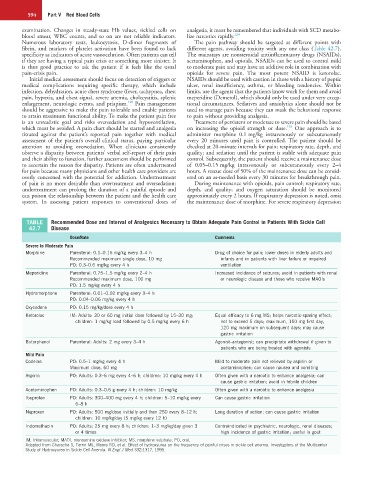
        Numerous  laboratory  tests,  leukocytosis,  D-dimer  fragments  of   The  pain  pathway  should  be  targeted  at  different  points  with
        fibrin,  and  markers  of  platelet  activation  have  been  found  to  lack   different agents, avoiding toxicity with any one class (Table 42.7).
        specificity as indicators of acute vasoocclusion. Often patients can tell   The mainstays are nonsteroidal antiinflammatory drugs (NSAIDs),
        if they are having a typical pain crisis or something more sinister. It   acetaminophen, and opioids. NSAIDs can be used to control mild
        is  thus  good  practice  to  ask  the  patient  if  it  feels  like  the  usual   to moderate pain and may have an additive role in combination with
        pain-crisis pain.                                     opioids  for  severe  pain.  The  most  potent  NSAID  is  ketorolac.
           Initial medical assessment should focus on detection of triggers or   NSAIDs should be used with caution in those with a history of peptic
        medical  complications  requiring  specific  therapy,  which  include   ulcer,  renal  insufficiency,  asthma,  or  bleeding  tendencies.  Within
        infection, dehydration, acute chest syndrome (fever, tachypnea, chest   limits, use the agents that the patients know work for them and avoid
        pain, hypoxia, and chest signs), severe anemia, cholecystitis, splenic   meperidine (Demerol), which should only be used under very excep-
                                           128
        enlargement, neurologic events, and priapism.  Pain management   tional circumstances. Sedatives and anxiolytics alone should not be
        should be aggressive to make the pain tolerable and enable patients   used to manage pain because they can mask the behavioral response
        to attain maximum functional ability. To make the patient pain free   to pain without providing analgesia.
        is  an  unrealistic  goal  and  risks  oversedation  and  hypoventilation,   Treatment of persistent or moderate to severe pain should be based
                                                                                               128
        which must be avoided. A pain chart should be started and analgesia   on  increasing  the  opioid  strength  or  dose.   One  approach  is  to
        titrated  against  the  patient’s  reported  pain  together  with  medical   administer  morphine  0.1 mg/kg  intravenously  or  subcutaneously
        assessment  of  the  patient’s  overall  clinical  status,  paying  particular   every  20  minutes  until  pain  is  controlled. The  patient  should  be
        attention  to  avoiding  oversedation.  When  clinicians  consistently   checked at 20-minute intervals for pain; respiratory rate, depth, and
        observe a disparity between patients’ verbal self-report of their pain   quality; and sedation until the patient is stable with adequate pain
        and their ability to function, further assessment should be performed   control. Subsequently, the patient should receive a maintenance dose
        to ascertain the reason for disparity. Patients are often undertreated   of  0.05–0.15 mg/kg  intravenously  or  subcutaneously  every  2–4
        for pain because many physicians and other health care providers are   hours. A rescue dose of 50% of the maintenance dose can be consid-
        overly concerned with the potential for addiction. Undertreatment   ered on an as-needed basis every 30 minutes for breakthrough pain.
        of pain is no more desirable than overtreatment and oversedation;   During maintenance with opioids, pain control; respiratory rate,
        undertreatment can prolong the duration of a painful episode and   depth,  and  quality;  and  oxygen  saturation  should  be  monitored
        can poison the relationship between the patient and the health care   approximately every 2 hours. If respiratory depression is noted, omit
        system.  In  assessing  patient  responses  to  conventional  doses  of   the maintenance dose of morphine. For severe respiratory depression


          TABLE   Recommended Dose and Interval of Analgesics Necessary to Obtain Adequate Pain Control in Patients With Sickle Cell
          42.7    Disease
                        Dose/Rate                                      Comments
         Severe to Moderate Pain
         Morphine       Parenteral: 0.1–0.15 mg/kg every 3–4 h         Drug of choice for pain; lower doses in elderly adults and
                        Recommended maximum single dose, 10 mg           infants and in patients with liver failure or impaired
                        PO: 0.3–0.6 mg/kg every 4 h                      ventilation
         Meperidine     Parenteral: 0.75–1.5 mg/kg every 2–4 h         Increased incidence of seizures; avoid in patients with renal
                        Recommended maximum dose, 100 mg                 or neurologic disease and those who receive MAOIs
                        PO: 1.5 mg/kg every 4 h
         Hydromorphone  Parenteral: 0.01–0.02 mg/kg every 3–4 h
                        PO: 0.04–0.06 mg/kg every 4 h
         Oxycodone      PO: 0.15 mg/kg/dose every 4 h
         Ketorolac      IM: Adults: 30 or 60 mg initial dose followed by 15–30 mg;   Equal efficacy to 6 mg MS; helps narcotic-sparing effect;
                          children: 1 mg/kg load followed by 0.5 mg/kg every 6 h  not to exceed 5 days; maximum, 150 mg first day,
                                                                         120 mg maximum on subsequent days; may cause
                                                                         gastric irritation
         Butorphanol    Parenteral: Adults: 2 mg every 3–4 h           Agonist–antagonist; can precipitate withdrawal if given to
                                                                         patients who are being treated with agonists
         Mild Pain
         Codeine        PO: 0.5–1 mg/kg every 4 h                      Mild to moderate pain not relieved by aspirin or
                        Maximum dose, 60 mg                              acetaminophen; can cause nausea and vomiting
         Aspirin        PO: Adults: 0.3–6 mg every 4–6 h; children: 10 mg/kg every 4 h  Often given with a narcotic to enhance analgesia; can
                                                                         cause gastric irritation; avoid in febrile children
         Acetaminophen  PO: Adults: 0.3–0.6 g every 4 h; children: 10 mg/kg  Often given with a narcotic to enhance analgesia
         Ibuprofen      PO: Adults: 300–400 mg every 4 h; children: 5–10 mg/kg every   Can cause gastric irritation
                          6–8 h
         Naproxen       PO: Adults: 500 mg/dose initially and then 250 every 8–12 h;   Long duration of action; can cause gastric irritation
                          children: 10 mg/kg/day (5 mg/kg every 12 h)
         Indomethacin   PO: Adults: 25 mg every 8 h; children: 1–3 mg/kg/day given 3   Contraindicated in psychiatric, neurologic, renal diseases;
                          or 4 times                                     high incidence of gastric irritation; useful in gout
         IM, Intramuscular; MAOI, monoamine oxidase inhibitor; MS, morphine sulphate; PO, oral.
         Adapted from Charache S, Terrin ML, Moore RD, et al. Effect of hydroxyurea on the frequency of painful crises in sickle cell anemia. Investigators of the Multicenter
         Study of Hydroxyurea in Sickle Cell Anemia. N Engl J Med 332:1317, 1995.

