


Page 811 - Hematology_ Basic Principles and Practice ( PDFDrive )
P. 811
Chapter 50  Disorders of Phagocyte Function  697


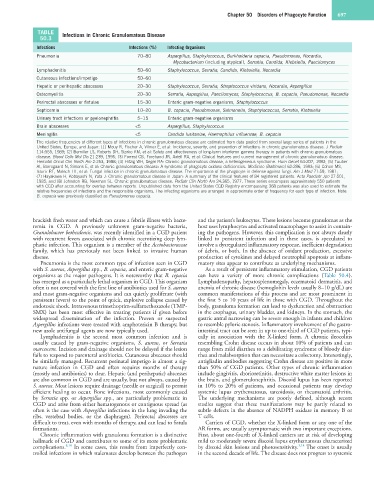
             TABLE   Infections in Chronic Granulomatous Disease
              50.3
             Infections                    Infections (%)  Infecting Organisms
             Pneumonia                        70−80     Aspergillus, Staphylococcus, Burkholderia cepacia, Pseudomonas, Nocardia,
                                                          Mycobacterium (including atypical), Serratia, Candida, Klebsiella, Paecilomyces
             Lymphadenitis                    50−60     Staphylococcus, Serratia, Candida, Klebsiella, Nocardia
             Cutaneous infections/impetigo    50−60
             Hepatic or perihepatic abscesses  20−30    Staphylococcus, Serratia, Streptococcus viridans, Nocardia, Aspergillus
             Osteomyelitis                    20−30     Serratia, Aspergillus, Paecilomyces, Staphylococcus, B. cepacia, Pseudomonas, Nocardia
             Perirectal abscesses or fistulae  15−30    Enteric gram-negative organisms, Staphylococcus
             Septicemia                       10−20     B. cepacia, Pseudomonas, Salmonella, Staphylococcus, Serratia, Klebsiella
             Urinary tract infections or pyelonephritis  5−15  Enteric gram-negative organisms
             Brain abscesses                 <5         Aspergillus, Staphylococcus
             Meningitis                      <5         Candida lusitaniae, Haemophilus influenzae, B. cepacia
             The relative frequencies of different types of infections in chronic granulomatous disease are estimated from data pooled from several large series of patients in the
             United States, Europe, and Japan: (1) Mouy R, Fischer A, Vilmer E, et al: Incidence, severity, and prevention of infections in chronic granulomatous disease. J Pediatr
             114:555, 1989; (2) Bemiller LS, Roberts DH, Starko KM, et al: Safety and effectiveness of long-term interferon gamma therapy in patients with chronic granulomatous
             disease. Blood Cells Mol Dis 21:239, 1995; (3) Forrest CB, Forehand JR, Axtell RA, et al: Clinical features and current management of chronic granulomatous disease.
             Hematol Oncol Clin North Am 2:253, 1988; (4) Hitzig WH, Seger RA: Chronic granulomatous disease, a heterogeneous syndrome. Hum Genet 64:207, 1983; (5) Tauber
             AI, Borregaard N, Simons E, et al: Chronic granulomatous disease: A syndrome of phagocyte oxidase deficiencies. Medicine (Baltimore) 62:286, 1983; (6) Cohen MS,
             Isturiz RE, Malech HL, et al: Fungal infection in chronic granulomatous disease. The importance of the phagocyte in defense against fungi. Am J Med 71:59, 1981;
             (7) Hayakawa H, Kobayashi N, Yata J: Chronic granulomatous disease in Japan: A summary of the clinical features of 84 registered patients. Acta Paediatr Jpn 27:501,
             1985; and (8) Johnston RB, Newman SL. Chronic granulomatous disease. Pediatr Clin North Am 24:365, 1977. These series encompass approximately 550 patients
             with CGD after accounting for overlap between reports. Unpublished data from the United States CGD Registry encompassing 368 patients was also used to estimate the
             relative frequencies of infections and the responsible organisms. The infecting organisms are arranged in approximate order of frequency for each type of infection. Note:
             B. cepacia was previously classified as Pseudomonas cepacia.


            brackish fresh water and which can cause a febrile illness with bacte-  and the patient’s leukocytes. These lesions become granulomas as the
            remia  in  CGD.  A  previously  unknown  gram-negative  bacteria,   host uses lymphocytes and activated macrophages to assist in contain-
            Granulobacter bethesdensis, was recently identified in a CGD patient   ing the pathogens. However, this complication is not always clearly
            with recurrent fevers associated with chronic necrotizing deep lym-  linked  to  persistent  infection  and  in  these  cases,  is  speculated  to
            phatic infection. This organism is a member of the Acetobacteraceae   involve a dysregulated inflammatory response, inefficient degradation
            family,  which  has  previously  not  been  linked  to  invasive  human   of debris, or both. In the absence of oxidant production, excessive
            disease.                                              production of cytokines and delayed neutrophil apoptosis at inflam-
              Pneumonia is the most common type of infection seen in CGD   matory sites appear to contribute as underlying mechanisms.
            with S. aureus, Aspergillus spp., B. cepacia, and enteric gram-negative   As a result of persistent inflammatory stimulation, CGD patients
            organisms as the major pathogens. It is noteworthy that B. cepacia   can  have  a  variety  of  more  chronic  complications  (Table  50.4).
            has emerged as a particularly lethal organism in CGD. This organism   Lymphadenopathy, hepatosplenomegaly, eczematoid dermatitis, and
            often is not covered with the first line of antibiotics used for S. aureus   anemia of chronic disease (hemoglobin levels usually 8–10 g/dL) are
            and most gram-negative organisms and can quietly proliferate (with   common manifestations of this process and are most prominent in
            persistent fevers) to the point of quick, explosive collapse caused by   the first 5 to 10 years of life in those with CGD. Throughout the
            endotoxic shock. Intravenous trimethoprim-sulfamethoxazole (TMP-  body, granuloma formation can lead to dysfunction and obstruction
            SMX)  has  been  most  effective  in  treating  patients  if  given  before   in the esophagus, urinary bladder, and kidneys. In the stomach, the
            widespread  dissemination  of  the  infection.  Proven  or  suspected   gastric antral narrowing can be severe enough in infants and children
            Aspergillus infections were treated with amphotericin B therapy, but   to resemble pyloric stenosis. Inflammatory involvement of the gastro-
            new azole antifungal agents are now typically used.   intestinal tract can be seen in up to one-third of CGD patients, typi-
              Lymphadenitis  is  the  second  most  common  infection  and  is   cally  in  association  with  the  X-linked  form.  A  chronic  ileocolitis
            usually  caused  by  gram-negative  organisms,  S.  aureus,  or  Serratia   resembling Crohn disease occurs in about 10% of patients and can
            marcescens. Incision and drainage should not be delayed if the lesion   range from mild diarrhea to a debilitating syndrome of bloody diar-
            fails to respond to parenteral antibiotics. Cutaneous abscesses should   rhea and malabsorption that can necessitate a colectomy. Interestingly,
            be similarly managed. Recurrent perinatal impetigo is almost a sig-  antigliadin antibodies suggesting Crohn disease are positive in more
            nature  infection  in  CGD  and  often  requires  months  of  therapy   than 50% of CGD patients. Other types of chronic inflammation
            (mostly oral antibiotics) to clear. Hepatic (and perihepatic) abscesses   include gingivitis, chorioretinitis, destructive white matter lesions in
            are also common in CGD and are usually, but not always, caused by   the brain, and glomerulonephritis. Discoid lupus has been reported
            S. aureus. Most lesions require drainage (needle or surgical) to permit   in  10%  to  20%  of  patients,  and  occasional  patients  may  develop
            efficient healing to occur. Bone infections, most commonly caused   systemic  lupus  erythematosus,  sarcoidosis,  or  rheumatoid  arthritis.
            by  Serratia  spp.  or  Aspergillus  spp.,  are  particularly  problematic  in   The  underlying  mechanisms  are  poorly  defined,  although  recent
            CGD and arise from either hematogenous or contiguous spread (as   studies  suggest  that  these  manifestations  may  be  partly  related  to
            often is the case with Aspergillus infections in the lung invading the   subtle defects in the absence of NADPH oxidase in memory B or
            ribs,  vertebral  bodies,  or  the  diaphragm).  Perirectal  abscesses  are   T cells.
            difficult to treat, even with months of therapy, and can lead to fistula   Carriers of CGD, whether the X-linked form or any one of the
            formations.                                           AR forms, are usually asymptomatic with two important exceptions.
              Chronic inflammation with granuloma formation is a distinctive   First, about one-fourth of X-linked carriers are at risk of developing
            hallmark of CGD and contributes to some of its more problematic   mild to moderately severe discoid lupus erythematosus characterized
            complications. 8,14  In some cases, this results from imperfectly con-  by discoid skin lesions and photosensitivity. 3,14  The onset is usually
            trolled infections in which stalemates develop between the pathogen   in the second decade of life. The disease does not progress to systemic

