


Page 809 - Hematology_ Basic Principles and Practice ( PDFDrive )
P. 809
Chapter 50  Disorders of Phagocyte Function  695


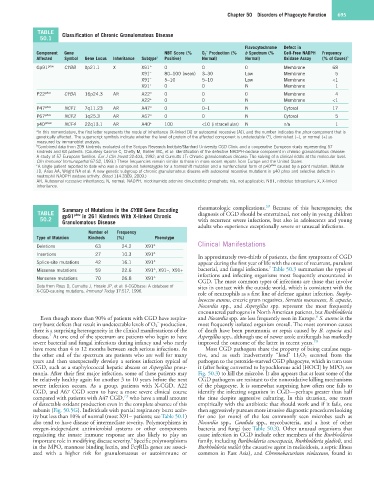
             TABLE   Classification of Chronic Granulomatous Disease
              50.1
                                                                                 Flavocytochrome   Defect in
                                                                    −
             Component   Gene                          NBT Score (%   O 2  Production (%   b Spectrum (%   Cell-Free NADPH   Frequency
             Affected  Symbol  Gene Locus  Inheritance  Subtype a  Positive)  Normal)  Normal)  Oxidase Assay  (% of Cases) b
             Gp91 phox  CYBB  Xp21.1  X        X91°    0           0             0            Membrane        68
                                               X91 −   80−100 (weak)  3−30       Low          Membrane         5
                                               X91 −   5−10        5−10          Low          Membrane        <1
                                               X91 +   0           0             N            Membrane         1
             P22 phox  CYBA  16p24.3  AR       A22°    0           0             0            Membrane         4
                                               A22 +   0           0             N            Membrane        <1
             P47 phox  NCF1  7q11.23  AR       A47°    0           0−1           N            Cytosol         17
             P67 phox  NCF2  1q25.3   AR       A67°    0           0             N            Cytosol          5
             p40 phoxc  NCF4  22q13.1  AR      A40 +   100         <10 (intracellular)  N     n/a              1
             a In this nomenclature, the first letter represents the mode of inheritance (X-linked [X] or autosomal recessive [A]), and the number indicates the phox component that is
             genetically affected. The superscript symbols indicate whether the level of protein of the affected component is undetectable (°), diminished (−), or normal (+) as
             measured by immunoblot analysis.
             b Combined data from 209 kindreds evaluated at the Scripps Research Institute/Stanford University CGD Clinic and a cooperative European study representing 57
             kindreds and 63 patients. (Courtesy Casimir C, Chetty M, Bohler MC, et al: Identification of the defective NADPH-oxidase component in chronic granulomatous disease:
             A study of 57 European families. Eur J Clin Invest 22:403, 1992; and Curnutte JT: Chronic granulomatous disease: The solving of a clinical riddle at the molecular level.
             Clin Immunol Immunopathol 67:S2, 1993.) These frequencies remain similar to those in more recent reports from Europe and the United States.
             c A single patient reported to date who was a compound heterozygote for a frameshift mutation and a nonfunctional form of p40 phox  caused by a point mutation. (Matute
             JD, Arias AA, Wright NA et al: A new genetic subgroup of chronic granulomatous disease with autosomal recessive mutations in p40 phox and selective defects in
             neutrophil NADPH oxidase activity. Blood 114:3309, 2009.)
             AR, Autosomal recessive inheritance; N, normal; NADPH, nicotinamide adenine dinucleotide phosphate; n/a, not applicable; NBT, nitroblue tetrazolium; X, X-linked
             inheritance.


                                                                                        3,8
                     Summary of Mutations in the CYBB Gene Encoding   rheumatologic  complications.   Because  of  this  heterogeneity,  the
             TABLE   gp91 pbox  in 261 Kindreds With X-linked Chronic   diagnosis of CGD should be entertained, not only in young children
              50.2                                                with recurrent severe infections, but also in adolescents and young
                     Granulomatous Disease
                                                                  adults who experience exceptionally severe or unusual infections.
                              Number of   Frequency
             Type of Mutation  Kindreds  (%)        Phenotype
                                                                  Clinical Manifestations
             Deletions          63       24.2    X91°
             Insertions         27       10.3    X91°
                                                                  In approximately two-thirds of patients, the first symptoms of CGD
             Splice-site mutations  42   16.1    X91°             appear during the first year of life with the onset of recurrent, purulent
                                                                                         7
             Missense mutations  59      22.6    X91°, X91−, X91+  bacterial, and fungal infections.  Table 50.3 summarizes the types of
                                                                  infections and infecting organisms most frequently encountered in
             Nonsense mutations  70      26.8    X91°             CGD. The most common types of infections are those that involve
             Data from Roos D, Curnutte J, Hossle JP, et al: X-CGDbase: A database of   sites in contact with the outside world, which is consistent with the
             X-CGD-causing mutations. Immunol Today 17:517, 1996.
                                                                  role of neutrophils as a first line of defense against infection. Staphy-
                                                                  lococcus aureus, enteric gram negatives, Serratia marcescens, B. cepacia,
                                                                  Nocardia  spp.,  and  Aspergillus  spp.  represent  the  most  frequently
                                                                  encountered pathogens in North American patients, but Burkholderia
                                                                                                        8
              Even though more than 90% of patients with CGD have respira-  and Nocardia spp. are less frequently seen in Europe.  S. aureus is the
                                                    −
            tory burst defects that result in undetectable levels of O 2  production,   most frequently isolated organism overall. The most common causes
            there is a surprising heterogeneity in the clinical manifestations of the   of death have been pneumonia or sepsis caused by B. cepacia and
                 7
            disease.  At one end of the spectrum are patients who begin to have   Aspergillus spp., although use of newer azole antifungals has markedly
            severe bacterial and fungal infections during infancy and who rarely   improved the outcome of the latter in recent years. 7,8
            have more than 4 to 12 months between such serious infections. At   Most CGD pathogens share the property of being catalase nega-
            the other end of the spectrum are patients who are well for many   tive,  and  as  such  inadvertently  “lend”  H 2 O 2   secreted  from  the
            years  and  then  unexpectedly  develop  a  serious  infection  typical  of   pathogen to the peroxide-starved CGD phagocyte, which in turn uses
            CGD, such as a staphylococcal hepatic abscess or Aspergillus pneu-  it (after being converted to hypochlorous acid [HOCl] by MPO; see
            monia. After their first major infection, some of these patients may   Fig. 50.3) to kill the microbe. It also appears that at least some of the
            be relatively healthy again for another 3 to 10 years before the next   CGD pathogens are resistant to the nonoxidative killing mechanisms
            severe  infection  occurs.  As  a  group,  patients  with  X-CGD,  A22   of the phagocyte. It is somewhat surprising how often one fails to
            CGD,  and  A67  CGD  seem  to  have  a  more  severe  clinical  course   identify the infecting organism in CGD—perhaps greater than half
                                          7,9
            compared with patients with A47 CGD,  who have a small amount   the  time  despite  aggressive  culturing.  In  this  situation,  one  treats
            of detectable oxidant production even in the complete absence of this   empirically with the antibiotic that should work and if it fails, one
            subunit (Fig. 50.5G). Individuals with partial respiratory burst activ-  then aggressively pursues more invasive diagnostic procedures looking
            ity but less than 10% of normal (most X91− patients; see Table 50.1)   for  one  (or  more)  of  the  less  commonly  seen  microbes  such  as
            also tend to have disease of intermediate severity. Polymorphisms in   Nocardia  spp.,  Candida  spp.,  mycobacteria,  and  a  host  of  other
            oxygen-independent  antimicrobial  systems  or  other  components   bacteria and fungi (see Table 50.3). Other unusual organisms that
            regulating  the  innate  immune  response  are  also  likely  to  play  an   cause infection in CGD include other members of the Burkholderia
                                            9
            important role in modifying disease severity.  Specific polymorphisms   family, including Burkholderia cenocepacia, Burkholderia gladioli, and
            in the MPO, mannose binding lectin, and FcγRIIa genes are associ-  Burkholderia mallei (the causative agent in melioidosis, a septic illness
            ated  with  a  higher  risk  for  granulomatous  or  autoimmune  or   common  in  East  Asia),  and  Chromobacterium  violaceum,  found  in

