


Page 893 - Hematology_ Basic Principles and Practice ( PDFDrive )
P. 893
776    Part VII  Hematologic Malignancies


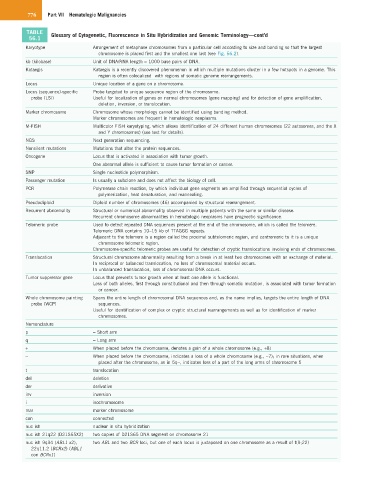
          TABLE   Glossary of Cytogenetic, Fluorescence in Situ Hybridization and Genomic Terminology—cont’d
          56.1
         Karyotype             Arrangement of metaphase chromosomes from a particular cell according to size and banding so that the largest
                                 chromosome is placed first and the smallest one last (see Fig. 56.2).
         kb (kilobase)         Unit of DNA/RNA length = 1000 base pairs of DNA.
         Kataegis              Kataegis is a recently discovered phenomenon in which multiple mutations cluster in a few hotspots in a genome. This
                                 region is often colocalized  with regions of somatic genome rearrangements.
         Locus                 Unique location of a gene on a chromosome.
         Locus (sequence)-specific   Probe targeted to unique sequence region of the chromosome.
           probe (LSI)         Useful for localization of genes on normal chromosomes (gene mapping) and for detection of gene amplification,
                                 deletion, inversion, or translocation.
         Marker chromosome     Chromosome whose morphology cannot be identified using banding method.
                               Marker chromosomes are frequent in hematologic neoplasms.
         M-FISH                Multicolor FISH karyotyping, which allows identification of 24 different human chromosomes (22 autosomes, and the X
                                 and Y chromosomes) (see text for details).
         NGS                   Next generation sequencing.
         Nonsilent mutations   Mutations that alter the protein sequences.
         Oncogene              Locus that is activated in association with tumor growth.
                               One abnormal allele is sufficient to cause tumor formation or cancer.
         SNP                   Single nucleotide polymorphism.
         Passenger mutation    Is usually a subclone and does not affect the biology of cell.
         PCR                   Polymerase chain reaction, by which individual gene segments are amplified through sequential cycles of
                                 polymerization, heat denaturation, and reannealing.
         Pseudodiploid         Diploid number of chromosomes (46) accompanied by structural rearrangement.
         Recurrent abnormality  Structural or numerical abnormality observed in multiple patients with the same or similar disease.
                               Recurrent chromosome abnormalities in hematologic neoplasms have prognostic significance.
         Telomeric probe       Used to detect repeated DNA sequences present at the end of the chromosome, which is called the telomere.
                               Telomeric DNA contains 10–15 kb of TTAGGG repeats.
                               Adjacent to the telomere is a region called the proximal subtelomeric region, and centromeric to it is a unique
                                 chromosome telomeric region.
                               Chromosome-specific telomeric probes are useful for detection of cryptic translocations involving ends of chromosomes.
         Translocation         Structural chromosome abnormality resulting from a break in at least two chromosomes with an exchange of material.
                               In reciprocal or balanced translocation, no loss of chromosomal material occurs.
                               In unbalanced translocation, loss of chromosomal DNA occurs.
         Tumor suppressor gene  Locus that prevents tumor growth when at least one allele is functional.
                               Loss of both alleles, first through constitutional and then through somatic mutation, is associated with tumor formation
                                 or cancer.
         Whole chromosome painting   Spans the entire length of chromosomal DNA sequences and, as the name implies, targets the entire length of DNA
           probe (WCP)           sequences.
                               Useful for identification of complex or cryptic structural rearrangements as well as for identification of marker
                                 chromosomes.
         Nomenclature
         p                     = Short arm
         q                     = Long arm
         +                     When placed before the chromosome, denotes a gain of a whole chromosome (e.g., +8)
         −                     When placed before the chromosome, indicates a loss of a whole chromosome (e.g., −7); in rare situations, when
                                 placed after the chromosome, as in 5q−, indicates loss of a part of the long arms of chromosome 5
         t                     translocation
         del                   deletion
         der                   derivative
         inv                   inversion
         i                     isochromosome
         mar                   marker chromosome
         con                   connected
         nuc ish               nuclear in situ hybridization
         nuc ish 21q22 (D21S65X2)  two copies of D21S65 DNA segment on chromosome 21
         nuc ish 9q34 (ABL1 x2),   two ABL and two BCR loci, but one of each locus is juxtaposed on one chromosome as a result of t(9;22)
           22q11.2 (BCRx2) (ABL1
           con BCRx1)

