


Page 927 - Hematology_ Basic Principles and Practice ( PDFDrive )
P. 927
810    Part VII  Hematologic Malignancies


          TABLE   Mixed Lineage Leukemia Translocations and Rearrangements 2015—cont’d
          56.9
         #         Cytogenetic Abnormality         Breakpoint        Hugo Name         Leukemia Type
         17        t(10;11)(q25;q23)
         18        t(11;11)(q11;q23)
         19        t(11;11)(q13;q23)
         20        t(11;11)(q21;q23)
         21        t(11;12)(q23;p13)
         22        t(11;12)(q23;q13)
         23        t(11;12)(q23;q24)
         24        t(4;13;11)(q21;q34;q23)
         25        t(11;14)(q23;q11)
         26        t(11;14)(q23;q32)
         27        t(11;15)q23;q15)
         28        t(11;17)(q23;q11)
         29        t(11;17)(q23;q23)
         30        t(11;18)(q23;q12)
         31        t(11;18)(q23;q23)
         32        t(11;20)(q23;q13)
         33        t(11;21)(q23;q11)
         34        t(Y;11)(p11;q23)
         35        t(X;11)(q22;q23)
         AL, Acute leukemia; ALL, acute lymphoblastic leukemia; AML, acute myeloid leukemia; BAL, biphenotypic acute leukemia; CML, chronic myelogenous leukemia; JMML,
         juvenile myomonocytic leukemia; MDS, myelodysplastic syndrome; t-AL, therapy-related AL; t-ALL, therapy-related ALL; T-ALL, T-cell ALL; t-AML, therapy-related AML;
         t-CML, therapy-related CML; t-MDS, therapy-related MDS; t-T-ALL, therapy-related T-cell ALL.
         Courtesy C. Meyer and Rolf Marschalek, Diagnostic Center of Acute Leukemia (DCAL), Institute for Pharmaceutical Biology, Goethe University, Frankfurt, Germany,
         February 14, 2015.


                                                                                  t(9;11)(p22;q23)
                                                                            9
                                                                                               11
                     1          2          3         4          5


                   6       7       8      9       10     11      12


                   13      14        15       16       17       18


                   19        20       21        22       X        Y
                A                 46,XY,t(9;11)(p22;q23)             B
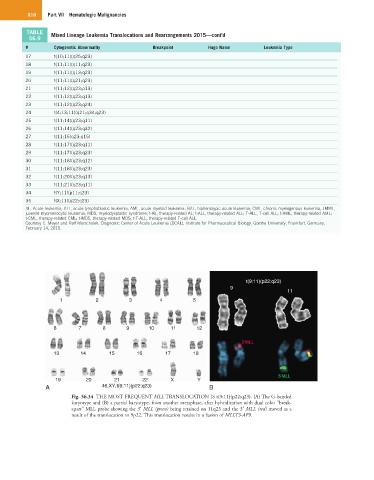
                        Fig. 56.34  THE MOST FREQUENT MLL TRANSLOCATION IS t(9;11)(p22;q23). (A) The G-banded
                        karyotype and (B) a partial karyotype, from another metaphase, after hybridization with dual color “break-
                        apart” MLL probe showing the 5′ MLL (green) being retained on 11q23 and the 3′ MLL (red) moved as a
                        result of the translocation to 9p22. This translocation results in a fusion of MLLT3-AF9.

