


Page 923 - Hematology_ Basic Principles and Practice ( PDFDrive )
P. 923
806    Part VII  Hematologic Malignancies


         A               B                    C                 D
                                                                                      E


                                                                I
           F                                H
                                G


         J                  K


                                                     L

                                                                                   M

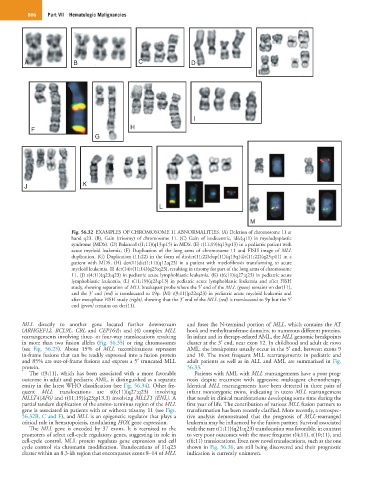
                        Fig. 56.32  EXAMPLES OF CHROMOSOME 11 ABNORMALITIES. (A) Deletion of chromosome 11 at
                        band q23. (B), Gain (trisomy) of chromosome 11. (C) Gain of isodicentric, idic(q11) in myelodysplastic
                        syndrome (MDS). (D) Balanced t(1;11)(q13;p15) in MDS. (E) t(11;19)(q13;p13) in a pediatric patient with
                        acute  myeloid  leukemia.  (F)  Duplication  of  the  long  arms  of  chromosome  11  and  FISH  image  of  MLL
                        duplication. (G) Duplication (11;22) in the form of dicder(11;22)dup(11)(q13q14)t(11;22)(q23;p11) in a
                        patient  with  MDS.  (H)  der(11)dic(1;11)(q12;q23)  in  a  patient  with  myelofibrosis  transforming  to  acute
                        myeloid leukemia. (I) der(14)t(11;14)(q23;q23), resulting in trisomy for part of the long arms of chromosome
                        11. (J) t(4;11)(q23;q23) in pediatric acute lymphoblastic leukemia. (K) t(6;11)(q27;q23) in pediatric acute
                        lymphoblastic  leukemia.  (L)  t(11;19)(q23;p13)  in  pediatric  acute  lymphoblastic  leukemia  and  after  FISH
                        study, showing separation of MLL breakapart probe where the 5′ end of the MLL (green) remains on der(11),
                        and the 3′ end (red) is translocated to 19p. (M) t(9;11)(p22;q23) in pediatric acute myeloid leukemia and
                        after metaphase FISH study (right), showing that the 3′ end of the MLL (red) is translocated to 9p but the 5′
                        end (green) remains on der(11).


        MLL  directly  to  another  gene  located  further  downstream   and fuses the N-terminal portion of MLL, which contains the AT
        (ARHGEF12,  BCL9L,  CBL  and  CEP164);  and  (4)  complex  MLL   hook and methyltransferase domains, to numerous different proteins.
        rearrangements involving three- or four-way translocations resulting   In infant and in therapy-related AML, the MLL genomic breakpoints
        in more than two fusion alleles (Fig. 56.35) or ring chromosomes   cluster at the 3′ end, near exon 12. In childhood and adult de novo
        (see  Fig.  56.25).  About  15%  of  MLL  recombinations  represent   AML, the breakpoints usually occur in the 5′ end, between exons 9
        in-frame fusions that can be readily expressed into a fusion protein   and  10. The  most  frequent  MLL  rearrangements  in  pediatric  and
        and 85% are out-of-frame fusions and express a 5′ truncated MLL   adult patients as well as in ALL and AML are summarized in Fig.
        protein.                                              56.33.
           The  t(9;11),  which  has  been  associated  with  a  more  favorable   Patients with AML with MLL rearrangements have a poor prog-
        outcome in adult and pediatric AML, is distinguished as a separate   nosis  despite  treatment  with  aggressive  multiagent  chemotherapy.
        entity in the latest WHO classification (see Fig. 56.34). Other fre-  Identical MLL rearrangements have been detected in three pairs of
        quent  MLL  translocations  are  t(6;11)(q27;q23)  involving   infant monozygotic twins, indicating in utero MLL rearrangement
        MLLT4(AF6) and t(11;19)(q23;p13.3) involving MLLT1 (ENL). A   that result in clinical manifestations developing some time during the
        partial tandem duplication of the amino-terminus region of the MLL   first year of life. The contribution of various MLL fusion partners to
        gene is associated in patients with or without trisomy 11 (see Figs.   transformation has been recently clarified. More recently, a retrospec-
        56.32B, C and F), and MLL is an epigenetic regulator that plays a   tive  analysis  demonstrated  that  the  prognosis  of  MLL-rearranged
        critical role in hematopoiesis, modulating HOX gene expression.  leukemia may be influenced by the fusion partner. Survival associated
           The  MLL  gene  is  encoded  by  37  exons.  It  is  recruited  to  the   with the rare t(1;11)(q21;q23) translocation was favorable, in contrast
        promoters of select cell-cycle regulatory genes, suggesting its role in   to very poor outcomes with the more frequent t(4;11), t(10;11), and
        cell-cycle  control.  MLL  protein  regulates  gene  expression  and  cell   t(6;11) translocations. Even now novel translocations, such as the one
        cycle  control  via  chromatin  modification. Translocations  of  11q23   shown in Fig. 56.36, are still being discovered and their prognostic
        cluster within an 8.3-kb region that encompasses exons 8–14 of MLL   indication is currently unknown.

