


Page 932 - Hematology_ Basic Principles and Practice ( PDFDrive )
P. 932
Chapter 56  Conventional and Molecular Cytogenomic Basis of Hematologic Malignancies  815


                                                                               BCR-ABL
                                                                               (ASXL1)
                                                                               (WT1)
                                                              PV         CML
                                                ET      TET2                              CSF3R
                                                      DNMT3A                       aCML   SETBP1
                                                      JAK2 MPL
                                                       CALR
                               Spliceosome
                                   ASXL1                                                         TET2
                                 DNMT3A                                                          ASXL1
                                  RUNX1    MDS             IMF                            CMML   MLL-PTD
                                    TET2                                                         NRAS
                                                                                                 FLT3

                             PML-RARA
                           CBFB-MYH11                                                               TET2
                        RUNX1-RUNX1T1   Normal                     AML                        SM    KIT
                               DNMT3A
                                 NPM1
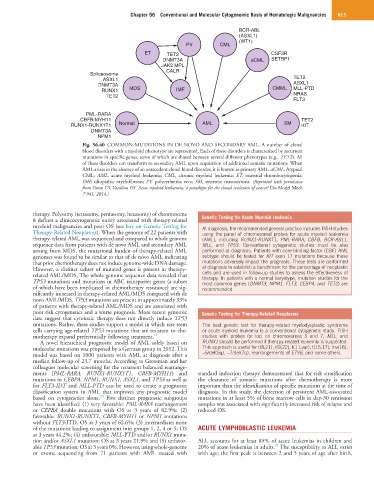
                            Fig. 56.40  COMMON MUTATIONS IN DE NOVO AND SECONDARY AML. A number of clonal
                            blood disorders with a myeloid phenotype are represented. Each of these disorders is characterized by recurrent
                            mutations in specific genes, some of which are shared between several different phenotypes (e.g., TET2). All
                            of these disorders can transform to secondary AML upon acquisition of additional somatic mutations. When
                            AML arises in the absence of an antecedent clonal blood disorder, it is known as primary AML. aCML, Atypical
                            CML;  AML,  acute  myeloid  leukemia;  CML,  chronic  myeloid  leukemia;  ET,  essential  thrombocytopenia;
                            IMF, idiopathic myelofibrosis; PV, polycythemia vera; SM, systemic mastocytosis. (Reprinted with permission
                            from Grove CS, Vassiliou GS: Acute myeloid leukaemia: a paradigm for the clonal evolution of cancer? Dis Model Mech
                            7:941, 2014.)


            therapy. Polysomy (tetrasomy, pentasomy, hexasomy) of chromosome
            8 defines a clinicocytogenetic entity associated with therapy-related   Genetic Testing for Acute Myeloid Leukemia
            myeloid malignancies and poor OS (see box on Genetic Testing for   At diagnosis, the recommended general practice includes FISH studies
            Therapy-Related Neoplasms). When the genome of 22 patients with   using  the  panel  of  chromosomal  probes  for  acute  myeloid  leukemia
            therapy-related AML was sequenced and compared to whole genome   (AML),  including  RUNX1-RUNXT1,  PML-RARA,  CBFB,  BCR-ABL1,
            sequence data from patients with de novo AML and secondary AML   MLL,  and  TP53.  Conventional  cytogenetic  studies  must  be  also
            arising from MDS, the mutational burden of therapy-related AML   performed at diagnosis. Patients with core-binding factor (CBF) AML
            genomes was found to be similar to that of de novo AML indicating   subtype  should  be  tested  for  KIT  exon  17  mutations  because  these
            that prior chemotherapy does not induce genome-wide DNA damage.   mutations adversely impact the prognosis. These tests are performed
            However, a distinct subset of mutated genes is present in therapy-  at diagnosis to establish a benchmark for the percentage of neoplastic
            related AML/MDS. The whole genome sequence data revealed that   cells and are used in follow-up studies to assess the effectiveness of
                                                                   therapy. In patients with a normal karyotype, mutation studies for the
            TP53 mutations and mutations in ABC transporter genes (a subset   most common genes (DNMT3, NPM1, FLT3, CEBPA, and TET2) are
            of which have been implicated in chemotherapy resistance) are sig-  recommended.
            nificantly increased in therapy-related AML/MDS compared with de
            novo AML/MDS. TP53 mutations are present in approximately 33%
            of patients with therapy-related AML/MDS and are associated with
            poor risk cytogenetics and a worse prognosis. More recent genomic   Genetic Testing for Therapy-Related Neoplasms
            data suggest that cytotoxic therapy does not directly induce TP53
            mutations. Rather, these studies support a model in which rare stem   The  best  genetic  test  for  therapy-related  myelodysplastic  syndrome
            cells carrying age-related TP53 mutations that are resistant to che-  or acute myeloid leukemia is a conventional cytogenetic study. FISH
            motherapy expand preferentially following treatment. 19  studies  with  probes  for  loci  on  chromosomes  5  and  7,  MLL,  and
              A novel hierarchical prognostic model of AML solely based on   RUNX1 should be performed if therapy-related leukemia is suspected.
            molecular mutations was proposed by a German group in 2012. This   This approach is useful for t(8;21), t(9;22), t(11;var), t(15;17), inv(16),
            model was based on 1000 patients with AML at diagnosis after a   −5/del(5q), −7/del(7q), rearrangements of ETV6, and some others.
            median follow-up of 23.7 months. According to Grossman and her
            colleagues molecular screening for the recurrent balanced rearrange-
            ments  (PML-RARA,  RUNX1-RUNX1T1,  CBFB-MYH11)  and   standard induction therapy demonstrated that for risk stratification
            mutations in CEBPA, NPM1, RUNX1, ASXL1, and TP53 as well as   the  clearance  of  somatic  mutations  after  chemotherapy  is  more
            for  FLT3-IDT  and  MLL-PTD  can  be  used  to  create  a  prognostic   important than the identification of specific mutations at the time of
            classification  system  in  AML  that  improves  any  prognostic  model   diagnosis. In this study, the detection of persistent AML-associated
                                  20
            based  on  cytogenetics  alone.   Five  distinct  prognostic  subgroups   mutations in at least 5% of bone marrow cells in day-30 remission
            have been identified: (1) very favorable: PML-RARA rearrangement   samples was associated with significantly increased risk of relapse and
            or  CEPBA  double  mutations  with  OS  at  3  years  of  82.9%;  (2)   reduced OS.
            favorable:  RUNX1-RUNXT1,  CBFB-MYH11  or  NPM1  mutations
            without FLT3-ITD, OS at 3 years of 62.6%; (3) intermediate: none
            of the mutations leading to assignment into groups 1, 2, 4 or 5; OS   ACUTE LYMPHOBLASTIC LEUKEMIA
            at 3 years 44.2%; (4) unfavorable: MLL-PTD and/or RUNX1 muta-
            tion and/or ASXL1 mutation: OS at 3 years 21.9% and (5) unfavor-  ALL accounts for at least 85% of acute leukemias in children and
                                                                                           21
            able TP53 mutation: OS at 3 years 0%. However, using whole-genome   20% of acute leukemias in adults.  The susceptibility to ALL varies
            or  exome  sequencing  from  71  patients  with  AML  treated  with   with age; the first peak is between 2 and 5 years of age after birth,

