


Page 928 - Hematology_ Basic Principles and Practice ( PDFDrive )
P. 928
Chapter 56  Conventional and Molecular Cytogenomic Basis of Hematologic Malignancies  811


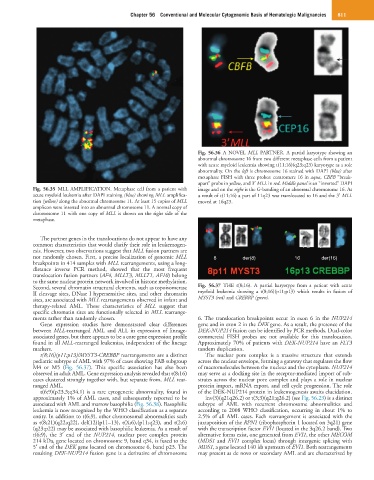
                                                                  Fig.  56.36  A  NOVEL  MLL  PARTNER.  A  partial  karyotype  showing  an
                                                                  abnormal chromosome 16 from two different metaphase cells from a patient
                                                                  with acute myeloid leukemia showing t(11;16)(q23;q23) karyotype as a sole
                                                                  abnormality. On the left is chromosome 16 stained with DAPI (blue) after
                                                                  metaphase FISH with three probes: centromere 16 in aqua, CBFB “break-
                                                                  apart” probe in yellow, and 3′ MLL in red. Middle panel is an “inverted” DAPI
            Fig. 56.35  MLL AMPLIFICATION. Metaphase cell from a patient with   image and on the right is the G-banding of an abnormal chromosome 16. As
            acute myeloid leukemia after DAPI staining (blue) showing MLL amplifica-  a result of t(11;16) a part of 11q23 was translocated to 16 and the 3′ MLL
            tion (yellow) along the abnormal chromosome 11. At least 15 copies of MLL   moved at 16q23.
            amplicon were inserted into an abnormal chromosome 11. A normal copy of
            chromosome 11 with one copy of MLL is shown on the right side of the
            metaphase.


              The partner genes in the translocations do not appear to have any
            common characteristics that would clarify their role in leukemogen-
            esis. However, two observations suggest that MLL fusion partners are
            not randomly chosen. First, a precise localization of genomic MLL   8  der(8)        16       der(16)
            breakpoints in 414 samples with MLL rearrangements, using a long-
            distance  inverse  PCR  method,  showed  that  the  most  frequent
            translocation fusion partners (AF4, MLLT3, MLLT1, AF10) belong
            to the same nuclear protein network involved in histone methylation.
            Second, several chromatin structural elements, such as topoisomerase   Fig.  56.37  THE  t(8;16).  A  partial  karyotype  from  a  patient  with  acute
            II cleavage sites, DNase I hypersensitive sites, and other chromatin   myeloid  leukemia  showing  a  t(8;16)(p11;p13)  which  results  in  fusion  of
            sites, are associated with MLL rearrangements observed in infant and   MYST3 (red) and CREBBP (green).
            therapy-related  AML.  These  characteristics  of  MLL  suggest  that
            specific chromatin sites are functionally selected in MLL rearrange-
            ments rather than randomly chosen.                    6. The translocation breakpoints occur in exon 6 in the NUP214
              Gene  expression  studies  have  demonstrated  clear  differences   gene and in exon 2 in the DEK gene. As a result, the presence of the
            between  MLL-rearranged  AML  and  ALL  in  expression  of  lineage-  DEK-NUP214 fusion can be identified by PCR methods. Dual-color
            associated genes, but there appears to be a core gene expression profile   commercial  FISH  probes  are  not  available  for  this  translocation.
            found in all MLL-rearranged leukemias, independent of the lineage   Approximately 70% of patients with DEK-NUP214 have an FLT3
            markers.                                              tandem duplication.
              t(8;16)(p11;p13)/MYST3-CREBBP rearrangements are a distinct   The  nuclear  pore  complex  is  a  massive  structure  that  extends
            pediatric subtype of AML with 97% of cases showing FAB subgroup   across the nuclear envelope, forming a gateway that regulates the flow
            M4  or  M5  (Fig.  56.37).  This  specific  association  has  also  been   of macromolecules between the nucleus and the cytoplasm. NUP214
            observed in adult AML. Gene expression analysis revealed that t(8;16)   may serve as a docking site in the receptor-mediated import of sub-
            cases clustered strongly together with, but separate from, MLL rear-  strates across the nuclear pore complex and plays a role in nuclear
            ranged AML.                                           protein import, mRNA export, and cell cycle progression. The role
              t(6;9)(p23.3;q34.1)  is  a  rare  cytogenetic  abnormality,  found  in   of the DEK-NUP214 protein in leukemogenesis awaits elucidation.
            approximately 1% of AML cases, and subsequently reported to be   inv(3)(q21q26.2) or t(3;3)(q21;q26.2) (see Fig. 56.23) is a distinct
            associated with AML and marrow basophilia (Fig. 56.38). Basophilic   subtype  of  AML  with  recurrent  chromosome  abnormalities  and
            leukemia is now recognized by the WHO classification as a separate   according  to  2008  WHO  classification,  occurring  in  about  1%  to
            entity. In addition to t(6;9), other chromosomal abnormalities such   2.5%  of  all  AML  cases.  Each  rearrangement  is  associated  with  the
            as t(8;21)(q22;q22), del(12)(p11–13), t(X;6),(p11;q23), and t(2;6)  juxtaposition of the RPN1 (ribophosphorin 1 located on 3q21) gene
            (q23;p22) may be associated with basophilic leukemia. As a result of   with the transcription factor EVI1 (located in the 3q26.2 band). Two
            t(6;9),  the  3′  end  of  the  NUP214,  nuclear  pore  complex  protein   alternative forms exist, one generated from EVI1, the other MECOM
            214 kDa, gene located on chromosome 9, band q34, is fused to the   (MDS1  and  EVI1  complex  locus)  through  intergenic  splicing  with
            5′ end of the DEK gene located on chromosome 6, band p23. The   MDS1, a gene located 140 kb upstream of EVI1. Both rearrangements
            resulting DEK-NUP214 fusion gene is a derivative of chromosome   may present as de novo or secondary AML and are characterized by

