


Page 930 - Hematology_ Basic Principles and Practice ( PDFDrive )
P. 930
Chapter 56  Conventional and Molecular Cytogenomic Basis of Hematologic Malignancies  813


                                                                  abnormalities. The overall frequency of MK in AML varies between
                                                                  6% and 20%. Although in a study of 1058 patients with AML and
                                                                  abnormal  karyotype,  30%  had  MK  (see  Fig.  56.27,  bottom  row).
                                                                  AML  with  MK  is  frequently  associated  with  other  adverse  risk
                                                                  cytogenetic  abnormalities,  such  as  inv(3),  −5  or  del(5q),  −7  or
                                                                  del(7q),  abnormal  (12p),  −18/del(18q),  abnormal  (17p),  and  a
                                                                  complex  karyotype. The  frequency  of  these  recurrent  monosomies
                                                                  are: −7 and −17 in 6%, −18 in 5%, −5 and −21 in 4%, −20 in 3%,
                                                                  −3, −12, and 22 in 2% and loss of chromosomes 2, 4, 9, 13, and 19
                                                                  in 1%. MK is a strong prognostic predictor of poor outcome com-
                                                                  pared with a traditionally defined complex karyotype. Patients with
                                                                  MK had a 4-year OS of 4% as compared with 21% in patients with
                                                                  other unfavorable karyotypes but without MK. Responses to induc-
                                                                  tion therapy and OS of patients who have AML with MK are dismal:
                                                                  CR rates of 32% and a 4-year survival of 9%. MKs in a study of 248
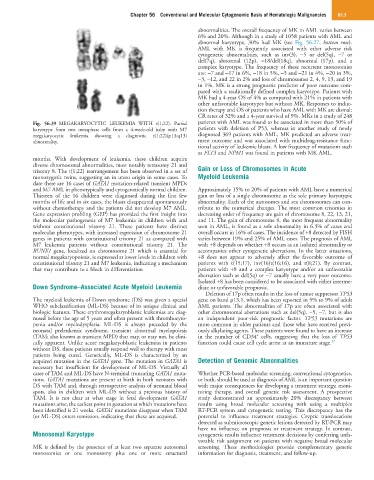
            Fig.  56.39  MEGAKARYOCYTIC  LEUKEMIA  WITH  t(1;22).  Partial   patients with AML was found to be associated in more than 50% of
            karyotype  from  two  metaphase  cells  from  a  4-week-old  baby  with  M7   patients  with  deletion  of  P53,  whereas  in  another  study  of  newly
            megakaryocytic  leukemia  showing  a  diagnostic  t(1;22)(p13;q13)   diagnosed 369 patients with AML, MK predicted an adverse treat-
            abnormality.                                          ment  outcome  and  was  associated  with  multidrug-resistance  func-
                                                                  tional activity of leukemic blasts. A low frequency of mutations such
                                                                  as FLT3 and NPM1 was found in patients with MK AML.
            months.  With  development  of  leukemia,  these  children  acquire
            diverse chromosomal abnormalities, most notably tetrasomy 21 and
            trisomy 8. The t(1;22) rearrangement has been observed in a set of   Gain or Loss of Chromosomes in Acute
            monozygotic twins, suggesting an in utero origin in some cases. To   Myeloid Leukemia
            date there are 16 cases of GATA1 mutation-related transient MPDs
            and M7 AML in phenotypically and cytogenetically normal children.   Approximately 15% to 20% of patients with AML have a numerical
            Thirteen  of  the  16  children  were  diagnosed  during  the  first  few   gain or loss of a single chromosome as the sole primary karyotypic
            months of life and in six cases, the blasts disappeared spontaneously   abnormality. Each of the autosomes and sex chromosomes can con-
            without chemotherapy and the patients did not develop M7 AML.   tribute  to  the  numerical  changes. The  most  common  trisomies  in
            Gene expression profiling (GEP) has provided the first insight into   decreasing order of frequency are gain of chromosome 8, 22, 13, 21,
            the  molecular  pathogenesis  of  M7  leukemia  in  children  with  and   and 11. The gain of chromosome 8, the most frequent abnormality
            without  constitutional  trisomy  21.  These  patients  have  distinct   seen in AML, is found as a sole abnormality in 6.3% of cases and
            molecular phenotypes, with increased expression of chromosome 21   overall occurs in 16% of cases. The incidence of +8 detected by FISH
            genes in patients with constitutional trisomy 21 as compared with   varies between 19% and 25% of AML cases. The prognosis of AML
            M7  leukemia  patients  without  constitutional  trisomy  21.  The   with +8 depends on whether +8 occurs as an isolated abnormality or
            RUNX1  gene,  localized  on  chromosome  21  which  is  essential  for   accompanies other cytogenetic aberrations. In the latter situations,
            normal megakaryopoiesis, is expressed at lower levels in children with   +8  does  not  appear  to  adversely  affect  the  favorable  outcome  of
            constitutional trisomy 21 and M7 leukemia, indicating a mechanism   patients  with  t(15;17),  inv(16)t(16;16),  and  t(8;21).  By  contrast,
            that may contribute to a block in differentiation     patients  with  +8  and  a  complex  karyotype  and/or  an  unfavorable
                                                                  aberration such as del(5q) or −7 usually have a very poor outcome.
                                                                  Isolated +8 has been considered to be associated with either interme-
            Down Syndrome–Associated Acute Myeloid Leukemia       diate or unfavorable prognosis.
                                                                    Deletion of 17p often results in the loss of tumor suppressor TP53
            The myeloid leukemia of Down syndrome (DS) was given a special   gene on band p13.1, which has been reported in 5% to 9% of adult
            WHO subclassification (ML-DS) because of its unique clinical and   AML patients. The abnormalities of 17p are often associated with
            biologic features. These erythromegakaryoblastic leukemias are diag-  other chromosomal aberrations such as del(5q), −5, −7, but is also
            nosed before the age of 5 years and often present with thrombocyto-  an  independent  poor-risk  prognostic  factor.  TP53  mutations  are
            penia  and/or  myelodysplasia.  ML-DS  is  always  preceded  by  the   more common in older patients and those who have received previ-
            neonatal  preleukemic  syndrome,  transient  abnormal  myelopoiesis   ously alkylating agents. These patients were found to have an increase
                                                                                     +
            (TAM; also known as transient MPD) that may, or may not, be clini-  in  the  number  of  CD34   cells,  suggesting  that  the  loss  of  TP53
            cally apparent. Unlike acute megakaryoblastic leukemias in patients   function could cause cell cycle arrest at an immature stage. 17
            without DS, these patients usually respond well to therapy with most
            patients  being  cured.  Genetically,  ML-DS  is  characterized  by  an
            acquired mutation in the GATA1 gene. The mutation in GATA1 is   Detection of Genomic Abnormalities
            necessary but insufficient for development of ML-DS. Virtually all
            cases of TAM and ML-DS have N-terminal truncating GATA1 muta-  Whether PCR-based molecular screening, conventional cytogenetics,
            tions. GATA1 mutations are present at birth in both neonates with   or both, should be used at diagnosis of AML is an important question
            DS with TAM and, through retrospective analysis of neonatal blood   with major consequences for developing a treatment strategy, moni-
            spots,  also  in  children  with  ML-DS  without  a  previous  history  of   toring  therapy,  and  overall  genetic  risk  assessment.  A  prospective
            TAM.  It  is  not  clear  at  what  stage  in  fetal  development  GATA1   study  demonstrated  an  approximately  20%  discrepancy  between
            mutations arise; the earliest point in gestation at which mutations have   results  using  broad  molecular  screening  with  using  a  multiplex
            been identified is 21 weeks. GATA1 mutations disappear when TAM   RT-PCR  system  and  cytogenetic  testing. This  discrepancy  has  the
            (or ML-DS) enters remission, indicating that these are acquired.  potential  to  influence  treatment  strategies.  Cryptic  translocations
                                                                  detected as submicroscopic genetic lesions detected by RT-PCR may
                                                                  have  no  influence  on  prognosis  or  treatment  strategy.  In  contrast,
            Monosomal Karyotype                                   cytogenetic results influence treatment decisions by conferring unfa-
                                                                  vorable risk assignment on patients with negative broad molecular
            MK  is  defined  by  the  presence  of  at  least  two  separate  autosomal   screening.  These  methodologies  provide  complementary  genetic
            monosomies  or  one  monosomy  plus  one  or  more  structural   information for diagnosis, treatment, and follow-up.

