


Page 929 - Hematology_ Basic Principles and Practice ( PDFDrive )
P. 929
812    Part VII  Hematologic Malignancies


                                                              NPM1/MLF1 chimeric gene, which includes approximately half of
                                                              the 24-kb NPM1 gene, localized on 5q35, extending from exons 1–6,
                                                              juxtaposed  to  virtually  the  entire  35-kb  MLF1  gene,  localized  on
                                                              3q25, starting at exon 2. The chimeric NPM1/MLF1 fusion protein
                                                              totals 426 amino acids with 175 amino acids from NPM1 fused to
                                                              251  amino  acids  from  MLF1,  which  excludes  only  the  initial  16
                                                              amino acids from MLF1 in this chimeric protein. In approximately
                                                              88% of patients with t(3;5) the translocation results in NPM1/MLF1
                                                              fusion. In some patients with balanced t(3;5) the fusion is not appar-
                                                              ent because of the variant 3;5 translocations that may include multiple
                                                              genes at 3q21–25 and 5q31–35.
                                                                 The presence of a hyperdiploid karyotype in acute erythroleuke-
                                                              mia occurs in 47% to 56% of patients, along with a loss of genetic
                                                              material in chromosomes 5, 7, and 18. A monosomal karyotype was
                                                              identified in 43% of cases in one series. Balanced translocations are
                                                              rare in erythroleukemia, although rare cases of MLL rearrangements
                                                              have been reported. The frequent occurrence of a complex karyotype
                                                              with abnormalities of chromosomes 5 and 7 may be one reason for
                                                              the poor prognosis associated with acute erythroleukemia. Mutations
                                                              frequently seen in other subgroups of AML (such as FLT3, KIT or
                                                              RAS mutations) have not been reported in acute erythroleukemia. In
                           t(6;9)(p23.3;q34.1)                pediatric patients, acute erythroleukemia is very rare, present in 2.3%
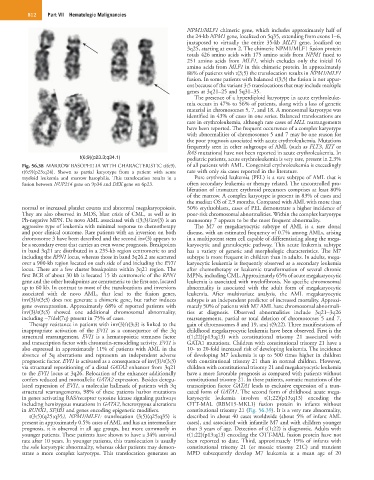
        Fig. 56.38  MARROW BASOPHILIA WITH CHARACTERISTIC t(6;9).   of all patients with AML. Congenital erythroleukemia is exceedingly
        t(6;9)(p23;q24).  Shown  as  partial  karyotype  from  a  patient  with  acute   rare with only six cases reported in the literature.
        myeloid  leukemia  and  marrow  basophilia.  This  translocation  results  in  a   Pure erythroid leukemia (PEL) is a rare subtype of AML that is
        fusion between NUP214 gene on 9p34 and DEK gene on 6p23.   often secondary leukemia or therapy related. The uncontrolled pro-
                                                              liferation of immature erythroid precursors comprises at least 80%
                                                              of the marrow. A complex karyotype is present in 83% of cases and
                                                              the median OS of 2.9 months. Compared with AML with more than
        normal or increased platelet counts and abnormal megakaryopoiesis.   50% erythroblasts, cases of PEL demonstrate a higher incidence of
        They are also observed in MDS, blast crisis of CML, as well as in   poor-risk chromosomal abnormalities. Within the complex karyotype
        Ph-negative MPN. De novo AML associated with t(3;3)/inv(3) is an   monosomy 7 appears to be the most frequent abnormality.
        aggressive type of leukemia with minimal response to chemotherapy   The  M7  or  megakaryocytic  subtype  of  AML  is  a  rare  clonal
        and poor clinical outcome. Rare patients with an inversion on both   disease, with an estimated frequency of 0.7% among AMLs, arising
        chromosome 3 have been described and the second inv(3) appears to   in a multipotent stem cell capable of differentiating along the mega-
        be a secondary event that carries an even worse prognosis. Breakpoints   karyocytic and granulocytic pathway. This acute leukemia subtype
        in band 3q21 are distributed in a 235-kb region centromeric to and   has  a  variety  of  genetic  and  morphologic  characteristics. The  M7
        including the RPN1 locus, whereas those in band 3q26.2 are scattered   subtype is more frequent in children than in adults. In adults, mega-
        over a 900-kb region located on each side of and including the EVI1   karyocytic leukemia is frequently observed as a secondary leukemia
        locus. There are a few cluster breakpoints within 3q21 region. The   after  chemotherapy  or  leukemic  transformation  of  several  chronic
        first BCR of about 30 kb is located 15 kb centromeric of the RPN1   MPNs, including CML. Approximately 65% of acute megakaryocytic
        gene and the other breakpoints are centromeric to the first one, located   leukemia is associated with myelofibrosis. No specific chromosomal
        up to 60 kb. In contrast to most of the translocations and inversions   abnormality  is  associated  with  the  adult  form  of  megakaryocytic
        associated  with  de  novo  AML,  that  lead  to  the  fusion  genes,   leukemia.  After  multivariate  analysis,  the  AML  megakaryocytic
        inv(3)/t(3;3) does not generate a chimeric gene, but rather induces   subtype is an independent predictor of increased mortality. Approxi-
        gene  overexpression.  Approximately  68%  of  reported  patients  with   mately 50% of patients with M7 AML have chromosomal abnormali-
        inv(3)/t(3;3)  showed  one  additional  chromosomal  abnormality,   ties  at  diagnosis.  Observed  abnormalities  include  3q21–3q26
        including −7/del(7q) present in 75% of cases.         rearrangements, partial or total deletion of chromosomes 5 and 7,
           Therapy resistance in patients with inv(3)/t(3;3) is linked to the   gain of chromosomes 8 and 19, and t(9;22). Three manifestations of
        inappropriate  activation  of  the  EVI1  as  a  consequence  of  the  3q   childhood megakaryocytic leukemia have been observed. First is the
        structural  rearrangement.  EVI1  is  a  hematopoietic  stemness  factor   t(1;22)(p13;q13)  with  constitutional  trisomy  21  associated  with
        and transcription factor with chromatin-remodeling activity. EVI1 is   GATA1 mutations. Children with constitutional trisomy 21 have a
        also expressed in approximately 11% of patients with AML in the   10- to 20-fold increased risk of developing leukemia. The incidence
        absence  of  3q  aberrations  and  represents  an  independent  adverse   of developing M7 leukemia is up to 500 times higher in children
        prognostic factor. EVI1 is activated as a consequence of inv(3)/t(3;3)   with constitutional trisomy 21 than in normal children. However,
        via structural repositioning of a distal GATA2 enhancer from 3q21   children with constitutional trisomy 21 and megakaryocytic leukemia
        to the EVI1 locus at 3q26. Relocation of the enhancer additionally   have a more favorable prognosis as compared with patients without
        confers reduced and monoallelic GATA2 expression. Besides deregu-  constitutional trisomy 21. In these patients, somatic mutations of the
        lated expression of EVI1, a molecular hallmark of patients with 3q   transcription factor GATA1 leads to exclusive expression of a trun-
        structural rearrangements, 98% of these patients harbor mutations   cated form of GATA1. The second form of childhood acute mega-
        in genes activating RAS/receptor tyrosine kinase signaling pathways   karyocytic  leukemia  involves  t(1;22)(p13;q13)  encoding  the
        including hemizygous mutations in GATA2, heterozygous alterations   OTT-MAL  (RBM15-MKL1)  fusion  protein  in  infants  without
        in RUNX1, SF3B1 and genes encoding epigenetic modifiers.  constitutional trisomy 21 (Fig. 56.39). It is a very rare abnormality,
           t(3;5)(q25;q35),  NPM1/MLF1:  translocation  (3;5)(q25;q35)  is   described in about 40 cases worldwide (about 5% of infant AML
        present in approximately 0.5% cases of AML and has an intermediate   cases), and associated with infantile M7 and with children younger
        prognosis, it is observed in all age groups, but more commonly in   than 3 years of age. Detection of t(1;22) is diagnostic. Adults with
        younger patients. These patients have shown to have a 34% survival   t(1;22)(p13;q13) encoding the OTT-MAL fusion protein have not
        rate after 10 years. In younger patients, this translocation is usually   been  reported  to  date. Third,  approximately  19%  of  infants  with
        the sole karyotypic abnormality, whereas older patients may demon-  constitutional  trisomy  21  (or  mosaic  trisomy  21C)  and  transient
        strate  a  more  complex  karyotype.  This  translocation  generates  an   MPD  subsequently  develop  M7  leukemia  at  a  mean  age  of  20

