


Page 933 - Hematology_ Basic Principles and Practice ( PDFDrive )
P. 933
816    Part VII  Hematologic Malignancies


                                                             MLL–ENL
                                                        TLX1  0.3%
                                                        0.3%
                                                    LYL1         ETP 2%
                                                    1.4%
                                                                    Others (T-ALL)
                                                  TLX3
                            Others (B–ALL)        2.3%              1.7%
                                   4.5%       TAL1                      MYCt(8;14), t(2;8), t(8,22)
                             TCF3–HLF           7%                      2%
                                 0.5%
                                                                              ETV6–RUNX1
                                Hypodiploid  44                               20%
                                         1%
                              MLL–AFF1
                                    2%       Other MLL
                                       rearragements 4%                          Hyperdiploid  50
                                                                                 25%
                                               iAMP21
                                                  2%
                                               dic(9;20)               TCF3–PBX1
                                                                       4%
                                                   2%
                                                                BCR–ABL 1–like
                                                    ERG         9%
                                                     4%
                                                    CRLF2
                                                      4%
                                                 BCR–ABL 1
                                                        2%
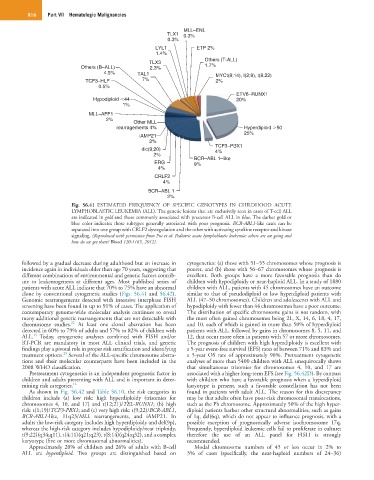
                        Fig.  56.41  ESTIMATED  FREQUENCY  OF  SPECIFIC  GENOTYPES  IN  CHILDHOOD  ACUTE
                        LYMPHOBLASTIC LEUKEMIA (ALL). The genetic lesions that are exclusively seen in cases of T-cell ALL
                        are indicated in gold and those commonly associated with precursor B-cell ALL in blue. The darker gold or
                        blue  color indicates those  subtypes  generally associated with  poor  prognosis. BCR-ABL1-like  cases  can be
                        separated into one group with CRLF2 dysregulation and the other with activating cytokine receptor and kinase
                        signaling. (Reproduced with permission from Pui et al: Pediatric acute lymphoblastic leukemia: where are we going and
                        how do we get there? Blood 120:1165, 2012).


        followed by a gradual decrease during adulthood but an increase in   cytogenetics: (a) those with 51–55 chromosomes whose prognosis is
        incidence again in individuals older than age 70 years, suggesting that   poorer, and (b) those with 56–67 chromosomes whose prognosis is
        different combinations of environmental and genetic factors contrib-  excellent.  Both  groups  have  a  more  favorable  prognosis  than  do
        ute  to  leukemogenesis  at  different  ages.  Most  published  series  of   children with hypodiploidy or near-haploid ALL. In a study of 1880
        patients with acute ALL indicate that 70% to 75% have an abnormal   children with ALL, patients with 45 chromosomes have an outcome
        clone by conventional cytogenetic studies (Figs. 56.41 and 56.42).   similar to that of pseudodiploid or low hyperdiploid patients with
        Genomic  rearrangements  detected  with  intensive  interphase  FISH   ALL (47–50 chromosomes). Children and adolescents with ALL and
        screening have been found in up to 91% of cases. The application of   hypodiploidy with fewer than 44 chromosomes have a poor outcome.
        contemporary  genome-wide  molecular  analysis  continues  to  reveal   The distribution of specific chromosome gains is not random, with
        many additional genetic rearrangements that are not detectable with   the most often gained chromosomes being 21, X, 14, 6, 18, 4, 17,
                        22
        chromosome  studies.   At  least  one  clonal  aberration  has  been   and 10, each of which is gained in more than 50% of hyperdiploid
        detected in 60% to 79% of adults and 57% to 82% of children with   patients with ALL, followed by gains in chromosomes 8, 5, 11, and
            15
        ALL.   Today,  cytogenetic  analyses  combined  with  FISH  and/or   12, that occur more often in patients with 57 or more chromosomes.
        RT-PCR  are  mandatory  in  most  ALL  clinical  trials,  and  genetic   The prognosis of children with high hyperdiploidy is excellent with
        findings play a pivotal role in proper risk stratification and identifying   a 5-year event-free survival (EFS) rates of between 71% and 83% and
                      23
        treatment options.  Several of the ALL-specific chromosome aberra-  a  5-year  OS  rate  of  approximately  90%.  Pretreatment  cytogenetic
        tions  and  their  molecular  counterparts  have  been  included  in  the   analyses of more than 5400 children with ALL unequivocally shows
        2008 WHO classification.                              that  simultaneous  trisomies  for  chromosomes  4,  10,  and  17  are
           Pretreatment cytogenetics is an independent prognostic factor in   associated with a higher long-term EFS (see Fig. 56.42D). By contrast
        children and adults presenting with ALL and is important in deter-  with children who have a favorable prognosis when a hyperdiploid
        mining risk categories. 16                            karyotype  is  present,  such  a  favorable  constellation  has  not  been
           As shown in Fig. 56.42 and Table 56.10, the risk categories in   found in patients with adult ALL. The reason for this discrepancy
        children  include  (a)  low  risk:  high  hyperdiploidy  (trisomies  for   may be that adults often have poor-risk chromosomal translocations,
        chromosomes 4, 10, and 17) and t(12;21)/TEL-RUNX1; (b) high   such as the Ph chromosome. Approximately 50% of the high hyper-
        risk: t(1;19)/TCF3-PBX1; and (c) very high risk: t(9;22)/BCR-ABL1,   diploid patients harbor other structural abnormalities, such as gains
        BCR-ABL1-like,  11q23/MLL  rearrangements,  and  iAMP21.  In   of 1q, del(6q), which do not appear to influence prognosis, with a
        adults the low-risk category includes high hyperdiploidy and del(9p),   possible  exception  of  prognostically  adverse  isochromosome  17q.
        whereas the high-risk category includes hypodiploidy/near triploidy,   Frequently, hyperdiploid leukemic cells fail to proliferate in culture;
        t(9;22)(q34;q11), t(4;11)(q21;q23), t(8;14)(q24;q32), and a complex   therefore  the  use  of  an  ALL  panel  for  FISH  is  strongly
        karyotype (five or more chromosomal abnormalities).   recommended.
           Approximately 20% of children and 26% of adults with B-cell   Modal  chromosome  numbers  of  45  or  less  occur  in  2%  to
        ALL  are  hyperdiploid.  Two  groups  are  distinguished  based  on   3%  of  cases  (specifically,  the  near-haploid  numbers  of  24–36)

