


Page 934 - Hematology_ Basic Principles and Practice ( PDFDrive )
P. 934
Chapter 56  Conventional and Molecular Cytogenomic Basis of Hematologic Malignancies  817


                                                                                                       Low risk


              A                   B                 C                    D


                                                                                                       High risk


              E


                                                                                                     Very high risk


              F                     G               H
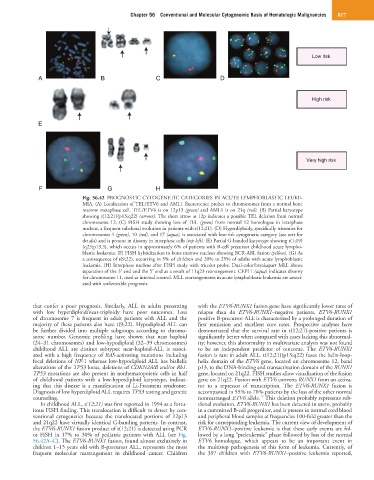
                            Fig. 56.42  PROGNOSTIC CYTOGENETIC CATEGORIES IN ACUTE LYMPHOBLASTIC LEUKE-
                            MIA. (A) Localization of TEL/ETV6 and AML1 fluorescence probes to chromosomes from a normal bone
                            marrow metaphase cell. TEL/ETV6 is on 12p13 (green) and AML1 is on 21q (red). (B) Partial karyotype
                            showing t(12;21)(p13;q22) (arrows). The short arrow at 12p indicates a possible TEL deletion from normal
                            chromosome  12.  (C)  FISH  study  showing  loss  of TEL  (green)  from  normal  12  homologue  in  interphase
                            nucleus, a frequent subclonal evolution in patients with t(12;21). (D) Hyperdiploidy, specifically trisomies for
                            chromosomes 4 (green), 10 (red), and 17 (aqua), is associated with low-risk cytogenetic category (see text for
                            details) and is present in disomy in interphase cells (top left). (E) Partial G-banded karyotype showing t(1;19)
                            (q23;p13.3), which occurs in approximately 6% of patients with B-cell precursor childhood acute lympho-
                            blastic leukemia. (F) FISH hybridization to bone marrow nucleus showing BCR-ABL fusion (yellow). (G) As
                            a consequence of t(9;22), occurring in 5% of children and 20% to 25% of adults with acute lymphoblastic
                            leukemia. (H) Interphase nucleus after FISH study with tricolor probe. Dual-color/breakapart MLL shows
                            separation of the 3′ end and the 5′ end as a result of 11q23 rearrangement. CEP11 (aqua) indicates disomy
                            for chromosome 11, used as internal control. MLL rearrangements in acute lymphoblastic leukemia are associ-
                            ated with unfavorable prognosis.


            that  confer  a  poor  prognosis.  Similarly,  ALL  in  adults  presenting   with the ETV6-RUNX1 fusion gene have significantly lower rates of
            with  low  hyperdiploid/near-triploidy  have  poor  outcomes.  Loss   relapse  than  do  ETV6-RUNX1–negative  patients.  ETV6-RUNX1
            of  chromosome  7  is  frequent  in  adult  patients  with  ALL  and  the   positive B-precursor ALL is characterized by a prolonged duration of
            majority of these patients also have t(9;22). Hypodiploid ALL can   first  remission  and  excellent  cure  rates.  Prospective  analyses  have
            be  further  divided  into  multiple  subgroups  according  to  chromo-  demonstrated  that  the  survival  rate  in  t(12;21)-positive  patients  is
            some  number.  Genomic  profiling  have  shown  that  near  haploid   significantly better when compared with cases lacking this abnormal-
            (24–31 chromosomes) and low-hypodiploid (32–39 chromosomes)   ity; however, this abnormality in multivariate analysis was not found
            childhood  ALL  are  distinct  subtypes:  near-haploid-ALL  is  associ-  to  be  an  independent  predictor  of  outcome.  The  ETV6-RUNX1
            ated with a high frequency of  RAS-activating mutations  including   fusion is rare in adult ALL. t(12;21)(p13;q22) fuses the helix-loop-
            focal deletions of NF-1 whereas low-hypodiploid ALL has biallelic   helix domain of the ETV6 gene, located on chromosome 12, band
            alterations of the TP53 locus, deletions of CDKN2A/B and/or Rb1.   p13, to the DNA-binding and transactivation domain of the RUNX1
            TP53 mutations are also present in nonhematopoietic cells in half   gene, located on 21q22. FISH studies allow visualization of the fusion
            of  childhood  patients  with  a  low-hyperdiploid  karyotype,  indicat-  gene on 21q22. Fusion with ETV6 converts RUNX1 from an activa-
            ing  that  this  disease  is  a  manifestation  of  Li-Fraumeni  syndrome.   tor  to  a  repressor  of  transcription.  The  ETV6-RUNX1  fusion  is
            Diagnosis of low hyperdiploid ALL requires TP53 testing and genetic   accompanied in 55% to 70% patients by the loss of the other normal
                                                                                      17
            counseling.                                           nonrearranged ETV6 allele.  This deletion probably represents sub-
              In childhood ALL, t(12;21) was first reported in 1994 as a fortu-  clonal evolution. ETV6-RUNX1 has been detected in utero, probably
            itous FISH finding. This translocation is difficult to detect by con-  in a committed B-cell progenitor, and is present in normal cord blood
            ventional  cytogenetics  because  the  translocated  portions  of  12p13   and peripheral blood samples at frequencies 100-fold greater than the
            and 21q22 have virtually identical G-banding patterns. In contrast,   risk for corresponding leukemia. The current view of development of
            the ETV6-RUNX1 fusion product of t(12;21) is detected using PCR   ETV6-RUNX1–positive leukemia is that these early events are fol-
            or FISH in 17% to 30% of pediatric patients with ALL (see Fig.   lowed by a long “preleukemic” phase followed by loss of the normal
            56.42A–C). The ETV6-RUNX1 fusion, found almost exclusively in   ETV6  homologue,  which  appears  to  be  an  important  event  in
            children 1–15 years old with B-precursor ALL, represents the most   the multistep pathogenesis of this form of leukemia. Currently, of
            frequent  molecular  rearrangement  in  childhood  cancer.  Children   the  397  children  with  ETV6-RUNX1–positive  leukemia  reported,

