


Page 1077 - Williams Hematology ( PDFDrive )
P. 1077
1052           Part VIII:  Monocytes and Macrophages                                                                                   Chapter 67:  Structure, Receptors, and Functions of Monocytes and Macrophages             1053


                                                                                 26
                   The most constant and characteristic ultrastructural features of   differentiation,   activation,  recognition,  migration,  and  function
               macrophages are the electron-dense membrane-bound lysosomes that   of the monocyte/macrophage. Monocytes have been classified into
               often can be seen fusing with phagosomes to form secondary lysosomes.   distinct subtypes based on surface expression of CD14 and CD16,
               Within the secondary lysosomes, ingested cellular, bacterial, and non-  molecules that form part of the lipopolysaccharide (LPS) toll-like
               cellular material can be seen in various stages of degradation, often   receptor (TLR) and one of the  immunoglobulin FcRs, respectively.
               recognizable as degenerating mitochondria or nuclear material. These   These include CD14+-bright/CD16– monocytes, CD14+-dim/CD16+
               secondary lysosomes also contain partially degraded material from the   monocytes, and CD14-dim/CD16+ monocytes. Monocyte hetero-
               late stages of the endocytic process, often appearing as multilamellar   geneity was initially divided into the CD14+-bright/CD16-negative
               lipid bodies. Microtubules and microfilaments are prominent in macro-  cells, which comprise 90 to 95 percent of total circulating monocytes
                                                                                     27
               phages. Actin- and myosin-like proteins have been isolated from mono-  (classical monocyte) —CD14-bright or dim refer to the fluorescence
               cytes and partially characterized. Resting macrophages have irregular   magnitude of staining using a specific CD14 monoclonal antibody.
               cell borders and pseudopodia pushed out in all directions. Their cyto-  The minor subset is CD14-dim, CD16-positive, and less phagocytic
               plasm has rough endoplasmic reticulum and Golgi complex in the per-  than the classical monocyte. The classical monocyte produces reactive
               inuclear area. Lipid globules, primary lysosomes, and mitochondria are   oxygen species (ROS) and cytokines in response to TLR engagement.
               characteristically prominent. Activated monocytes/macrophages are   The minor subset selectively secretes tumor necrosis factor (TNF)-α,
               motile cells that extend a leading pseudopod as they move forward. 25  IL-13, and CCL2 in response to viruses and immune complexes con-
                                                                      taining nucleic acids via TLR-7, TLR-8, MyD88-MEK (myeloid dif-
                                                                                                          28
                                                                      ferentiation factor 88–MAPK kinase), and AHD.  This minor subset,
                    RECEPTORS                                         CD14-dim,  is competent in (SR [scavenger receptor]) function of
                                                                              29
                                                                      vascular,  intraluminal  debris  and  uptake  of  immune  complexes.
                                                                                                                        30
               MEMBRANE RECEPTORS AND OTHER                           In addition, their phenotype is related to the ability to produce and
               SURFACE PROTEINS OF MONOCYTES                          secrete select cytokines. 31
                                                                          Macrophages are proficient at endocytosis (both fluid phase and
               AND MACROPHAGES                                        receptor-mediated) and are highly professional phagocytes of particu-
               Monocyte/macrophage cells have surface receptors that have been   lates of all origin, organic (cellular, microbial) as well as inorganic for-
               characterized by their binding to specific monoclonal antibod-  eign materials.  In contrast, when dendritic cells (DCs) mature into
                                                                                 32
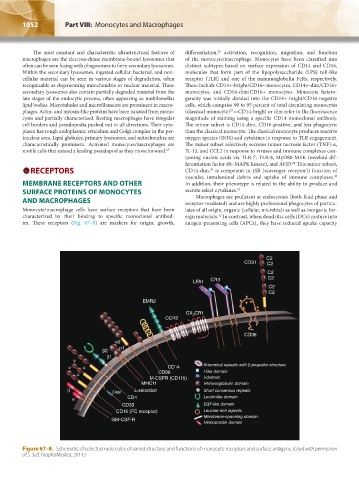
               ies. These receptors (Fig. 67–8) are markers for origin, growth,   antigen-presenting cells (APCs), they have reduced uptake capacity


                                                                                                 C2
                                                                                          CD31   C2
                                                                                                  C2
                                                                         LFA1  CR3                C2
                                                                                                  C2
                                                                                                  C2
                                                        EMR2
                                                                         CR1
                                                                      CX 3
                                                               CCR2

                                                                                          CD36
                                              α2
                                                α1
                                          β2
                                            β1
                                v
                               v    c                           CD14        N-terminal repeats with β-propeller structure
                                  c                          CD86           I-like domain
                                                          M-CSFR (CD115)    I-domain
                                                       MHC11                Immunoglobulin domain
                              β              ITAM    L-selection            Short concensus repeats
                                α                  CD4                      Lectin-like domain
                                                 CD33                       EGF-like domain
                                               CD16 (FC receptor)           Leucine-rich repeats
                                                                            Membrane-spanning domain
                                             GM-CSF-R
                                                                            Hemopoeitin domain


               Figure 67–8.  Schematic of selected molecules of varied structure and functions of monocyte receptors and surface antigens. (Used with permission
               of S. Seif, GraphisMedica, 2014.)


          Kaushansky_chapter 67_p1043-1074.indd   1052                                                                  9/21/15   10:43 AM

