


Page 1096 - Williams Hematology ( PDFDrive )
P. 1096
1070  Part VIII:  Monocytes and Macrophages  Chapter 67:  Structure, Receptors, and Functions of Monocytes and Macrophages  1071


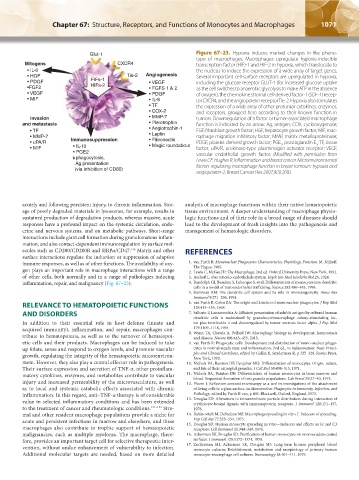
                                        Glut-1                              Figure 67–23.  Hypoxia induces marked changes in the pheno-
                                                                            type of macrophages. Macrophages upregulate hypoxia-inducible
                   Mitogens                       CXCR4                     transcription factor (HIF)-1 and HIF-2 in hypoxia, which translocate to
                   • IL-6                                                   the nucleus to induce the expression of a wide array of target genes.
                   • HGF                             Tie-2  Angiogenesis    Several important cell-surface receptors are upregulated in hypoxia,
                   • PDGF                FIFs-1             • VEGF          including the glucose receptor GLUT-1 (for increased glucose uptake
                   •FGF2                 HIFs-2             • FGFS 1 & 2    as the cell switches to anaerobic glycolysis to make ATP in the absence
                   • VEGF                                   • PDGF          of oxygen), the chemokine stromal cell-derived factor-1 (SDF-1) recep-
                   • MIF                                    • IL-8          tor CXCR4, and the angiopoietin receptor Tie-2. Hypoxia also stimulates
                                                            • TF            the expression of a wide array of other protumor cytokines, enzymes,
                                                            • COX-2         and receptors, grouped here according to their known function in
                    Invasion                                • MMP-7         tumors. Downregulation of a factor or tumor-associated macrophage
                  and metastasis                            • Pleiotrophin  function is indicated by an arrow. Ag, antigen; COX, cyclooxygenase;
                    • TF                                    • Angiotrophin-1  FGF, fibroblast growth factor; HGF, hepatocyte growth factor; MIF, mac-
                                                            • Leptin
                    • MMP-7                                                 rophage migration inhibitory factor; MMP, matrix metalloproteinase;
                    • uPA/R       Immunosuppression         • Fibronectin   PDGF, platelet-derived growth factor; PGE , prostaglandin E ; TF, tissue
                                                                                                                    2
                                                                                                        2
                    • MIF          • IL-10                  • Magic roundabout  factor; uPA/R, urokinase-type plasminogen activator receptor; VEGF,
                                   • PGE2                                   vascular endothelial growth factor. (Modified with permission from
                                     phagocytosis,                          Lewis CE, Hughes R: Inflammation and breast cancer. Microenvironmental
                                     Ag presentation                        factors regulating macrophage function in breast tumours: hypoxia and
                                    (via inhibition of CD80)
                                                                            angiopoietin-2. Breast Cancer Res 2007;9(3):209.)


                  acutely and following persistent injury, to chronic inflammation. Stor-  analysis of macrophage functions within their native hematopoietic
                  age of poorly degraded materials in lysosomes, for example, results in   tissue environment. A deeper understanding of macrophage physio-
                  sustained production of degradation products, whereas massive, acute   logic functions and of their role in a broad range of diseases should
                  responses have a profound impact on the systemic circulation, endo-  lead to the development of fresh insights into the pathogenesis and
                  crine  and  nervous  systems,  and  on  metabolic  pathways.  Short-range   management of hematologic disorders.
                  interactions include giant cell formation during granulomatous inflam-
                  mation, and also contact-dependent immunoregulation by surface mol-
                                                      140
                  ecules such as CD200/CD200R and SIRPα/CD47.  Matrix and other   REFERENCES
                  surface interactions regulate the induction or suppression of adaptive
                  immune responses, as well as of other functions. The availability of oxy-    1.  van Furth R: Mononuclear Phagocytes: Characteristics, Physiology, Function. M. Nijhoff,
                                                                           The Hague, 1985.
                  gen plays an important role in macrophage interactions with a range     2.  Lewis C, McGee JD: The Macrophage, 2nd ed. Oxford University Press, New York, 1992.
                  of other cells, both normally and in a range of pathologies inducing     3.  Aschoff L: Das reticulo-endotheliale system. Ergeb Inn Med Kinderheilkd 26, 1924.
                  inflammation, repair, and malignancy (Fig. 67–23).      4.  Randolph GJ, Beaulieu S, Lebecque S, et al: Differentiation of monocytes into dendritic
                                                                           cells in a model of transendothelial trafficking. Science 282:480–483, 1998.
                                                                          5.  Steinman RM: The dendritic cell system and its role in immunogenicity. Annu Rev
                                                                           Immunol 9:271–296, 1991.
                  RELEVANCE TO HEMATOPOIETIC FUNCTIONS                    6.  van Furth R, Cohn ZA: The origin and kinetics of mononuclear phagocytes. J Exp Med
                                                                           128:415–435, 1968.
                  AND DISORDERS                                           7.  Sallusto F, Lanzavecchia A: Efficient presentation of soluble antigen by cultured human
                                                                           dendritic cells is maintained by granulocyte/macrophage colony-stimulating fac-
                  In addition  to their essential role  in host defense (innate and   tor plus interleukin 4 and downregulated by tumor necrosis factor alpha. J Exp Med
                  acquired immunity), inflammation, and repair, macrophages con-  179:1109–1118, 1994.
                  tribute to hematopoiesis, as well as to the turnover of hematopoi-    8.  Wynn TA, Chawla A, Pollard JW: Macrophage biology in development, homeostasis
                                                                           and disease. Nature 496:445–455, 2013.
                  etic cells and their products. Macrophages can be induced to take     9.  van Furth R: Phagocytic cells: Development and distribution of mono-nuclear phago-
                  up folate, sense and respond to oxygen levels, and promote vascular   cytes in normal steady state and inflammation, 2nd ed., in Inflammation: Basic Princi-
                  growth, regulating the integrity of the hematopoietic microenviron-  ples and Clinical Correlates, edited by Gallin JI, Snyderman R, p 325–329. Raven Press,
                                                                           New York, 1992.
                  ment. However, they also play a central effector role in pathogenesis.     10.  Nichols BA, Bainton DF, Farquhar MG: Differentiation of monocytes. Origin, nature,
                  Their surface expression and secretion of TNF-α, other proinflam-  and fate of their azurophil granules. J Cell Biol 50:498–515, 1971.
                  matory cytokines, enzymes, and metabolites contribute to vascular     11.  Nichols BA, Bainton DF: Differentiation of human monocytes in bone marrow and
                                                                           blood. Sequential formation of two granule populations. Lab Invest 29:27–40, 1973.
                  injury and increased permeability of the microvasculature, as well     12.  Ploem J: Reflection contrast microscopy as a tool in investigations of the attachment
                  as  to  local and  systemic  catabolic  effects associated with  chronic   of living cells to a glass surface, in Mononuclear Phagocytes in Immunity, Infection, and
                  inflammation. In this regard, anti–TNF-α therapy is of considerable   Pathology, edited by Furth R van, p 405. Blackwell, Oxford, England, 1975.
                  value in selected inflammatory conditions and has been extended     13.  Douglas SD: Alterations in intramembrane particle distribution during interaction of
                                                                           erythrocyte-bound ligands with immunoprotein receptors.  J Immunol 120:151–157,
                  to the treatment of cancer and rheumatologic conditions. 141–144  Stro-  1978.
                  mal and other resident macrophage populations provide a niche for     14.  Rabinovitch M, DeStefano MJ: Macrophage spreading in vitro. I. Inducers of spreading.
                  acute and persistent infections in marrow and elsewhere, and these   Exp Cell Res 77:323–334, 1973.
                  macrophages  also  contribute  to  trophic support  of  hematopoietic     15.  Douglas SD: Human monocyte spreading in vitro—Inducers and effects on Fc and C3
                                                                           receptors. Cell Immunol 21:344–349, 1976.
                  malignancies, such as multiple myeloma. The macrophage, there-    16.  Ackerman SK, Douglas SD: Purification of human monocytes on microexudate-coated
                  fore, provides an important target cell for selective therapeutic inter-  surfaces. J Immunol 120:1372–1374, 1978.
                  vention, without undue enhancement of vulnerability to infection.     17.  Zuckerman SH, Ackerman SK, Douglas SD: Long-term human peripheral blood
                                                                           monocyte  cultures:  Establishment,  metabolism  and  morphology  of  primary  human
                  Additional molecular targets are needed, based on more detailed   monocyte-macrophage cell cultures. Immunology 38:401–411, 1979.


          Kaushansky_chapter 67_p1043-1074.indd   1071                                                                  9/21/15   10:44 AM

