


Page 1101 - Williams Hematology ( PDFDrive )
P. 1101
1076           Part VIII:  Monocytes and Macrophages                                                                               Chapter 68:  Production, Distribution, and Activation of Monocytes and Macrophages            1077


               macrophages in marrow erythropoietic islands is poorly understood, as   development, both in hematopoiesis and in extravascular tissues, and
               is the considerable role of macrophages in iron and heme metabolism.   much remains to be learned regarding their properties in the fetus.
               Macrophages interact with cells in numerous ways; however, during
               erythropoiesis a special phagocytic process allows for the removal of   Growth, Differentiation, and Turnover
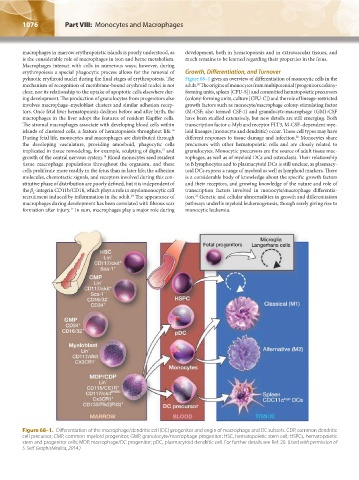
               pyknotic erythroid nuclei during the final stages of erythropoiesis. The   Figure 68–1 gives an overview of differentiation of monocytic cells in the
               mechanism of recognition of membrane-bound erythroid nuclei is not   adult.  The origins of monocytes from multipotential (progenitors colony-
                                                                          20
               clear, nor its relationship to the uptake of apoptotic cells elsewhere dur-  forming units, spleen [CFU-S]) and committed hematopoietic precursors
               ing development. The production of granulocytes from progenitors also   (colony-forming units, culture [CFU-C]) and the role of lineage-restricted
               involves macrophage–myeloblast clusters and similar adhesion recep-  growth factors such as monocyte/macrophage colony-stimulating factor
               tors. Once fetal liver hematopoiesis declines before and after birth, the   (M-CSF; also termed CSF-1) and granulocyte-macrophage  (GM)-CSF
               macrophages in the liver adopt the features of resident Kupffer cells.   have been studied extensively, but new details are still emerging. Both
               The stromal macrophages associate with developing blood cells within   transcription factor c-Myb and receptor FLT3, M-CSF–dependent mye-
                                                                 16
               islands of clustered cells, a feature of hematopoiesis throughout life.    loid lineages (monocyte and dendritic) occur. These cell types may have
                                                                                                           20
               During fetal life, monocytes and macrophages are distributed through   different responses to tissue damage and infection.  Monocytes share
               the developing vasculature, providing amoeboid, phagocytic cells   precursors with other hematopoietic cells and are closely related to
                                                              17
               implicated in tissue remodeling, for example, sculpting of digits,  and   granulocytes. Monocytic precursors are the source of adult tissue mac-
                                           18
               growth of the central nervous system.  Blood monocytes seed resident   rophages, as well as of myeloid DCs and osteoclasts. Their relationship
               tissue macrophage populations throughout the organism, and these   to B lymphocytes and to plasmacytoid DCs is still unclear, as plasmacy-
               cells proliferate more readily in the fetus than in later life; the adhesion   toid DCs express a range of myeloid as well as lymphoid markers. There
               molecules, chemotactic signals, and receptors involved during this con-  is a considerable body of knowledge about the specific growth factors
               stitutive phase of distribution are poorly defined, but it is independent of   and their receptors, and growing knowledge of the nature and role of
               the β -integrin CD11b/CD18, which plays a role in myelomonocytic cell   transcription factors involved in monocyte/macrophage differentia-
                   2
                                                    19
                                                                         21
               recruitment induced by inflammation in the adult.  The appearance of   tion.  Genetic and cellular abnormalities in growth and differentiation
               macrophages during development has been correlated with fibrous scar   pathways underlie myeloid leukemogenesis, though rarely giving rise to
               formation after injury.  In sum, macrophages play a major role during   monocytic leukemia.
                               17


               Figure 68–1.  Differentiation of the macrophage/dendritic cell (DC) progenitor and origin of macrophage and DC subsets. CDP, common dendritic
               cell precursor; CMP, common myeloid progenitor; GMP, granulocyte/macrophage progenitor; HSC, hematopoietic stem cell; HSPCs, hematopoietic
               stem and progenitor cells; MDP, macrophage/DC progenitor; pDC, plasmacytoid dendritic cell. For further details see Ref. 20. (Used with permission of
               S. Seif, GraphisMedica, 2014.)


          Kaushansky_chapter 68_p1075-1088.indd   1076                                                                  9/17/15   3:41 PM

