


Page 1094 - Williams Hematology ( PDFDrive )
P. 1094
1068  Part VIII:  Monocytes and Macrophages  Chapter 67:  Structure, Receptors, and Functions of Monocytes and Macrophages  1069


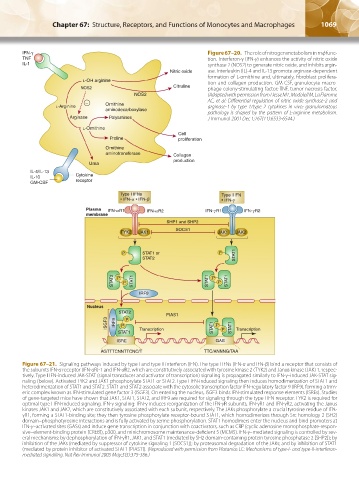
                  IFN-γ                                                         Figure 67–20.  The role of nitrogen metabolism in mф func-
                  TNF                                                           tion. Interferon-γ (IFN-γ) enhances the activity of nitric oxide
                  IL-1                                                          synthase 2 (NOS2) to generate nitric oxide, and inhibits argin-
                                                                   Nitric oxide  ase. Interleukin (IL)-4 and IL-13 promote arginase-dependent
                                                                                formation of L-ornithine and, ultimately, fibroblast prolifera-
                                      L-OH arginine                             tion and collagen production. GM-CSF, granulocyte-macro-
                                     NOS2                           Citruline   phage colony-stimulating factor; TNF, tumor necrosis factor.
                                                       NOS2                     (Adapted with permission from Hesse M1, Modolell M, La Flamme
                                       –      Ornithine                         AC, et al: Differential regulation of nitric oxide synthase-2 and
                             L-Arginine                                         arginase-1 by type 1/type 2 cytokines in vivo: granulomatous
                                              aminodecarboxylase
                                                                                pathology is shaped by the pattern of L-arginine metabolism.
                                  Arginase     Polyamines                       J Immunol 2001 Dec 1;167(11):6533-6544.)
                                      L-Ornithine
                                                                      Cell
                                               Proline                proliferation
                                              Ornithine
                                              aminotransferase      Collagen
                                                                    production
                                        Urea
                    IL-4/IL-13
                    IL-10           Cytokine
                    GM-CSF          receptor


                  Figure 67–21.  Signaling pathways induced by type I and type II interferon (IFN). The type I IFNs (IFN-α and IFN-β) bind a receptor that consists of
                  the subunits IFN-α receptor (IFN-αR)-1 and IFN-αR2, which are constitutively associated with tyrosine kinase 2 (TYK2) and Janus kinase (JAK) 1, respec-
                  tively. Type I IFN-induced JAK-STAT (signal transducer and activator of transcription) signaling is propagated similarly to IFN-γ–induced JAK-STAT sig-
                  naling (below). Activated TYK2 and JAK1 phosphorylate STAT1 or STAT2. Type I IFN-induced signaling then induces homodimerization of STAT1 and
                  heterodimerization of STAT1 and STAT2. STAT1 and STAT2 associate with the cytosolic transcription factor IFN-regulatory factor 9 (IRF9), forming a trim-
                  eric complex known as IFN-stimulated gene factor 3 (ISGF3). On entering the nucleus, ISGF3 binds IFN-stimulated response elements (ISREs). Studies
                  of gene-targeted mice have shown that JAK1, STAT1, STAT2, and IRF9 are required for signaling through the type I IFN receptor. TYK2 is required for
                  optimal type I IFN-induced signaling. IFN-γ signaling: IFN-γ induces reorganization of the IFN-γR subunits, IFN-γR1 and IFN-γR2, activating the Janus
                  kinases JAK1 and JAK2, which are constitutively associated with each subunit, respectively. The JAKs phosphorylate a crucial tyrosine residue of IFN-
                  γR1, forming a STAT1-binding site; they then tyrosine phosphorylate receptor-bound STAT1, which homodimerizes through Src homology 2 (SH2)
                  domain–phosphotyrosine interactions and is fully activated by serine phosphorylation. STAT1 homodimers enter the nucleus and bind promoters at
                  IFN-γ–activated sites (GASs) and induce gene transcription in conjunction with coactivators, such as CBP (cyclic adenosine monophosphate-respon-
                  sive–element-binding protein [CREB]), p300, and minichromosome maintenance-deficient 5 (MCM5). IFN-γ–mediated signaling is controlled by sev-
                  eral mechanisms: by dephosphorylation of IFN-γR1, JAK1, and STAT1 (mediated by SH2 domain-containing protein tyrosine phosphatase 2 [SHP2]); by
                  inhibition of the JAKs (mediated by suppressor of cytokine signaling 1 [SOCS1]); by proteasomal degradation of the JAKs; and by inhibition of STAT1
                  (mediated by protein inhibitor of activated STAT1 [PIAS1]). (Reproduced with permission from Platanias LC: Mechanisms of type-I- and type-II-interferon-
                  mediated signalling. Nat Rev Immunol 2005 May;5(5):375-386.)


          Kaushansky_chapter 67_p1043-1074.indd   1069                                                                  9/21/15   10:44 AM

