


Page 1104 - Williams Hematology ( PDFDrive )
P. 1104
1078  Part VIII:  Monocytes and Macrophages  Chapter 68:  Production, Distribution, and Activation of Monocytes and Macrophages  1079


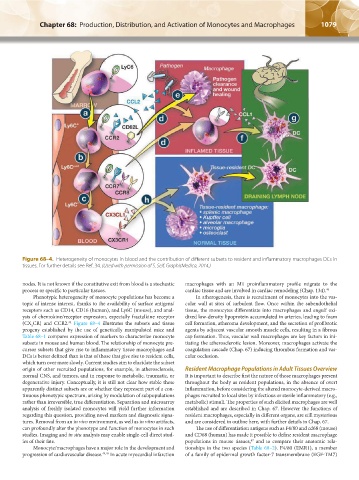
                  Figure 68–4.  Heterogeneity of monocytes in blood and the contribution of different subsets to resident and inflammatory macrophages DCs in
                  tissues. For further details see Ref. 34. (Used with permission of S. Seif, GraphisMedica, 2014.)


                  nodes. It is not known if the constitutive exit from blood is a stochastic   macrophages  with  an  M1  proinflammatory  profile  migrate  to  the
                  process or specific to particular tissues.            cardiac tissue and are involved in cardiac remodeling (Chap. 134). 46
                     Phenotypic heterogeneity of monocyte populations has become a   In atherogenesis, there is recruitment of monocytes into the vas-
                  topic of intense interest, thanks to the availability of surface antigens/  cular wall at sites of turbulent flow. Once within the subendothelial
                  receptors such as CD14, CD16 (human), and Ly6C (mouse), and anal-  tissue, the monocytes differentiate into macrophages and engulf oxi-
                  ysis of chemokine/receptor expression, especially fractalkine receptor   dized low-density lipoprotein accumulated in arteries, leading to foam
                                 34
                  (CX CR) and CCR2.   Figure 68–4 illustrates the subsets and tissue   cell formation, atheroma development, and the secretion of profibrotic
                     3
                  progeny established by the use of genetically manipulated mice and    agents by adjacent vascular smooth muscle cells, resulting in a fibrous
                  Table 68–1 compares expression of markers to characterize monocyte   cap formation. Thus, vascular wall macrophages are key factors in ini-
                  subsets in mouse and human blood. The relationship of monocyte pre-  tiating the atherosclerotic lesion. Moreover, macrophages activate the
                  cursor subsets that give rise to inflammatory tissue macrophages and   coagulation cascade (Chap. 67) inducing thrombus formation and vas-
                  DCs is better defined than is that of those that give rise to resident cells,   cular occlusion.
                  which turn over more slowly. Current studies aim to elucidate the subset
                  origin of other recruited populations, for example, in atherosclerosis,   Resident Macrophage Populations in Adult Tissues Overview
                  normal CNS, and tumors, and in response to metabolic, traumatic, or   It is important to describe first the nature of those macrophages present
                  degenerative injury. Conceptually, it is still not clear how stable these   throughout the body as resident populations, in the absence of overt
                  apparently distinct subsets are or whether they represent part of a con-  inflammation, before considering the altered monocyte-derived macro-
                  tinuous phenotypic spectrum, arising by modulation of subpopulations   phages recruited to local sites by infectious or sterile inflammatory (e.g.,
                  rather than irreversible, true differentiation. Separation and microarray   metabolic) stimuli. The properties of such elicited macrophages are well
                  analysis of freshly isolated monocytes will yield further information   established and are described in Chap. 67. However the functions of
                  regarding this question, providing novel markers and diagnostic signa-  resident macrophages, especially in different organs, are still mysterious
                  tures. Removal from an in vivo environment, as well as in vitro artifacts,   and are considered in outline here, with further details in Chap. 67.
                  can profoundly alter the phenotype and function of monocytes in such   The use of differentiation antigens such as F4/80 and cd68 (mouse)
                  studies. Imaging and in situ analysis may enable single-cell direct stud-  and CD68 (human) has made it possible to define resident macrophage
                                                                                              47
                  ies of their fate.                                    populations in mouse tissues,  and to compare their anatomic rela-
                     Monocyte/macrophages have a major role in the development and   tionships in the two species (Table 68–2). F4/80 (EMR1), a member
                  progression of cardiovascular disease. 44,45  In acute myocardial infarction   of a family of epidermal growth factor-7 transmembrane (EGF-TM7)


          Kaushansky_chapter 68_p1075-1088.indd   1079                                                                  9/17/15   3:41 PM

