


Page 1106 - Williams Hematology ( PDFDrive )
P. 1106
1080  Part VIII:  Monocytes and Macrophages  Chapter 68:  Production, Distribution, and Activation of Monocytes and Macrophages  1081


                       Tonsil (cryostat)


                        EMR2
                       A                               B                                C


                                       D                               E

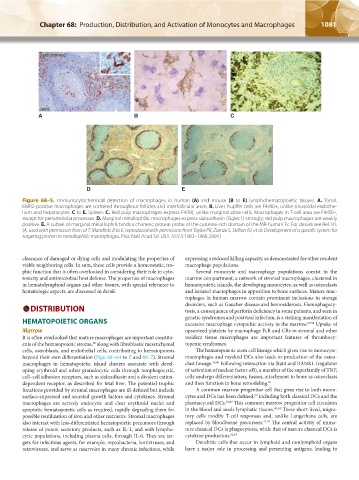
                  Figure 68–5.  Immunocytochemical detection of macrophages in human  (A) and mouse  (B to  E) lymphohematopoietic tissues.  A. Tonsil.
                  EMR2-positive macrophages are scattered throughout follicles and interfollicular areas. B. Liver. Kupffer cells are F4/80+, unlike sinusoidal endothe-
                  lium and hepatocytes. C to E. Spleen. C. Red pulp macrophages express F4/80, unlike marginal zone cells. Macrophages in T-cell area are F4/80–,
                  except for periarteriolar processes. D. Marginal metallophilic macrophages express sialoadhesin (Siglec1) strongly; red pulp macrophages are weakly
                  positive. E. A subset of marginal metallophils binds a chimeric protein probe of the cysteine-rich domain of the MR-human Fc. For details see Ref. 91.
                  (A, used with permission from of T. Marafioti. B to E, reproduced with permission from Taylor PR, Zamze S, Stillion RJ, et al: Development of a specific system for
                  targeting protein to metallophilic macrophages. Proc Natl Acad Sci USA 101(7):1963–1968, 2004.)


                  clearance of damaged or dying cells and modulating the properties of   expressing a reduced killing capacity, as demonstrated for other resident
                  viable neighboring cells. In sum, these cells provide a homeostatic, tro-  macrophage populations.
                  phic function that is often overlooked in considering their role in cyto-  Several monocyte and macrophage populations coexist in the
                  toxicity and antimicrobial host defense. The properties of macrophages   marrow compartment; a network of stromal macrophages, clustered in
                  in hematolymphoid organs and other tissues, with special relevance to   hematopoietic islands, the developing monocytes, as well as osteoclasts
                  hematologic aspects, are discussed in detail.         and isolated macrophages in apposition to bone surfaces. Mature mac-
                                                                        rophages in human marrow contain prominent inclusions in storage
                     DISTRIBUTION                                       disorders, such as Gaucher disease and hemosiderosis. Hemophagocy-
                                                                        tosis, a consequence of perforin deficiency in some patients, and seen in
                                                                        genetic syndromes and postviral infection, is a striking manifestation of
                  HEMATOPOIETIC ORGANS                                  excessive macrophage cytopathic activity in the marrow. 57,58  Uptake of
                  Marrow                                                opsonized platelets by macrophage FcR and CRs in stromal and other
                  It is often overlooked that mature macrophages are important constitu-  resident tissue macrophages are important features of thrombocy-
                  ents of the hematopoietic stroma,  along with fibroblastic mesenchymal   topenic syndromes.
                                         56
                  cells, osteoblasts, and endothelial cells, contributing to hematopoiesis   The hematopoietic stem cell lineage which gives rise to monocyte-
                  beyond their own differentiation (Figs. 68–6A to E and 68–7). Stromal   macrophages and myeloid DCs also leads to production of the osteo-
                  macrophages in hematopoietic island clusters associate with devel-  clast lineage. 59,60  Following interaction via Stat4 and RANKL (regulator
                  oping erythroid and other granulocytic cells through nonphagocytic,   of activation of nuclear factor-κB), a member of the superfamily of TNF,
                  cell–cell adhesion receptors, such as sialoadhesin and a divalent cation-   cells undergo differentiation, fusion, attachment to bone as osteoclasts
                  dependent receptor, as described for fetal liver. The potential trophic   and then function in bone remodeling. 61
                  functions provided by stromal macrophages are ill-defined but include   A common marrow progenitor cell that gives rise to both mono-
                  surface-expressed and secreted growth factors and cytokines. Stromal   cytes and DCs has been defined,  including both classical DCs and the
                                                                                                20
                  macrophages are actively endocytic and clear erythroid nuclei and   plasmacytoid DCs. 62,63  This common marrow progenitor cell circulates
                  apoptotic hematopoietic cells as required, rapidly degrading them for   in the blood and seeds lymphatic tissues. 62,63  These short-lived, migra-
                  possible reutilization of iron and other nutrients. Stromal macrophages   tory cells modify T-cell responses and, unlike Langerhans cells, are
                  also interact with less-differentiated hematopoietic precursors through   replaced by bloodborne precursors. 41,42  The central activity of imma-
                  release of potent secretory products, such as IL-1, and with lympho-  ture classical DCs is phagocytosis, while that of mature classical DCs is
                  cytic populations, including plasma cells, through IL-6. They are tar-  cytokine production. 62,63
                  gets for infectious agents, for example, mycobacteria, lentiviruses, and   Dendritic cells that occur in lymphoid and nonlymphoid organs
                  retroviruses, and serve as reservoirs in many chronic infections, while   have a major role in processing and presenting antigens, leading to


          Kaushansky_chapter 68_p1075-1088.indd   1081                                                                  9/17/15   3:41 PM

