


Page 1102 - Williams Hematology ( PDFDrive )
P. 1102
1076  Part VIII:  Monocytes and Macrophages  Chapter 68:  Production, Distribution, and Activation of Monocytes and Macrophages  1077


                  MATURATION AND DIFFERENTIATION OF                     expansion, and their genetic elimination has no effect on the lineage.
                  MONOCYTES AND MACROPHAGES                             M-CSF promotes survival as well as growth and differentiation of mac-
                                                                        rophages,  exclusively,  acting through  a specific  receptor  (CSF-1R),
                                              22
                                                             23
                  The classic studies of Lewis and Lewis  in 1926, Maximow  in 1932,   encoded by the protooncogene c-FMS, which has been extensively used
                                 24
                  and Ebert and Florey  in 1939, showed that monocytes transform into   as a lineage marker for fluorescence-activated cell sorting (FACS) analy-
                  macrophages and multinucleated giant cells in vitro. Macrophages can   sis (CD115) and transgenesis. 27,28  The role of M-CSF has been reviewed
                                                                                                                          29
                  be produced from monocytes or hematopoietic progenitor cells culture   and its role in macrophage and osteoclast development is illustrated in
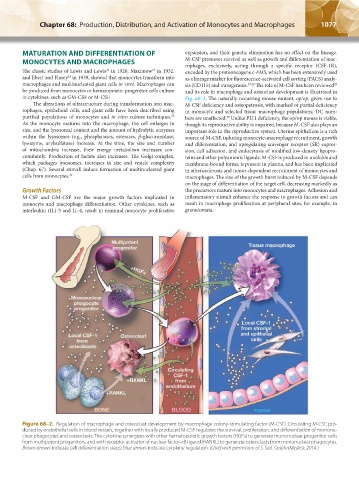
                  in cytokines, such as GM-CSF or M-CSF.                Fig. 68–2. The naturally occurring mouse mutant, op/op, gives rise to
                     The alterations of ultrastructure during transformation into mac-  M-CSF deficiency and osteopetrosis, with marked or partial deficiency
                  rophages, epithelioid cells, and giant cells have been described using   in monocyte and selected tissue macrophage populations; DC num-
                                                                    25
                  purified populations of monocytes and  in vitro culture techniques.    bers are unaffected.  Unlike PU.1 deficiency, the op/op mouse is viable,
                                                                                      30
                  As the monocyte matures into the macrophage, the cell enlarges in   though its reproductive ability is impaired, because M-CSF also plays an
                  size, and the lysosomal content and the amount of hydrolytic enzymes   important role in the reproductive system. Uterine epithelium is a rich
                  within the lysosomes (e.g., phosphatases, esterases,  β-glucuronidase,   source of M-CSF, inducing monocyte-macrophage recruitment, growth
                  lysozyme, arylsulfatase) increase. At the time, the size and number   and differentiation, and upregulating scavenger receptor (SR) expres-
                  of mitochondria increase, their energy metabolism increases con-  sion, cell adhesion, and endocytosis of modified low-density lipopro-
                  comitantly. Production of lactate also increases. The Golgi complex,   teins and other polyanionic ligands. M-CSF is produced in a soluble and
                  which packages lysosomes, increases in  size and vesicle complexity     membrane-bound forms, is present in plasma, and has been implicated
                  (Chap. 67). Several stimuli induce formation of multinucleated giant   in atherosclerosis and tumor-dependent recruitment of monocytes and
                  cells from monocytes. 26                              macrophages. The size of the growth burst induced by M-CSF depends
                                                                        on the stage of differentiation of the target cell, decreasing markedly as
                  Growth Factors                                        the precursors mature into monocytes and macrophages. Adhesion and
                  M-CSF and GM-CSF are the major growth factors implicated in   inflammatory stimuli enhance the response to growth factors and can
                  monocyte and macrophage differentiation. Other cytokines, such as   result in macrophage proliferation at peripheral sites, for example, in
                  interleukin (IL)-3 and IL-4, result in minimal monocyte proliferative   granulomata.


                  Figure 68–2.  Regulation of macrophage and osteoclast development by macrophage colony-stimulating factor (M-CSF). Circulating M-CSF, pro-
                  duced by endothelial cells in blood vessels, together with locally produced M-CSF regulates the survival, proliferation, and differentiation of mononu-
                  clear phagocytes and osteoclasts. The cytokine synergizes with other hematopoietic growth factors (HGFs) to generate mononuclear progenitor cells
                  from multipotent progenitors, and with receptor activator of nuclear factor-κB ligand (RANKL) to generate osteoclasts from mononuclear phagocytes.
                  Brown arrows indicate cell differentiation steps; blue arrows indicate cytokine regulation. (Used with permission of S. Seif, GraphisMedica, 2014.)


          Kaushansky_chapter 68_p1075-1088.indd   1077                                                                  9/17/15   3:41 PM

