


Page 1103 - Williams Hematology ( PDFDrive )
P. 1103
1078           Part VIII:  Monocytes and Macrophages                                                                               Chapter 68:  Production, Distribution, and Activation of Monocytes and Macrophages            1079


                   GM-CSF has a broader myeloid target profile. It is produced by   surface glycoprotein interactions with a selected substratum; T-helper
               many cells, including macrophages themselves, especially after inflam-  type 2 (Th2) cytokines, such as IL-4 and IL-13, act through a common
                                                                                                                        34
               matory stimuli such as lipopolysaccharide (LPS), and it enhances pro-  receptor chain and signaling pathway to enhance macrophage fusion.
               duction of monocytes and macrophages with a different morphology   DNA synthesis, a feature of high-turnover granulomata associated
               to that induced by M-CSF. GM-CSF is required for myeloid DC differ-  with infection, can result in abortive cell division and cell death. These
               entiation in vitro and has been widely used, alone and in combination   macrophage-derived giant cells are distinct from syncytia induced by
               with cytokines such as IL-4 or transforming growth factor (TGF)-β, to   fusogenic virus infection, especially paramyxoviruses and retroviruses
               produce DC from mouse marrow or from human monocytes in cell     such as the human immunodeficiency virus.
               culture. 31,32   Its targeted deletion  in mice  or  genetic  loss  of  function
               mutants of its specific receptor chain in humans results in pulmonary
               alveolar proteinosis, associated with defective alveolar macrophage   HETEROGENEITY
               metabolism of pulmonary surfactant. 33                 Monocytes are defined as the population of differentiated cells present
                                                                      in the circulation, with classical morphologic features (Chap. 67), and
               Survival, Differentiation, and Turnover Overview       include the less-well defined precursors able to give rise to myeloid DCs
               Once the cells have acquired the characteristics of mature monocytes/  and osteoclasts. Because of their ready availability from human blood
               macrophages, they display considerable heterogeneity in morphology   and the sensitive methods now available to analyze their phenotype
               and phenotypic plasticity. In general, their proliferative potential is lim-  ex vivo (FACS, microarray, immunochemistry, and cytochemistry),
               ited, and their life span can vary from less than 1 day to many months,   human monocytes have been more amenable to study, whereas in the
               depending on their microenvironment, infections, and other stimuli.   mouse, analysis of precursor–product relationship and tissue distribution
               Although terminally differentiated, macrophages remain extremely   have provided new insights into the fate and heterogeneity of the circu-
               active in messenger RNA and protein synthesis, with complex, often   lating population. The number of monocytes in the circulation depends
               characteristic profiles of gene expression, depending on innate and   on constitutive, steady-state production and delivery from marrow, pos-
               acquired immune stimuli and cellular interactions. Tissue macrophages   sibly from marginated pools in spleen, as well as adhesion and diapedesis
               are relatively resistant to apoptosis, compared with neutrophils, but this   in response to unknown stimuli and enhanced recruitment in response
               feature changes during infection. Their active membrane turnover and   to peripheral stimuli such as infection and inflammation. M-CSF and
               endocytosis make them susceptible to toxic agents, making them targets   glucocorticoids affect their level and phenotype, as do metabolic stim-
               for clearance by surviving macrophages. Sublethal injury and infection   uli; Chap. 70 describes clinical conditions that give rise to monocytosis.
               can also induce autophagy, increasingly recognized as an important   The biochemical properties and functions of monocytes are described in
               component of inflammatory and infectious diseases.     Chap. 67. They are relatively radioresistant once entering the circulation,
                   The remarkable ability of macrophages to undergo homotypic   where they persist for 12 to 48 hours as motile cells, with an ability to
               cell–cell fusion results in giant cell formation. This is a feature of osteo-  engulf particles and to adhere transiently or more stably to arterial as well
               clast differentiation,  depending on M-CSF and the tumor  necrosis   as microvascular endothelium, thus modulating their phagocytic ability.
               factor (TNF) family member receptor activator of nuclear factor-κB   Depending on interactions with the vessel wall and local differentiation,
               ligand (RANKL), which act on monocytic precursors to yield catabolic   monocytes are able to crawl along and patrol the intravascular surface
                                                                                                            20
               cells able to excavate and remodel living bone. Local adhesion and ruf-  utilizing CD11a, a  β -integrin–dependent property.  Mature macro-
                                                                                     2
               fling of their plasma membrane are associated with focal, polarized   phages lining the endothelium can also detach and recirculate, for exam-
               release of H  and hydrolytic enzymes by monocyte-derived osteoclasts.   ple, filled with lipid stores as foam cells in atherosclerosis, and circulate
                        +
               The attempted uptake of non- or poorly degradable foreign materials   heavily laden with erythroid breakdown products in malaria.
               induces “foreign-body giant cells,” with distinct properties; macrophage-   The presence of significant numbers of immune cells and molecules
               derived giant cells are also characteristic of granulomatous diseases such   in adipose tissue suggest vibrant interactions between the immune and
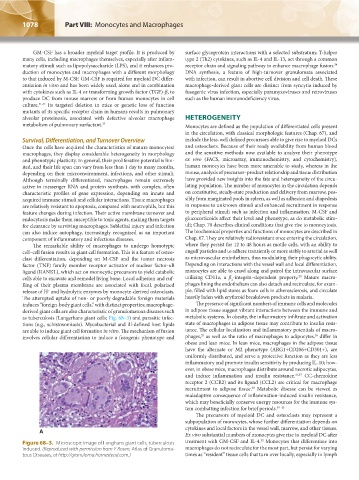
               as tuberculosis (Langerhans giant cells; Fig. 68–3) and parasitic infec-  metabolic systems. In obesity, the inflammatory infiltrate and activation
               tions (e.g., schistosomiasis). Mycobacterial and ill-defined host lipids   state of macrophages in adipose tissue may contribute to insulin resis-
               are able to induce giant cell formation in vitro. The mechanism of fusion   tance. The cellular localization and inflammatory potentials of macro-
                                                                                                                 36
                                                                           35
               involves cellular differentiation to induce a fusogenic phenotype and   phages,  as well as the ratio of macrophages to adipocytes,  differ in
                                                                      obese and lean mice. In lean mice, macrophages in the adipose tissue
                                                                      have the alternate or M2 phenotype (ARG1+CD206+CD301+), are
                                                                      uniformly distributed, and serve a protective function as they are less
                                                                      inflammatory and promote insulin sensitivity by producing IL-10; how-
                                                                      ever, in obese mice, macrophages distribute around necrotic adipocytes,
                                                                      and induce inflammation and insulin resistance. 35,37  CC-chemokine
                                                                      receptor 2 (CCR2) and its ligand (CCL2) are critical for macrophage
                                                                                            38
                                                                      recruitment to adipose tissue.  Metabolic disease can be viewed as
                                                                      maladaptive consequence of inflammation-induced insulin resistance,
                                                                      which may beneficially conserve energy resources for the immune sys-
                                                                      tem combatting infection for brief periods. 39–43
                                                                          The precursors of myeloid DC and osteoclasts may represent a
                                                                      subpopulation of monocytes, whose further differentiation depends on
                                                                      cytokines and local factors in the vessel wall, marrow, and other tissues.
                     A
                                                                      Ex vivo substantial numbers of monocytes give rise to myeloid DC after
                                                                                               32
               Figure 68–3.  Microscopic image of Langhans giant cells, tuberculosis   treatment with GM-CSF and IL-4.  Monocytes that differentiate into
               induced. (Reproduced with permission from Y Rosen, Atlas of Granuloma-  macrophages do not recirculate for the most part, but persist for varying
               tous Diseases, at http://granuloma.homestead.com.)     times as “resident” tissue cells that turn over locally, especially in lymph


          Kaushansky_chapter 68_p1075-1088.indd   1078                                                                  9/17/15   3:41 PM

