


Page 1111 - Williams Hematology ( PDFDrive )
P. 1111
1086           Part VIII:  Monocytes and Macrophages                                                                               Chapter 68:  Production, Distribution, and Activation of Monocytes and Macrophages            1087


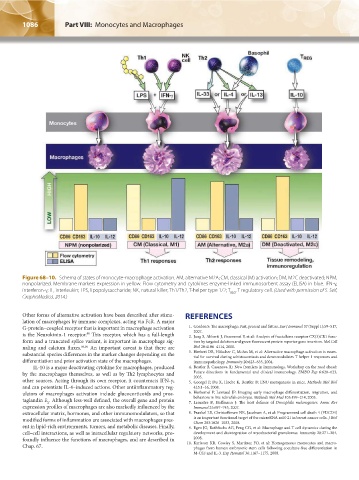
               Figure 68–10.  Schema of states of monocyte-macrophage activation. AM, alternative M2A; CM, classical (M) activation; DM, M2C deactivated; NPM,
               nonpolarized. Membrane markers expression in yellow. Flow cytometry and cytokines enzyme-linked immunosorbent assay (ELISA) in blue. IFN-γ,
               interferon-γ; IL, interleukin; LPS, lipopolysaccharide; NK, natural killer; Th1/Th2, T-helper type 1/2; T , T regulatory cell. (Used with permission of S. Seif,
                                                                                     REG
               GraphisMedica, 2014.)


               Other forms of alternative activation have been described after stimu-  REFERENCES
               lation of macrophages by immune complexes, acting via FcR. A major
               G-protein–coupled receptor that is important in macrophage activation     1.  Gordon S: The macrophage: Past, present and future. Eur J Immunol 37 (Suppl 1):S9–S17,
                                                                         2007.
                                     88
               is the Neurokinin-1 receptor.  This receptor, which has a full-length     2.  Jung S, Aliberti J, Graemmel P, et al: Analysis of fractalkine receptor CX(3)CR1 func-
               form and a truncated splice variant, is important in macrophage sig-  tion by targeted deletion and green fluorescent protein reporter gene insertion. Mol Cell
               naling and calcium fluxes. 89,90  An important caveat is that there are   Biol 20:4106–4114, 2000.
               substantial species differences in the marker changes depending on the     3.  Herbert DR, Hölscher C, Mohrs M, et al: Alternative macrophage activation is essen-
                                                                         tial for survival during schistosomiasis and downmodulates T helper 1 responses and
               differentiation and prior activation state of the macrophages.  immunopathology. Immunity 20:623–635, 2004.
                   IL-10 is a major deactivating cytokine for macrophages, produced     4.  Beutler B, Casanova JL: New frontiers in immunology. Workshop on the road ahead:
               by the macrophages themselves, as well as by Th2 lymphocytes and   Future directions in fundamental and clinical immunology.  EMBO Rep 6:620–623,
                                                                         2005.
               other sources. Acting through its own receptor, it counteracts IFN-γ,     5.  Georgel P, Du X, Hoebe K, Beutler B: ENU mutagenesis in mice. Methods Mol Biol
               and can potentiate IL-4–induced actions. Other antiinflammatory reg-  415:1–16, 2008.
               ulators of macrophages activation include glucocorticoids and pros-    6.  Herbomel P, Levraud JP: Imaging early macrophage differentiation, migration, and
                                                                         behaviors in live zebrafish embryos. Methods Mol Med 105:199–214, 2005.
               taglandin E . Although less-well defined, the overall gene and protein     7.  Lemaitre B, Hoffmann J: The host defense of  Drosophila melanogaster.  Annu Rev
                        2
               expression profiles of macrophages are also markedly influenced by the   Immunol 25:697–743, 2007.
               extracellular matrix, hormones, and other immunomodulators, so that     8.  Frankel LB, Christoffersen NR, Jacobsen A, et al: Programmed cell death 4 (PDCD4)
               modified forms of inflammation are associated with macrophages pres-  is an important functional target of the microRNA miR-21 in breast cancer cells. J Biol
                                                                         Chem 283:1026–1033, 2008.
               ent in lipid-rich environments, tumors, and metabolic diseases. Finally,     9.  Egen JG, Rothfuchs AG, Feng CG, et al: Macrophage and T cell dynamics during the
               cell–cell interactions, as well as intracellular regulatory networks, pro-  development and disintegration of mycobacterial granulomas. Immunity 28:271–284,
               foundly influence the functions of macrophages, and are described in   2008.
               Chap. 67.                                                10.  Karlsson KR, Cowley S, Martinez FO, et al: Homogeneous monocytes and macro-
                                                                         phages from human embryonic stem cells following coculture-free differentiation in
                                                                         M-CSF and IL-3. Exp Hematol 36:1167–1175, 2008.


          Kaushansky_chapter 68_p1075-1088.indd   1086                                                                  9/17/15   3:42 PM

