


Page 1108 - Williams Hematology ( PDFDrive )
P. 1108
1082  Part VIII:  Monocytes and Macrophages  Chapter 68:  Production, Distribution, and Activation of Monocytes and Macrophages  1083


                                     E
                                                                                                 G
                                                                               G
                                             E


                                                                                             M
                                                                  E
                                                M
                                 A                                      B


                                                             M                Eos


                                                    C
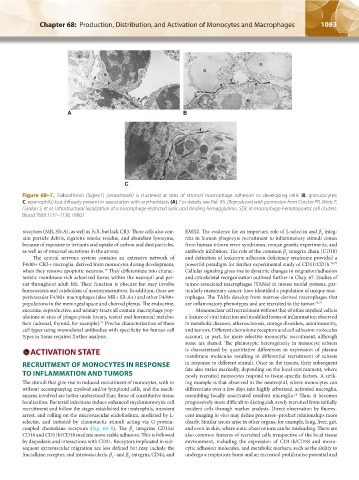
                  Figure 68–7.  Sialoadhesin  (Siglec1)  (arrowheads) is  clustered  at sites  of stromal macrophage  adhesion to developing cells  (B, granulocytes;
                  C, eosinophils) but diffusely present in association with erythroblasts (A). For details see Ref. 93. (Reproduced with permission from Crocker PR, Werb Z,
                  Gordon S, et al: Ultrastructural localization of a macrophage-restricted sialic acid binding hemagglutinin, SER, in macrophage-hematopoietic cell clusters.
                  Blood 76(6):1131–1138, 1990.)

                  receptors (MR, SR-A), as well as FcR, but lack CR3. These cells also con-  EMR2. The evidence for an important role of L-selectin and β  integ-
                                                                                                                      2
                  tain particle debris, cigarette smoke residue, and abundant lysozyme,   rins in human phagocyte recruitment to inflammatory stimuli comes
                  because of exposure to irritants and uptake of carbon and dust particles,   from human inborn error syndromes, mouse genetic experiments, and
                  as well as of mucosal secretions in the airway.       antibody inhibition. The role of the common β -integrin chain (CD18)
                                                                                                          2
                     The central nervous system contains an extensive network of   and definition of leukocyte adhesion deficiency syndrome provided a
                  F4/80+ CR3+ microglia, derived from monocytes during development,   powerful paradigm for further experimental study of CD11/CD18. 76,77
                  when they remove apoptotic neurons.  They differentiate into charac-  Cellular signaling gives rise to dynamic changes in migration/adhesion
                                             18
                  teristic membrane-rich arborized forms within the neuropil and per-  and cytoskeletal reorganization outlined further in Chap. 67. Studies of
                  sist throughout adult life. Their function is obscure but may involve   tumor-associated macrophages (TAMs) in mouse model systems, par-
                  homeostasis and catabolism of neurotransmitters. In addition, there are   ticularly mammary cancer, have identified a population of unique mac-
                  perivascular F4/80+ macrophages (also MR+ SR-A+) and other F4/80+   rophages. The TAMs develop from marrow-derived macrophages that
                  populations in the meningeal space and choroid plexus. The endocrine,   are inflammatory phenotypes and are recruited to the tumor. 78,79
                  exocrine, reproductive, and urinary tracts all contain macrophage pop-  Mononuclear cell recruitment without that of other myeloid cells is
                  ulations at sites of phagocytosis (ovary, testes) and hormonal metabo-  a feature of viral infection and modified forms of inflammation observed
                  lism (adrenal, thyroid, for example).  Precise characterization of these   in metabolic diseases, atherosclerosis, storage disorders, autoimmunity,
                                            71
                  cell types using monoclonal antibodies with specificity for human cell   and tumors. Different chemokine receptors and cell adhesion molecules
                  types in tissue requires further analysis.            account, in part, for more selective monocytic recruitment, although
                                                                        some are shared. The phenotypic heterogeneity in monocyte subsets
                     ACTIVATION STATE                                   is characterized by quantitative differences in expression of plasma
                                                                        membrane molecules resulting in differential recruitment of subsets
                  RECRUITMENT OF MONOCYTES IN RESPONSE                  in response to different stimuli. Once in the tissues, their subsequent
                  TO INFLAMMATION AND TUMORS                            fate also varies markedly, depending on the local environment, where
                                                                        newly recruited monocytes respond to tissue-specific factors. A strik-
                  The stimuli that give rise to induced recruitment of monocytes, with or   ing example is that observed in the neutrophil, where monocytes can
                  without accompanying myeloid and/or lymphoid cells, and the mech-  differentiate over a few days into highly arborized, activated microglia,
                  anisms involved are better understood than those of constitutive tissue   resembling locally reactivated resident microglia.  Thus, it becomes
                                                                                                             18
                  localization. Bacterial infections induce enhanced myelomonocytic cell   progressively more difficult to distinguish newly recruited from initially
                  recruitment and follow the stages established for neutrophils, transient   resident cells through marker analysis. Direct observation by fluores-
                  arrest, and rolling on the microvascular endothelium, mediated by L-   cent imaging in vivo may define precursor–product relationships more
                  selectin, and initiated by chemotactic stimuli acting via G-protein-   clearly. Similar issues arise in other organs, for example, lung, liver, gut,
                  coupled chemokine receptors (Fig. 68–8). The  β  integrins CD11a/  and even in skin, where static observations can be misleading. There are
                                                       2
                  CD18 and CD11b/CD18 mediate more stable adhesion. This is followed   also common features of recruited cells irrespective of the local tissue
                  by diapedesis and interactions with CD31. Receptors implicated in sub-  environment, including the expression of CD11b/CD18 and mono-
                  sequent extravascular migration are less defined but may include the   cytic adhesion molecules, and metabolic markers, such as the ability to
                  fractalkine receptor, and intravascularly, β - and β -integrin, CD44, and   undergo a respiratory burst and an increased proliferative potential and
                                                1    2


          Kaushansky_chapter 68_p1075-1088.indd   1083                                                                  9/17/15   3:42 PM

