


Page 1109 - Williams Hematology ( PDFDrive )
P. 1109
1084           Part VIII:  Monocytes and Macrophages                                                                               Chapter 68:  Production, Distribution, and Activation of Monocytes and Macrophages            1085


                                                        Firm adhesion
                                    Rolling
                                                CD62L shedding   Increase in CD11b

                                                                                     Extravasation


                                   CD54      CD99   Jam    CD31/PECAM
                                   CD62P     CD29
                                                            CD49d
                                             PSGL1
                                   CD62L
                                             Chemokines (e.g., CCR2/MCP-1)
                                   CD11b
                                   CD11a     Chemokine receptor (e.g., CCL2)
                                   N-glycans


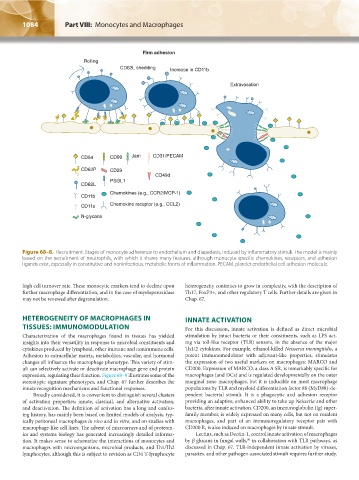
               Figure 68–8.  Recruitment. Stages of monocyte adherence to endothelium and diapedesis, induced by inflammatory stimuli. The model is mainly
               based on the recruitment of neutrophils, with which it shares many features, although monocyte-specific chemokines, receptors, and adhesion
               ligands exist, especially in constitutive and noninfectious, metabolic forms of inflammation. PECAM, platelet endothelial cell adhesion molecule.


               high cell turnover rate. These monocytic markers tend to decline upon   heterogeneity continues to grow in complexity, with the description of
               further macrophage differentiation, and in the case of myeloperoxidase   Th17, FoxP3+, and other regulatory T cells. Further details are given in
               may not be renewed after degranulation.                Chap. 67.


               HETEROGENEITY OF MACROPHAGES IN                        INNATE ACTIVATION
               TISSUES: IMMUNOMODULATION                              For this discussion, innate activation is defined as direct microbial
               Characterization of  the macrophages found in  tissues has  yielded   stimulation by intact bacteria or their constituents, such as LPS act-
               insights into their versatility in response to microbial constituents and   ing via toll-like receptor (TLR) sensors, in the absence of the major
               cytokines produced by lymphoid, other immune and nonimmune cells.   Th1/2 cytokines. For example, ethanol-killed Neisseria meningitidis, a
               Adhesion to extracellular matrix, metabolites, vascular, and hormonal   potent  immunomodulator  with adjuvant-like properties,  stimulates
               changes all influence the macrophage phenotype. This variety of stim-  the expression of two useful markers on macrophages: MARCO and
               uli can selectively activate or deactivate macrophage gene and protein   CD200. Expression of MARCO, a class A SR, is remarkably specific for
               expression, regulating their function. Figure 68–9 illustrates some of the   macrophages (and DCs) and is regulated developmentally on the outer
               stereotypic signature phenotypes, and Chap. 67 further describes the   marginal zone macrophages, but it is inducible on most macrophage
               innate recognition mechanisms and functional responses.  populations by TLR and myeloid differentiation factor 88 (MyD88)-de-
                   Broadly considered, it is convenient to distinguish several clusters   pendent bacterial stimuli. It is a phagocytic and adhesion receptor
               of activation properties; innate, classical, and alternative activation,   providing an adaptive, enhanced ability to take up Neisseria and other
               and deactivation. The definition of activation has a long and confus-  bacteria, after innate activation. CD200, an immunoglobulin (Ig) super-
               ing history, has mainly been based on limited models of analysis, typ-  family member, is widely expressed on many cells, but not on resident
               ically peritoneal macrophages in vivo and in vitro, and on studies with   macrophages, and part of an immunoregulatory receptor pair with
               macrophage-like cell lines. The advent of microarrays and of proteom-  CD200 R, is also induced on macrophages by innate stimuli.
               ics and systems biology has generated increasingly detailed informa-  Lectins, such as Dectin-1, control innate activation of macrophages
                                                                                           80
               tion. It makes sense to schematize the interactions of monocytes and   by β glucans in fungal walls,  in collaboration with TLR pathways, as
               macrophages with microorganisms, microbial products, and Th1/Th2   discussed in Chap. 67. TLR-independent innate activation by viruses,
               lymphocytes, although this is subject to revision as CD4 T-lymphocyte   parasites, and other pathogen-associated stimuli requires further study.


          Kaushansky_chapter 68_p1075-1088.indd   1084                                                                  9/17/15   3:42 PM

