


Page 1597 - Williams Hematology ( PDFDrive )
P. 1597
1572           Part XI:  Malignant Lymphoid Diseases                                                                                                                Chapter 95:  General Considerations for Lymphomas            1573


               The single most important test in a lymphoma patient is an adequate   TABLE 95–1.  Histologic Subtypes and Relative Frequency
               biopsy of affected tissue. In most cases, this should be an excisional
               lymph node biopsy, or generous incisional biopsy of an extranodal site.   of the Non-Hodgkin Lymphomas*
               When the only sites of disease involvement are deep in the thorax or   A.  B-cell lymphomas (~88% of all non-Hodgkin lymphoma [NHL])
               pelvis, rendering excisional node biopsy difficult, a core needle biopsy   1.  Diffuse large B-cell lymphomas (30%)
               obtained with the assistance of ultrasound or CT guidance may be ade-  T-cell–rich large B-cell lymphoma
               quate. Fine-needle aspiration alone should never be used as the sole   Primary diffuse large B-cell lymphoma of the central ner-
               method of establishing the initial diagnosis of lymphoma, 17,32,33  because   vous system
               the precise subtyping of lymphomas requires examination of tissue   Primary cutaneous diffuse large B-cell lymphoma
               architecture, not merely cytologic examination of isolated cells. Biop-
               sies should be subjected to microscopic examination, flow cytometry of   Epstein-Barr virus (EBV)–positive diffuse large B-cell lym-
                                                                            phoma of the elderly
               fresh cells, immunohistochemical examination of fixed tissue sections,
               and cytogenetic/interphase fluorescence in situ hybridization (iFISH)   Diffuse large B-cell lymphoma arising in human herpesvi-
                                                                            rus (HHV)-8–associated multicentric Castleman disease
                      33
               analysis.  In the near future, it is likely that genomic analyses using
               ribonucleic acid sequencing (RNA-seq) technology will also become   Diffuse large B-cell lymphomas with features simulating
               important to define specific mutations permitting personalized selec-  Hodgkin lymphoma
               tion of targeted agents capable of inhibiting deranged intracellular   2.  Follicular lymphoma (25%)
               pathways. 34                                               3.  Extranodal marginal zone lymphoma of mucosa-associated
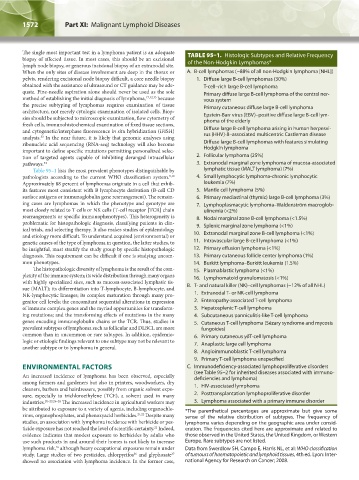
                   Table 95–1 lists the most prevalent phenotypes distinguishable by   lymphatic tissue (MALT lymphoma) (7%)
                                                                 9,10
               pathologists according to the current WHO classification system.    4.  Small lymphocytic lymphoma-chronic lymphocytic
               Approximately 88 percent of lymphomas originate in a cell that exhib-  leukemia (7%)
               its features most consistent with B lymphocyte derivation (B-cell CD   5.  Mantle cell lymphoma (5%)
               surface antigens or immunoglobulin gene rearrangement). The remain-  6.  Primary mediastinal (thymic) large B-cell lymphoma (3%)
               ing cases are lymphomas in which the phenotype and genotype are   7.  Lymphoplasmacytic lymphoma–Waldenström macroglob-
               most closely related to T cells or NK cells (T-cell receptor [TCR] chain   ulinemia (<2%)
               rearrangements or specific immunophenotypes). This heterogeneity is   8.  Nodal marginal zone B-cell lymphoma (<1.5%)
               problematic for histopathologic diagnosis, classifying patients in clin-  9.  Splenic marginal zone lymphoma (<1%)
               ical trials, and selecting therapy. It also makes studies of epidemiology
               and etiology more difficult. To understand acquired (environmental) or   10.  Extranodal marginal zone B-cell lymphoma (<1%)
               genetic causes of the type of lymphoma in question, the latter studies, to   11.  Intravascular large B-cell lymphoma (<1%)
               be insightful, must stratify the study group by specific histopathologic   12.  Primary effusion lymphoma (<1%)
               diagnosis. This requirement can be difficult if one is studying uncom-  13.  Primary cutaneous follicle center lymphoma (1%)
               mon phenotypes.                                           14.  Burkitt lymphoma–Burkitt leukemia (1.5%)
                   The histopathologic diversity of lymphoma is the result of the com-  15.  Plasmablastic lymphoma (<1%)
               plexity of the immune system; its wide distribution through many organs   16.  Lymphomatoid granulomatosis (<1%)
               with highly specialized sites, such as mucosa-associated lymphatic tis-  B.  T- and natural killer (NK)–cell lymphomas (~12% of all NHL)
               sue (MALT); its differentiation into T-lymphocyte, B-lymphocyte, and
               NK-lymphocytic lineages; its complex maturation through many pro-  1.  Extranodal T- or NK-cell lymphoma
               genitor cell levels; the concomitant sequential alterations in expression   2.  Enteropathy-associated T-cell lymphoma
               of immune complex genes and the myriad opportunities for transform-  3.  Hepatosplenic T-cell lymphoma
               ing mutations; and the transforming effects of mutations in the many   4.  Subcutaneous panniculitis-like T-cell lymphoma
               genes encoding immunoglobulin chains or the TCR. Thus, studies in   5.  Cutaneous T-cell lymphoma (Sézary syndrome and mycosis
               prevalent subtypes of lymphoma such as follicular and DLBCL are more   fungoides)
               common than in uncommon or rare subtypes. In addition, epidemio-  6.  Primary cutaneous γδT-cell lymphoma
               logic or etiologic findings relevant to one subtype may not be relevant to   7.  Anaplastic large cell lymphoma
               another subtype or to lymphoma in general.
                                                                         8.  Angioimmunoblastic T-cell lymphoma
                                                                         9.  Primary T-cell lymphoma unspecified
               ENVIRONMENTAL FACTORS                                   C.  Immunodeficiency-associated lymphoproliferative disorders
               An increased incidence of lymphoma has been observed, especially   (see Table 95–2 for inherited diseases associated with immuno-
                                                                         deficiencies and lymphoma)
               among farmers and gardeners but also in printers, woodworkers, dry
               cleaners, barbers and hairdressers, possibly from organic solvent expo-  1.  HIV-associated lymphoma
               sure, especially to trichloroethylene (TCE), a solvent used in many   2.  Posttransplantation lymphoproliferative disorder
               industries. 20–22,26–28  The increased incidence in agricultural workers may   3.  Lymphoma associated with a primary immune disorder
               be attributed to exposure to a variety of agents, including organochlo-  *The  parenthetical  percentages  are  approximate  but  give  some
               rines, organophosphates, and phenoxyacid herbicides. 21,22  Despite many   sense of the relative distribution of subtypes.  The frequency of
               studies, an association with lymphoma incidence with herbicide or pes-  lymphoma varies depending on the geographic area under consid-
               ticide exposure has not reached the level of scientific certainty.  Indeed,   eration. The frequencies cited here are approximate and related to
                                                            21
               evidence indicates that modest exposure to herbicides by adults who   those observed in the United States, the United Kingdom, or Western
               use such products in and around their homes is not likely to increase   Europe. Rare subtypes are not listed.
               lymphoma risk,  although heavy occupational exposures remain under   Data from Swerdlow SH, Campo E, Harris NL, et al: WHO classification
                           35
               study. Large studies of two pesticides, chlorpyrifos  and glyphosate    of tumours of haematopoietic and lymphoid tissues, 4th ed. Lyon: Inter-
                                                     36
                                                                 37
               showed no association with lymphoma incidence. In the former case,   national Agency for Research on Cancer; 2008.


          Kaushansky_chapter 95_p1569-1586.indd   1572                                                                  9/21/15   12:16 PM

