


Page 1600 - Williams Hematology ( PDFDrive )
P. 1600
1574  Part XI:  Malignant Lymphoid Diseases            Chapter 95:  General Considerations for Lymphomas             1575


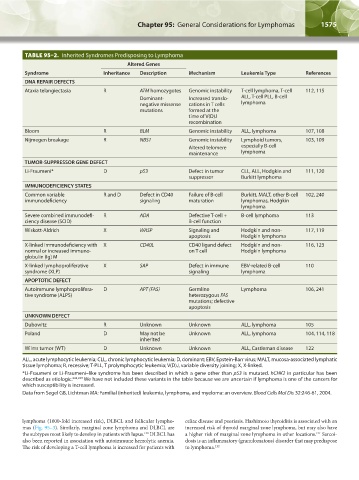
                   TABLE 95–2.  Inherited Syndromes Predisposing to Lymphoma
                                                     Altered Genes
                   Syndrome                  Inheritance  Description     Mechanism        Leukemia Type         References
                   DNA REPAIR DEFECTS
                   Ataxia telangiectasia     R           ATM homozygotes  Genomic instability  T-cell lymphoma, T-cell   112, 115
                                                         Dominant-        Increased translo-  ALL, T-cell PLL, B-cell
                                                         negative missense   cations in T cells   lymphoma
                                                         mutations        formed at the
                                                                          time of V(D)J
                                                                          recombination
                   Bloom                     R           BLM              Genomic instability  ALL, lymphoma     107, 108
                   Nijmegen breakage         R           NBS1             Genomic instability  Lymphoid tumors,   103, 109
                                                                          Altered telomere     especially B-cell
                                                                          maintenance      lymphoma
                   TUMOR-SUPPRESSOR GENE DEFECT
                   Li-Fraumeni*              D           p53              Defect in tumor   CLL, ALL, Hodgkin and   111, 120
                                                                          suppressor       Burkitt lymphoma
                   IMMUNODEFICIENCY STATES
                   Common variable           R and D     Defect in CD40   Failure of B-cell   Burkitt, MALT, other B-cell   102, 240
                   immunodeficiency                      signaling        maturation       lymphomas, Hodgkin
                                                                                           lymphoma
                   Severe combined immunodefi-  R        ADA              Defective T-cell +   B-cell lymphoma   113
                   ciency disease (SCID)                                  B-cell function
                   Wiskott-Aldrich           X           WASP             Signaling and    Hodgkin and non-      117, 119
                                                                          apoptosis        Hodgkin lymphoma
                   X-linked immunodeficiency with  X     CD40L            CD40 ligand defect   Hodgkin and non-   116, 123
                   normal or increased immuno-                            on T cell        Hodgkin lymphoma
                   globulin (Ig) M
                   X-linked lymphoproliferative   X      SAP              Defect in immune   EBV-related B-cell   110
                   syndrome (XLP)                                         signaling        lymphoma
                   APOPTOTIC DEFECT
                   Autoimmune lymphoprolifera-  D        APT (FAS)        Germline         Lymphoma              106, 241
                   tive syndrome (ALPS)                                     heterozygous FAS
                                                                          mutations; defective
                                                                          apoptosis
                   UNKNOWN DEFECT
                   Dubowitz                  R           Unknown          Unknown          ALL, lymphoma         105
                   Poland                    D           May not be       Unknown          ALL, lymphoma         104, 114, 118
                                                         inherited
                   Wilms tumor (WT)          D           Unknown          Unknown          ALL, Castleman disease  122

                  ALL, acute lymphocytic leukemia; CLL, chronic lymphocytic leukemia; D, dominant; EBV, Epstein-Barr virus; MALT, mucosa-associated lymphatic
                  tissue lymphoma; R, recessive; T-PLL, T prolymphocytic leukemia; V(D)J, variable diversity joining; X, X-linked.
                  *Li-Fraumeni or Li-Fraumeni–like syndrome has been described in which a gene other than p53 is mutated. hCHK2 in particular has been
                  described as etiologic. 242,243  We have not included these variants in the table because we are uncertain if lymphoma is one of the cancers for
                  which susceptibility is increased.
                  Data from Segel GB, Lichtman MA: Familial (inherited) leukemia, lymphoma, and myeloma: an overview. Blood Cells Mol Dis 32:246-61, 2004.


                  lymphoma (1000-fold increased risk), DLBCL and follicular lympho-  celiac disease and psoriasis. Hashimoto thyroiditis is associated with an
                  mas (Fig. 95–3). Similarly, marginal zone lymphoma and DLBCL are   increased risk of thyroid marginal zone lymphoma, but may also have
                                                                                                                    131
                  the subtypes most likely to develop in patients with lupus.  DLBCL has   a higher risk of marginal zone lymphoma in other locations.  Sarcoi-
                                                           130
                  also been reported in association with autoimmune hemolytic anemia.   dosis is an inflammatory (granulomatous) disorder that may predispose
                  The risk of developing a T-cell lymphoma is increased for patients with   to lymphoma. 132


          Kaushansky_chapter 95_p1569-1586.indd   1575                                                                  9/21/15   12:16 PM

