


Page 1601 - Williams Hematology ( PDFDrive )
P. 1601
1576           Part XI:  Malignant Lymphoid Diseases                                                                                                                Chapter 95:  General Considerations for Lymphomas            1577


                                 A                                   B


                                 C                                   D

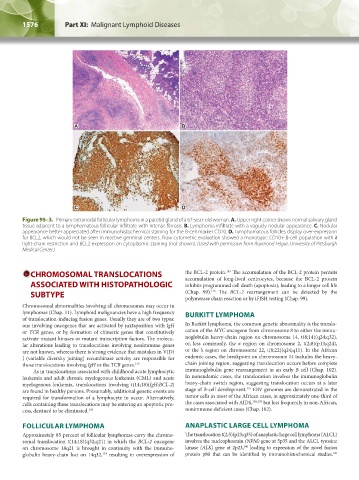
               Figure 95–3.  Primary extranodal follicular lymphoma in a parotid gland of a 67-year-old woman. A. Upper right corner shows normal salivary gland
               tissue adjacent to a lymphomatous follicular infiltrate with intense fibrosis. B. Lymphoma infiltrate with a vaguely nodular appearance. C. Nodular
               appearance better appreciated after immunohistochemical staining for the B-cell marker CD20. D. Lymphomatous follicles display over-expression
               for BCL2, which would not be seen in reactive germinal centers. Flow cytometric evaluation showed a monotypic CD10+ B-cell population with λ
               light-chain restriction and BCL2 expression on cytoplasmic staining (not shown). (Used with permission from Raymond Felgar, University of Pittsburgh
               Medical Center.)


                                                                                    135
                    CHROMOSOMAL TRANSLOCATIONS                        the BCL-2 protein.  The accumulation of the BCL-2 protein permits
                                                                      accumulation of long-lived centrocytes, because the BCL-2 protein
                  ASSOCIATED WITH HISTOPATHOLOGIC                     inhibits programmed cell death (apoptosis), leading to a longer cell life
                                                                               136
                  SUBTYPE                                             (Chap. 99).  The  BCL-2 rearrangement can be detected by the
                                                                      polymerase chain reaction or by iFISH testing (Chap. 99).
               Chromosomal abnormalities involving all chromosomes may occur in
               lymphomas (Chap. 11). Lymphoid malignancies have a high frequency   BURKITT LYMPHOMA
               of translocation-inducing fusion genes. Usually they are of two types:
               one involving oncogenes that are activated by juxtaposition with IgH   In Burkitt lymphoma, the common genetic abnormality is the translo-
               or  TCR genes, or by formation of chimeric genes that constitutively   cation of the MYC oncogene from chromosome 8 to either the immu-
               activate mutant kinases or mutant transcription factors. The molecu-  noglobulin heavy-chain region on chromosome 14, t(8;14)(q24;q32),
               lar alterations leading to translocations involving nonimmune genes   or, less commonly, the  κ region on chromosome 2, t(2;8)(p13;q24),
               are not known, whereas there is strong evidence that mistakes in V(D)  or the λ region on chromosome 22, t(8;22)(q24;q11). In the African
               J (variable diversity joining) recombinase activity are responsible for   endemic cases, the breakpoint on chromosome 14 includes the heavy-
               those translocations involving IgH or the TCR genes. 133  chain joining region, suggesting translocation occurs before complete
                   As in translocations associated with childhood acute lymphocytic   immunoglobulin gene rearrangement in an early B cell (Chap. 102).
               leukemia and adult chronic myelogenous leukemia (CML) and acute   In nonendemic cases, the translocation involves the immunoglobulin
               myelogenous leukemia, translocations involving t(14;18)(IgH;BCL-2)   heavy-chain switch region, suggesting translocation occurs at a later
                                                                                           137
               are found in healthy persons. Presumably, additional genetic events are   stage of B-cell development.  EBV genomes are demonstrated in the
               required  for  transformation  of  a  lymphocyte  to  occur.  Alternatively,   tumor cells in most of the African cases, in approximately one-third of
               cells containing these translocations may be entering an apoptotic pro-  the cases associated with AIDS, 138,139  but less frequently in non-African,
               cess, destined to be eliminated. 133                   nonimmune-deficient cases (Chap. 102).
               FOLLICULAR LYMPHOMA                                    ANAPLASTIC LARGE CELL LYMPHOMA

               Approximately 85 percent of follicular lymphomas carry the chromo-  The translocation t(2;5)(p23;q35) of anaplastic large cell lymphoma (ALCL)
               somal translocation t(14;18)(q32;q21) in which the  BCL-2 oncogene     involves the nucleophosmin (NPM) gene at 5p35 and the ALCL tyrosine
                                                                                          140
               on chromosome 18q21 is brought in continuity with the immuno-  kinase (ALK) gene at 2p23,  leading to expression of the novel fusion
                                                                                                                        141
               globulin heavy-chain loci on 14q32,  resulting in overexpression of   protein p80 that can be identified by immunohistochemical studies.
                                          134


          Kaushansky_chapter 95_p1569-1586.indd   1576                                                                  9/21/15   12:17 PM

