


Page 1602 - Williams Hematology ( PDFDrive )
P. 1602
1576  Part XI:  Malignant Lymphoid Diseases            Chapter 95:  General Considerations for Lymphomas             1577


                  This translocation has been identified in approximately 50 percent
                  of systemic cases in adults and in a majority of pediatric cases of
                  ALCL. 142,143  The t(2;5) translocation is rare in primary cutaneous ALCL,
                  which is generally considered to be a different disease than systemic
                  ALCL (Chap2. 103 and 104.) 144

                  MARGINAL ZONE LYMPHOMA OF MUCOSA-
                  ASSOCIATED LYMPHATIC TISSUE
                  t(11;18)(API2-MALT1), t(1;14)(IGH-BCL10), t(14;18)(IGH-MALT1),
                  and t(3;14)(IGH-FOXP1) occur in marginal zone B-cell lymphoma of
                  MALT of different sites. The first three chromosome translocations are
                  specifically associated with the marginal zone lymphoma of MALT lym-
                  phomas and the oncogenic products of these translocations target the
                  nuclear factor-κB pathway (Chap. 101). 101

                  MANTLE CELL LYMPHOMA
                  t(11;14)(q13;q32) is present in the cells of most cases of mantle cell lym-
                  phoma and results in cyclin D1 upregulation. iFISH is the most useful
                  test to identify the juxtaposition of the CCND1 and IGH genes in mantle
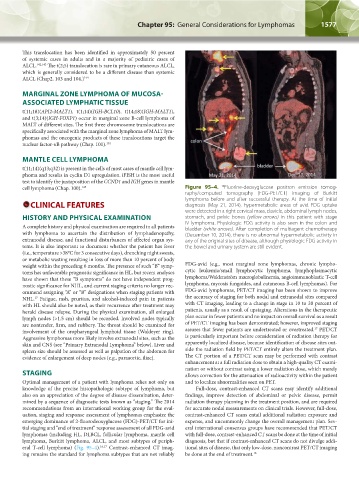
                  cell lymphoma (Chap. 100). 145                        Figure 95–4.  Fluorine-deoxyglucose positron emission tomog-
                                                                                     18
                                                                        raphy/computed tomography (FDG-PET/CT) imaging of Burkitt
                                                                        lymphoma before and after successful therapy. At the time of initial
                     CLINICAL FEATURES                                  diagnosis (May 21, 2014), hypermetabolic areas of avid FDG uptake
                                                                        were detected in a right cervical mass, clavicle, abdominal lymph nodes,
                  HISTORY AND PHYSICAL EXAMINATION                      stomach, and pelvic bones  (yellow arrows) in this patient with stage
                  A complete history and physical examination are required in all patients   IV lymphoma. Physiologic FDG activity is also seen in the colon and
                                                                        bladder (white arrows). After completion of multiagent chemotherapy
                  with lymphoma to ascertain the distribution of lymphadenopathy,   (December 10, 2014), there is no abnormal hypermetabolic activity in
                  extranodal disease, and functional disturbances of affected organ sys-  any of the original sites of disease, although physiologic FDG activity in
                  tems. It is also important to document whether the patient has fever   the bowel and urinary system are still evident.
                  (i.e., temperature >38°C for 3 consecutive days), drenching night sweats,
                  or metabolic wasting resulting in loss of more than 10 percent of body
                  weight within the preceding 6 months. The presence of such “B” symp-  FDG-avid (e.g., most marginal zone lymphomas, chronic lympho-
                  toms has unfavorable prognostic significance in HL, but recent analyses   cytic  leukemia/small  lymphocytic  lymphoma,  lymphoplasmacytic
                  have shown that these “B symptoms” do not have independent prog-  lymphoma/ Waldenström macroglobulinemia, angioimmunoblastic T-cell
                  nostic significance for NHL, and current staging criteria no longer rec-  lymphoma, mycosis fungoides, and cutaneous B-cell lymphomas). For
                  ommend assigning “A” or “B” designations when staging patients with   FDG-avid lymphomas, PET/CT imaging has been shown to improve
                      17
                  NHL.  Fatigue, rash, pruritus, and alcohol-induced pain in patients   the accuracy of staging for both nodal and extranodal sites compared
                  with HL should also be noted, as their recurrence after treatment may   with CT imaging, leading to a change in stage in 10 to 30 percent of
                  herald disease relapse. During the physical examination, all enlarged   patients, usually as a result of upstaging. Alterations in the therapeutic
                  lymph nodes (>1.5 cm) should be recorded. Involved nodes typically   plan occur in fewer patients and no impact on overall survival as a result
                  are nontender, firm, and rubbery. The throat should be examined for   of PET/CT imaging has been demonstrated; however, improved staging
                                                                                                                    17
                  involvement of the oropharyngeal lymphoid tissue (Waldeyer ring).   assures that fewer patients are undertreated or overtreated.  PET/CT
                  Aggressive lymphomas more likely involve extranodal sites, such as the   is particularly important before consideration of radiation therapy for
                  skin and CNS (see “Primary Extranodal Lymphoma” below). Liver and   apparently localized disease, because identification of disease sites out-
                  spleen size should be assessed as well as palpation of the abdomen for   side the radiation field by PET/CT entirely alters the treatment plan.
                  evidence of enlargement of deep nodes (e.g., paraaortic, iliac).  The CT portion of a PET/CT scan may be performed with contrast
                                                                        enhancement at a full radiation dose to obtain a high-quality CT exami-
                                                                        nation or without contrast using a lower radiation dose, which merely
                  STAGING                                               allows correction for the attenuation of radioactivity within the patient
                  Optimal management of a patient with lymphoma relies not only on   and to localize abnormalities seen on PET.
                  knowledge  of  the  precise  histopathologic  subtype  of  lymphoma,  but   Full-dose, contrast-enhanced CT scans may identify additional
                  also on an appreciation of the degree of disease dissemination, deter-  findings,  improve detection of abdominal or pelvic disease, permit
                  mined by a sequence of diagnostic tests known as “staging.” The 2014   radiation therapy planning in the treatment position, and are required
                  recommendations from an international working group for the eval-  for accurate nodal measurements on clinical trials. However, full-dose,
                  uation, staging and response assessment of lymphomas emphasize the   contrast-enhanced CT scans entail additional radiation exposure and
                  emerging dominance of 2-fluorodeoxyglucose (FDG)-PET/CT for ini-  expense, and uncommonly change the overall management plan. Sev-
                  tial staging and “end of treatment” response assessment of all FDG-avid   eral international consensus groups have recommended that PET/CT
                  lymphomas (including HL, DLBCL, follicular lymphoma, mantle cell    with full-dose, contrast-enhanced CT scans be done at the time of initial
                  lymphoma, Burkitt lymphoma, ALCL, and most subtypes of periph-  diagnosis, but that if contrast-enhanced CT scans do not divulge addi-
                  eral T-cell lymphoma) (Fig. 95–4). 16,17  Contrast-enhanced CT imag-  tional sites of disease, that only low-dose, noncontrast PET/CT imaging
                  ing remains the standard for lymphoma subtypes that are not reliably   be done at the end of treatment. 16


          Kaushansky_chapter 95_p1569-1586.indd   1577                                                                  9/21/15   12:17 PM

