


Page 1613 - Williams Hematology ( PDFDrive )
P. 1613
1588           Part XI:  Malignant Lymphoid Diseases                                                                                                                              Chapter 96:  Pathology of Lymphomas            1589


               attempts were made to incorporate these new entities into the existing     WORLD HEALTH ORGANIZATION
               classification  schemes,   problems  with  uniformity between  different
                                11
               institutions persisted. A desire to eliminate the continued confusion   CLASSIFICATION
               ultimately led to a new approach to lymphoma classification proposed
               by the International Lymphoma Study Group that used all available   In the late 1990s, a new World Health Organization (WHO) classifica-
               information, including morphology,  immunophenotype, genetic  and   tion for lymphoproliferative disorders was being developed, based on
               clinical features, to define a list of distinctive entities that could be uni-  the REAL classification. First published in 2001 (and revised in 2008),
               formly diagnosed by hematopathologists. The proposal was published   the WHO classification represented a consensus between an interna-
               in 1994 and was known as the Revised European-American Lymphoma   tional group of more than 50 experienced hematopathologists, includ-
                               12
               (REAL) classification.  Importantly, this classification identified enti-  ing contributions from a clinical advisory committee of hematologists
                                                                                                            14
               ties that had distinctive clinical features and could be reproducibly diag-  and oncologists experienced in treating lymphomas.  The WHO clas-
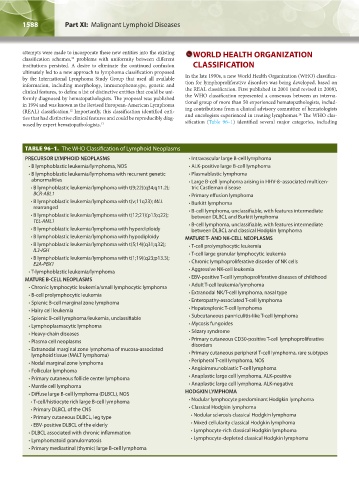
               nosed by expert hematopathologists. 13                 sification (Table 96–1) identified several major categories, including

                TABLE 96–1.  The WHO Classification of Lymphoid Neoplasms

                PRECURSOR LYMPHOID NEOPLASMS                           • Intravascular large B-cell lymphoma
                 • B lymphoblastic leukemia/lymphoma, NOS              • ALK-positive large B-cell lymphoma
                 • B lymphoblastic leukemia/lymphoma with recurrent genetic   • Plasmablastic lymphoma
                  abnormalities                                        • Large B-cell lymphoma arising in HHV-8–associated multicen-
                  • B lymphoblastic leukemia/lymphoma with t(9;22)(q34;q11.2);   tric Castleman disease
                   BCR-ABL1                                            • Primary effusion lymphoma
                  • B lymphoblastic leukemia/lymphoma with t(v;11q23); MLL   • Burkitt lymphoma
                   rearranged                                          • B-cell lymphoma, unclassifiable, with features intermediate
                  • B lymphoblastic leukemia/lymphoma with t(12;21)(p13;q22);   between DLBCL and Burkitt lymphoma
                   TEL-AML1                                            • B-cell lymphoma, unclassifiable, with features intermediate
                  • B lymphoblastic leukemia/lymphoma with hyperdiploidy  between DLBCL and classical Hodgkin lymphoma
                  • B lymphoblastic leukemia/lymphoma with hypodiploidy  MATURE T- AND NK-CELL NEOPLASMS
                  • B lymphoblastic leukemia/lymphoma with t(5;14)(q31;q32);   • T-cell prolymphocytic leukemia
                   IL3-IGH                                             • T-cell large granular lymphocytic leukemia
                  • B lymphoblastic leukemia/lymphoma with t(1;19)(q23;p13.3);   • Chronic lymphoproliferative disorder of NK cells
                   E2A-PBX1
                 • T-lymphoblastic leukemia/lymphoma                   • Aggressive NK-cell leukemia
                MATURE B-CELL NEOPLASMS                                • EBV-positive T-cell lymphoproliferative diseases of childhood
                 • Chronic lymphocytic leukemia/small lymphocytic lymphoma  • Adult T-cell leukemia/lymphoma
                 • B-cell prolymphocytic leukemia                      • Extranodal NK/T-cell lymphoma, nasal type
                 • Splenic B-cell marginal zone lymphoma               • Enteropathy-associated T-cell lymphoma
                 • Hairy cell leukemia                                 • Hepatosplenic T-cell lymphoma
                 • Splenic B-cell lymphoma/leukemia, unclassifiable    • Subcutaneous panniculitis-like T-cell lymphoma
                 • Lymphoplasmacytic lymphoma                          • Mycosis fungoides
                 • Heavy-chain diseases                                • Sézary syndrome
                 • Plasma cell neoplasms                               • Primary cutaneous CD30-positive T-cell lymphoproliferative
                                                                        disorders
                 • Extranodal marginal zone lymphoma of mucosa-associated    • Primary cutaneous peripheral T-cell lymphoma, rare subtypes
                  lymphoid tissue (MALT lymphoma)
                 • Nodal marginal zone lymphoma                        • Peripheral T-cell lymphoma, NOS
                 • Follicular lymphoma                                 • Angioimmunoblastic T-cell lymphoma
                 • Primary cutaneous follicle center lymphoma          • Anaplastic large cell lymphoma, ALK-positive
                 • Mantle cell lymphoma                                • Anaplastic large cell lymphoma, ALK-negative
                 • Diffuse large B-cell lymphoma (DLBCL), NOS         HODGKIN LYMPHOMA
                  • T-cell/histiocyte rich large B-cell lymphoma       • Nodular lymphocyte predominant Hodgkin lymphoma
                  • Primary DLBCL of the CNS                           • Classical Hodgkin lymphoma
                  • Primary cutaneous DLBCL, leg type                   • Nodular sclerosis classical Hodgkin lymphoma
                  • EBV-positive DLBCL of the elderly                   • Mixed cellularity classical Hodgkin lymphoma
                 • DLBCL associated with chronic inflammation           • Lymphocyte-rich classical Hodgkin lymphoma
                 • Lymphomatoid granulomatosis                          • Lymphocyte-depleted classical Hodgkin lymphoma
                 • Primary mediastinal (thymic) large B-cell lymphoma


          Kaushansky_chapter 96_p1587-1602.indd   1588                                                                  9/18/15   6:06 PM

