


Page 1617 - Williams Hematology ( PDFDrive )
P. 1617
1592           Part XI:  Malignant Lymphoid Diseases                                                                                                                              Chapter 96:  Pathology of Lymphomas            1593


               or in ruling out a nonhematolymphoid lesion causing lymphadenop-
               athy. Although automated flow cytometry can be used in conjunction
               with cytologic examination to provide additional information for lym-
               phoma diagnosis and classification, tissue biopsy generally is required
               before commencement of therapy.


                    PRECURSOR B- AND T-CELL
                  LYMPHOMAS/LEUKEMIAS
               Lymphoblastic  leukemia/lymphoma  represents  a  malignancy  of  lym-
               phoblasts, either of B or T lineage. They can present in the marrow (leu-
               kemia) or with predominant tissue involvement (lymphoma), but they
               are considered single-disease entities. Most cases of acute lymphoblastic
               leukemia are of B lineage, whereas most cases of lymphoblastic lym-
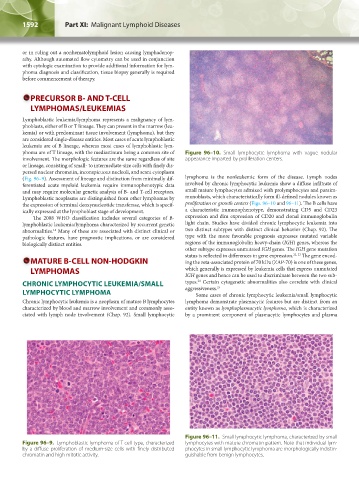
               phoma are of T lineage, with the mediastinum being a common site of   Figure 96–10.  Small lymphocytic lymphoma with vague nodular
               involvement. The morphologic features are the same regardless of site   appearance imparted by proliferation centers.
               or lineage, consisting of small- to intermediate-size cells with finely dis-
               persed nuclear chromatin, inconspicuous nucleoli, and scant cytoplasm
               (Fig. 96–9). Assessment of lineage and distinction from minimally dif-  lymphoma is the nonleukemic form of the disease. Lymph nodes
               ferentiated acute myeloid leukemia require immunophenotypic data   involved by chronic lymphocytic leukemia show a diffuse infiltrate of
               and may require molecular genetic analysis of B- and T-cell receptors.   small mature lymphocytes admixed with prolymphocytes and paraim-
               Lymphoblastic neoplasms are distinguished from other lymphomas by   munoblasts, which characteristically form ill-defined nodules known as
               the expression of terminal deoxynucleotide transferase, which is specif-  proliferation or growth centers (Figs. 96–10 and 96–11). The B cells have
               ically expressed at the lymphoblast stage of development.  a  characteristic  immunophenotype,  demonstrating  CD5  and  CD23
                   The 2008 WHO classification includes several categories of B-   expression and dim expression of CD20 and clonal immunoglobulin
               lymphoblastic leukemia/lymphoma characterized by recurrent genetic   light chain. Studies have divided chronic lymphocytic leukemia into
               abnormalities.  Many of these are associated with distinct clinical or   two distinct subtypes with distinct clinical behavior (Chap. 92). The
                          14
               pathologic  features,  have prognostic  implications,  or are  considered   type with the more favorable prognosis expresses mutated variable
               biologically distinct entities.                        regions of the immunoglobulin heavy-chain (IGH) genes, whereas the
                                                                      other subtype expresses unmutated IGH genes. The IGH gene mutation
                                                                      status is reflected in differences in gene expression. 22, 23  The gene encod-
                    MATURE B-CELL NON-HODGKIN                         ing the zeta-associated protein of 70 kDa (ZAP-70) is one of these genes,
                  LYMPHOMAS                                           which generally is expressed by leukemia cells that express unmutated
                                                                      IGH genes and hence can be used to discriminate between the two sub-
                                                                          24
               CHRONIC LYMPHOCYTIC LEUKEMIA/SMALL                     types.  Certain cytogenetic abnormalities also correlate with clinical
                                                                      aggressiveness.
                                                                                 25
               LYMPHOCYTIC LYMPHOMA                                       Some cases of chronic lymphocytic leukemia/small lymphocytic
               Chronic lymphocytic leukemia is a neoplasm of mature B lymphocytes   lymphoma demonstrate plasmacytic features but are distinct from an
               characterized by blood and marrow involvement and commonly asso-  entity known as lymphoplasmacytic lymphoma, which is characterized
               ciated with lymph node involvement (Chap. 92). Small lymphocytic   by a prominent component of plasmacytic lymphocytes and plasma


                                                                      Figure 96–11.  Small lymphocytic lymphoma, characterized by small
               Figure 96–9.  Lymphoblastic lymphoma of T-cell type, characterized   lymphocytes with mature chromatin pattern. Note that individual lym-
               by a diffuse proliferation of medium-size cells with finely distributed   phocytes in small lymphocytic lymphoma are morphologically indistin-
               chromatin and high mitotic activity.                   guishable from benign lymphocytes.


          Kaushansky_chapter 96_p1587-1602.indd   1592                                                                  9/18/15   6:07 PM

