


Page 1616 - Williams Hematology ( PDFDrive )
P. 1616
1590  Part XI:  Malignant Lymphoid Diseases                          Chapter 96:  Pathology of Lymphomas             1591


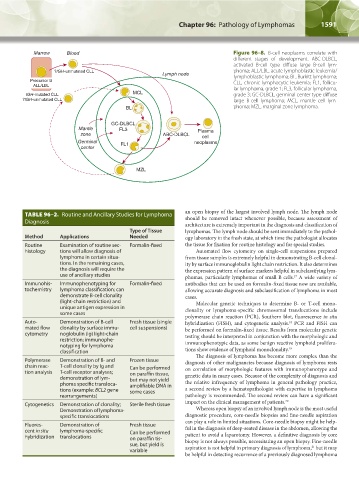
                      Marrow     Blood                                                   Figure 96–8.  B-cell neoplasms correlate with
                                                                                         different stages of development. ABC-DLBCL,
                                                                                         activated B-cell type diffuse large B-cell lym-
                            ?IGH-unmutated CLL                                           phoma; ALL/LBL, acute lymphoblastic leukemia/
                                                                 Lymph node              lymphoblastic lymphoma; BL, Burkitt lymphoma;
                    Precursor B                                                          CLL, chronic lymphocytic leukemia; FL1, follicu-
                     ALL/LBL                                                             lar lymphoma, grade 1; FL3, follicular lymphoma,
                   IGH-mutated CLL                     MCL                               grade 3; GC-DLBCL, germinal center type diffuse
                  ?IGH-unmutated CLL                                                     large B-cell lymphoma;  MCL, mantle  cell lym-
                                                     BL                                  phoma; MZL, marginal zone lymphoma.


                                                GC-DLBCL
                                     Mantle       FL3                        Plasma
                                     zone                        ABC-DLBCL    cell
                                    Germinal       FL1                     neoplasms
                                     center


                                                        MZL


                   TABLE 96–2.  Routine and Ancillary Studies for Lymphoma   an open biopsy of the largest involved lymph node. The lymph node
                                                                        should be removed intact whenever possible, because assessment of
                   Diagnosis                                            architecture is extremely important in the diagnosis and classification of
                                                      Type of Tissue    lymphomas. The lymph node should be sent immediately to the pathol-
                   Method     Applications            Needed            ogy laboratory in the fresh state, at which time the pathologist allocates
                   Routine    Examination of routine sec-  Formalin-fixed  the tissue for fixation for routine histology and for special studies.
                   histology  tions will allow diagnosis of                 Automated flow cytometry on single-cell suspensions prepared
                              lymphoma in certain situa-                from tissue samples is extremely helpful in demonstrating B-cell clonal-
                              tions. In the remaining cases,            ity by surface immunoglobulin light chain restriction. It also determines
                              the diagnosis will require the            the expression pattern of surface markers helpful in subclassifying lym-
                              use of ancillary studies                  phomas, particularly lymphomas of small B cells.  A wide variety of
                                                                                                             17
                   Immunohis-  Immunophenotyping for   Formalin-fixed   antibodies that can be used on formalin-fixed tissue now are available,
                   tochemistry  lymphoma classification; can            allowing accurate diagnosis and subclassification of lymphoma in most
                              demonstrate B-cell clonality              cases.
                              (light-chain restriction) and                 Molecular genetic techniques to determine B- or T-cell mono-
                              unique antigen expression in              clonality or lymphoma-specific chromosomal translocations include
                              some cases
                                                                        polymerase chain reaction (PCR), Southern blot, fluorescence in situ
                   Auto-      Demonstration of B-cell   Fresh tissue (single   hybridization (FISH), and cytogenetic analysis.  PCR and FISH can
                                                                                                           18
                   mated flow   clonality by surface immu-  cell suspensions)  be performed on formalin-fixed tissue. Results from molecular genetic
                   cytometry  noglobulin (Ig) light-chain               testing should be interpreted in conjunction with the morphologic and
                              restriction; immunophe-                   immunophenotypic data, as some benign reactive lymphoid prolifera-
                              notyping for lymphoma                                                        19
                              classification                            tions show evidence of lymphoid monoclonality.
                                                                            The diagnosis of lymphoma has become more complex than the
                   Polymerase   Demonstration of B- and   Frozen tissue  diagnosis of other malignancies because diagnosis of lymphoma rests
                   chain reac-  T-cell clonality by Ig and   Can be performed   on correlation of morphologic features with immunophenotype and
                   tion analysis  T-cell receptor analyses;   on paraffin tissue,
                              demonstration of lym-   but may not yield   genetic data in many cases. Because of the complexity of diagnosis and
                              phoma specific transloca-  amplifiable DNA in   the relative infrequency of lymphoma in general pathology practice,
                              tions (example: BCL2 gene   some cases    a second review by a hematopathologist with expertise in lymphoma
                              rearrangements)                           pathology is recommended. The second review can have a significant
                   Cytogenetics  Demonstration of clonality;   Sterile fresh tissue  impact on the clinical management of patients. 20
                              Demonstration of lymphoma-                    Whereas open biopsy of an involved lymph node is the most useful
                              specific translocations                   diagnostic procedure, core-needle biopsies and fine-needle aspiration
                   Fluores-   Demonstration of        Fresh tissue      can play a role in limited situations. Core-needle biopsy might be help-
                   cent in situ   lymphoma-specific   Can be performed   ful in the diagnosis of deep-seated disease in the abdomen, allowing the
                   hybridization  translocations      on paraffin tis-  patient to avoid a laparotomy. However, a definitive diagnosis by core
                                                      sue, but yield is   biopsy is not always possible, necessitating an open biopsy. Fine-needle
                                                                                                                   21
                                                      variable          aspiration is not helpful in primary diagnosis of lymphoma,  but it may
                                                                        be helpful in detecting recurrence of a previously diagnosed lymphoma


          Kaushansky_chapter 96_p1587-1602.indd   1591                                                                  9/18/15   6:07 PM

