


Page 1618 - Williams Hematology ( PDFDrive )
P. 1618
1592  Part XI:  Malignant Lymphoid Diseases                          Chapter 96:  Pathology of Lymphomas             1593


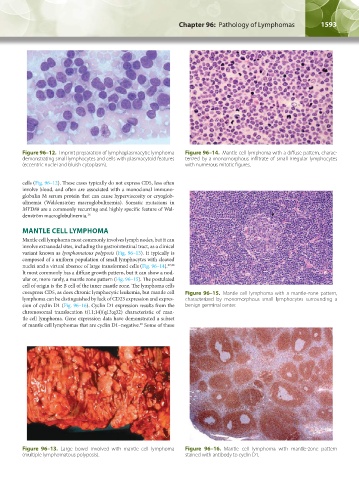
                  Figure 96–12.  Imprint preparation of lymphoplasmacytic lymphoma   Figure 96–14.  Mantle cell lymphoma with a diffuse pattern, charac-
                  demonstrating small lymphocytes and cells with plasmacytoid features   terized by a monomorphous infiltrate of small irregular lymphocytes
                  (eccentric nuclei and bluish cytoplasm).              with numerous mitotic figures.


                  cells (Fig. 96–12). These cases typically do not express CD5, less often
                  involve blood, and often are associated with a monoclonal immuno-
                  globulin M serum protein that can cause hyperviscosity or cryoglob-
                  ulinemia (Waldenström macroglobulinemia). Somatic mutations in
                  MYD88 are a commonly recurring and highly specific feature of Wal-
                  denström macroglobulinemia. 26

                  MANTLE CELL LYMPHOMA
                  Mantle cell lymphoma most commonly involves lymph nodes, but it can
                  involve extranodal sites, including the gastrointestinal tract, as a clinical
                  variant known as lymphomatous polyposis (Fig. 96–13). It typically is
                  composed of a uniform population of small lymphocytes with cleaved
                  nuclei and a virtual absence of large transformed cells (Fig. 96–14). 27,28
                  It most commonly has a diffuse growth pattern, but it can show a nod-
                  ular or, more rarely, a mantle zone pattern (Fig. 96–15). The postulated
                  cell of origin is the B cell of the inner mantle zone. The lymphoma cells
                  coexpress CD5, as does chronic lymphocytic leukemia, but mantle cell   Figure 96–15.  Mantle cell lymphoma with a mantle-zone pattern,
                  lymphoma can be distinguished by lack of CD23 expression and expres-  characterized by monomorphous small lymphocytes surrounding a
                  sion of cyclin D1 (Fig. 96–16). Cyclin D1 expression results from the   benign germinal center.
                  chromosomal translocation t(11;14)(q13;q32) characteristic of man-
                  tle cell lymphoma. Gene expression data have demonstrated a subset
                  of mantle cell lymphomas that are cyclin D1–negative.  Some of these
                                                         29


                  Figure 96–13.  Large bowel involved with mantle cell lymphoma   Figure 96–16.  Mantle  cell  lymphoma  with  mantle-zone  pattern
                  (multiple lymphomatous polyposis).                    stained with antibody to cyclin D1.


          Kaushansky_chapter 96_p1587-1602.indd   1593                                                                  9/18/15   6:07 PM

