


Page 1620 - Williams Hematology ( PDFDrive )
P. 1620
1594  Part XI:  Malignant Lymphoid Diseases                          Chapter 96:  Pathology of Lymphomas             1595


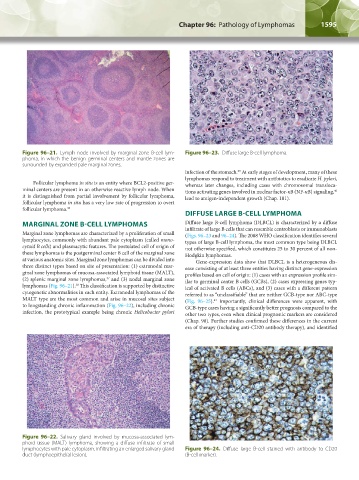
                  Figure 96–21.  Lymph node involved by marginal zone B-cell lym-  Figure 96–23.  Diffuse large B-cell lymphoma.
                  phoma, in which the benign germinal centers and mantle zones are
                  surrounded by expanded pale marginal zones.
                                                                        infection of the stomach.  At early stages of development, many of these
                                                                                          39
                                                                        lymphomas respond to treatment with antibiotics to eradicate H. pylori,
                     Follicular lymphoma in situ is an entity where BCL2-positive ger-  whereas later changes, including cases with chromosomal transloca-
                  minal centers are present in an otherwise reactive lymph node. When   tions activating genes involved in nuclear factor-κB (NF-κB) signaling,
                                                                                                                          40
                  it is distinguished from partial involvement by follicular lymphoma,   lead to antigen-independent growth (Chap. 101).
                  follicular lymphoma in situ has a very low rate of progression to overt
                  follicular lymphoma. 36
                                                                        DIFFUSE LARGE B-CELL LYMPHOMA
                  MARGINAL ZONE B-CELL LYMPHOMAS                        Diffuse large B-cell lymphoma (DLBCL) is characterized by a diffuse
                  Marginal zone lymphomas are characterized by a proliferation of small   infiltrate of large B cells that can resemble centroblasts or immunoblasts
                                                                        (Figs. 96–23 and 96–24). The 2008 WHO classification identifies several
                  lymphocytes, commonly with abundant pale cytoplasm (called mono-  types of large B-cell lymphoma, the most common type being DLBCL
                  cytoid B cells) and plasmacytic features. The postulated cell of origin of   not otherwise specified, which constitutes 25 to 30 percent of all non-
                  these lymphomas is the postgerminal center B cell of the marginal zone   Hodgkin lymphomas.
                  at various anatomic sites. Marginal zone lymphomas can be divided into   Gene-expression data show that DLBCL is a heterogeneous dis-
                  three distinct types based on site of presentation: (1) extranodal mar-  ease consisting of at least three entities having distinct gene-expression
                  ginal zone lymphomas of mucosa-associated lymphoid tissue (MALT),   profiles based on cell of origin: (1) cases with an expression profile sim-
                                              37
                  (2) splenic marginal zone lymphomas,  and (3) nodal marginal zone   ilar to germinal center B cells (GCBs), (2) cases expressing genes typ-
                  lymphomas (Fig. 96–21).  This classification is supported by distinctive   ical of activated B cells (ABCs), and (3) cases with a different pattern
                                    38
                  cytogenetic abnormalities in each entity. Extranodal lymphomas of the   referred to as “unclassifiable” that are neither GCB-type nor ABC-type
                  MALT type are the most common and arise in mucosal sites subject   (Fig. 96–25).  Importantly, clinical differences were apparent, with
                                                                                  41
                  to longstanding chronic inflammation (Fig. 96–22), including chronic   GCB-type cases having a significantly better prognosis compared to the
                  infection,  the  prototypical  example  being  chronic  Helicobacter pylori   other two types, even when clinical prognostic markers are considered
                                                                        (Chap. 98). Further studies confirmed these differences in the current
                                                                        era of therapy (including anti-CD20 antibody therapy), and identified


                  Figure 96–22.  Salivary gland involved by mucosa-associated lym-
                  phoid tissue (MALT) lymphoma, showing a diffuse infiltrate of small
                  lymphocytes with pale cytoplasm, infiltrating an enlarged salivary gland   Figure 96–24.  Diffuse  large  B-cell  stained  with  antibody  to  CD20
                  duct (lymphoepithelial lesion).                       (B-cell marker).


          Kaushansky_chapter 96_p1587-1602.indd   1595                                                                  9/18/15   6:07 PM

