


Page 1681 - Williams Hematology ( PDFDrive )
P. 1681
1656           Part XI:  Malignant Lymphoid Diseases                                                                                                                               Chapter 100:  Mantle Cell Lymphoma            1657


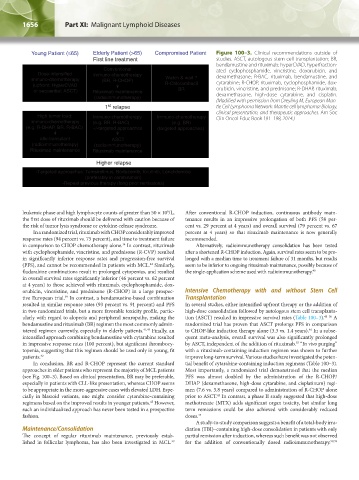
                  Young Patient (≤65)  Elderly Patient (>65)  Compromised Patient   Figure 100–3.  Clinical recommendations outside of
                                       First line treatment                     studies. ASCT, autologous stem cell transplantation; BR,
                                                                                bendamustine and rituximab; hyperCVAD, hyperfraction-
                                           Conventional                         ated cyclophosphamide, vincristine, doxorubicin, and
                     Dose-intensified  immuno-chemotherapy                      dexamethasone; R-BAC, rituximab, bendamustine, and
                  immuno-chemotherapy     (BR, R-CHOP)         Watch & wait ?   cytarabine; R-CHOP, rituximab, cyclophosphamide, dox-
                   (upfront: HyperCVAD                         R-Chlorambucil
                    or sequential: ASCT)  Rituximab maintenance     BR          orubicin, vincristine, and prednisone; R-DHAP, rituximab,
                                       (radioimmunotherapy)                     dexamethasone, high-dose cytarabine, and cisplatin.
                                                                                (Modified with permission from Dreyling M, European Man-
                                            st
                                           1  relapse                           tle Cell Lymphoma Network: Mantle cell lymphoma: Biology,
                                                                                clinical presentation, and therapeutic approaches. Am Soc
                    High tumor load:   Immuno-chemotherapy  Immuno-chemotherapy  Clin Oncol Educ Book 191–198, 2014.)
                  immuno-chemotherapy  (e.g. BR, R-BAC)           (e.g. BR)
                 (e.g. R-DHAP, BR, R-BAC)   +/-targeted approaches  (targeted approaches)
                     allo-transplant          ASCT
                   (radioimmunotherapy)  (radioimmunotherapy)
                  Rituximab maintenance  Rituximab maintenance

                                        Higher relapse
                    -Targeted approaches: Temsirolimus, Bortezomib, Ibrutinib, Lenalidomide
                                    (preferably in combination)
                             -Repeat previous therapy (long prior remissions)


               leukemic phase and high lymphocyte counts of greater than 50 × 10 /L,   After conventional R-CHOP induction, continuous  antibody main-
                                                                9
               the first dose of rituximab should be delivered with caution because of   tenance results in an impressive prolongation of both PFS (58 per-
               the risk of tumor lysis syndrome or cytokine-release syndrome.  cent vs. 29 percent at 4 years) and overall survival (79 percent vs. 67
                   In a randomized trial, rituximab with CHOP considerably improved   percent at 4 years) so that rituximab maintenance is now generally
               response rates (94 percent vs. 75 percent), and time to treatment failure   recommended.
               in comparison to CHOP chemotherapy alone.  In contrast, rituximab   Alternatively, radioimmunotherapy consolidation has been tested
                                                 34
               with cyclophosphamide, vincristine, and prednisone (R-CVP) resulted   after a shortened R-CHOP induction. Again, survival rates seem to be pro-
               in significantly inferior response rates and progression-free survival   longed with a median time to treatment failure of 31 months, but results
               (PFS), and cannot be recommended in patients with MCL.  Similarly,   seem to be inferior to ongoing rituximab maintenance, possibly because of
                                                          44
               fludarabine combinations result in prolonged cytopenias, and resulted   the single-application scheme used with radioimmunotherapy. 40
               in overall survival rates significantly inferior (46 percent vs. 62 percent
               at 4 years) to those achieved with rituximab, cyclophosphamide, dox-
               orubicin, vincristine, and prednisone (R-CHOP) in a large prospec-  Intensive Chemotherapy with and without Stem Cell
               tive European trial.  In contrast, a bendamustine-based combination   Transplantation
                              39
               resulted in similar response rates (93 percent vs. 91 percent) and PFS   In several studies, either intensified upfront therapy or the addition of
               in two randomized trials, but a more favorable toxicity profile, partic-  high-dose consolidation followed by autologous stem cell transplanta-
               ularly with regard to alopecia and peripheral neuropathy, making the   tion (ASCT) resulted in impressive survival rates (Table 100–3). 45–56  A
               bendamustine and rituximab (BR) regimen the most commonly admin-  randomized trial has proven that ASCT prolongs PFS in comparison
               istered regimen currently, especially in elderly patients. 41,44  Finally, an   to CHOP-like induction therapy alone (3.3 vs. 1.4 years).  In a subse-
                                                                                                               46
               intensified approach combining bendamustine with cytarabine resulted   quent meta-analysis, overall survival was also significantly prolonged
               in impressive response rates (100 percent), but significant thrombocy-  by ASCT, independent of the addition of rituximab.  “In vivo purging”
                                                                                                           57
               topenia, suggesting that this regimen should be used only in young, fit   with a rituximab-containing induction regimen was shown to further
               patients. 42                                           improve long-term survival. Various studies have investigated the poten-
                   In conclusion, BR and R-CHOP represent the current standard   tial benefit of cytarabine-containing induction regimens (Table  100–3).
               approaches in older patients who represent the majority of MCL patients   Most importantly, a randomized trial demonstrated that the median
               (see Fig. 100–3). Based on clinical presentation, BR may be preferable,   PFS was almost doubled by the administration of the R-CHOP/
               especially in patients with CLL-like presentation, whereas CHOP seems   DHAP (dexamethasone, high-dose cytarabine, and cisplatinum) regi-
               to be appropriate in the more-aggressive cases with elevated LDH. Espe-  men (7.6 vs. 3.8 years) compared to administration of R-CHOP alone
               cially in blastoid variants, one might consider cytarabine-containing   prior to ASCT.  In contrast, a phase II study suggested that high-dose
                                                                                 45
               regimens based on the improved results in younger patients.  However,   methotrexate (MTX) adds significant organ toxicity, but similar long
                                                          45
               such an individualized approach has never been tested in a prospective   term  remissions could  be also achieved with considerably  reduced
               fashion.                                               doses. 47
                                                                          A study-to-study comparison suggests a benefit of a total-body irra-
               Maintenance/Consolidation                              diation (TBI)–containing high-dose consolidation in patients with only
               The concept of regular rituximab maintenance, previously estab-  partial remission after induction, whereas such benefit was not observed
               lished in follicular lymphoma, has also been investigated in MCL.    for the addition of conventionally dosed radioimmunotherapy. 58,59
                                                                 39


          Kaushansky_chapter 100_p1653-1662.indd   1656                                                                 9/18/15   5:06 PM

