


Page 1683 - Williams Hematology ( PDFDrive )
P. 1683
1658           Part XI:  Malignant Lymphoid Diseases                                                                                                                               Chapter 100:  Mantle Cell Lymphoma            1659


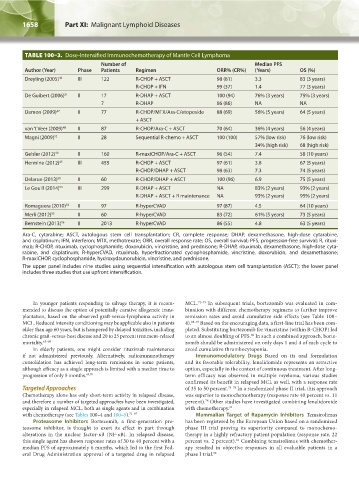
                TABLE 100–3.  Dose-Intensified Immunochemotherapy of Mantle Cell Lymphoma
                                          Number of                                          Median PFS
                Author (Year)     Phase   Patients   Regimen                     ORR% (CR%)  (Years)        OS (%)
                Dreyling (2005) 46  III   122        R-CHOP + ASCT               98 (81)     3.3            83 (3 years)
                                                     R-CHOP + IFN                99 (37)     1.4            77 (3 years)
                De Guibert (2006) 51  II  17         R-DHAP + ASCT               100 (94)    76% (3 years)  75% (3 years)
                                          7          R-DHAP                      86 (86)     NA             NA
                Damon (2009) 47   II      77         R-CHOP/MTX/Ara-C/etoposide  88 (69)     56% (5 years)  64 (5 years)
                                                     + ASCT
                van ‘t Veer (2009) 48  II  87        R-CHOP/Ara-C + ASCT         70 (64)     36% (4 years)  56 (4 years)
                Magni (2009) 52   II      28         Sequential R-chemo + ASCT   100 (100)   57% (low risk)  76 (low risk)
                                                                                             34% (high risk)  68 (high risk)
                Geisler (2012) 49  II     160        R-maxiCHOP/Ara-C + ASCT     96 (54)     7.4            58 (10 years)
                Hermine (2012) 45  III    455        R-CHOP + ASCT               97 (61)     3.8            67 (5 years)
                                                     R-CHOP/DHAP + ASCT          98 (63)     7.3            74 (5 years)
                Delarue (2013) 50  II     60         R-CHOP/DHAP + ASCT          100 (96)    6.9            75 (5 years)
                Le Gouill (2014) 53  III  299        R-DHAP + ASCT               NA          83% (2 years)  93% (2 years)
                                                     R-DHAP + ASCT + R maintenance  NA       93% (2 years)  95% (2 years)

                Romaguera (2010) 54  II   97         R-hyperCVAD                 97 (87)     4.5            64 (10 years)
                Merli (2012) 55   II      60         R-hyperCVAD                 83 (72)     61% (5 years)  73 (5 years)
                Bernstein (2013) 56  II   2013       R-hyperCVAD                 86 (55)     4.8            63 (5 years)

               Ara-C, cytarabine; ASCT, autologous stem cell transplantation; CR, complete response; DHAP, dexamethasone, high-dose cytarabine,
               and cisplatinum; IFN, interferon; MTX, methotrexate; ORR, overall response rate; OS, overall survival; PFS, progression-free survival; R, rituxi-
               mab; R-CHOP, rituximab, cyclophosphamide, doxorubicin, vincristine, and prednisone; R-DHAP, rituximab, dexamethasone, high-dose cyta-
               rabine,  and  cisplatinum;  R-hyperCVAD, rituximab,  hyperfractionated  cyclophosphamide,  vincristine,  doxorubicin,  and  dexamethasone;
               R-maxiCHOP, cyclophosphamide, hydroxydaunorubicin, vincristine, and prednisone.
               The upper panel includes nine studies using sequential intensification with autologous stem cell transplantation (ASCT); the lower panel
               includes three studies that use upfront intensification.


                   In younger patients responding to salvage therapy, it is recom-  MCL. 71–73  In subsequent trials, bortezomib was evaluated in com-
               mended to discuss the option of potentially curative allogeneic trans-  bination with different chemotherapy regimens to further improve
               plantation, based on the observed graft-versus-lymphoma activity in   remission rates and avoid cumulative side effects (see Table  100–
               MCL. Reduced intensity conditioning may be applicable also in patients   4). 88–93  Based on the encouraging data, a first-line trial has been com-
               older than age 60 years, but is hampered by delayed toxicities, including   pleted. Substituting bortezomib for vincristine (within R-CHOP) led
               chronic graft-versus-host disease and 20 to 25 percent treatment-related   to an almost doubling of PFS.  In such a combined approach, borte-
                                                                                            98
               mortality. 65–68                                       zomib should be administered on only days 1 and 4 of each cycle to
                   In elderly patients, one might consider rituximab maintenance   avoid cumulative thrombocytopenia.
               if  not  administered  previously.  Alternatively, radioimmunotherapy   Immunomodulatory Drugs  Based on its oral formulation
               consolidation has achieved long-term remissions in some patients,   and its favorable tolerability, lenalidomide represents an attractive
               although efficacy as a single approach is limited with a median time to   option, especially in the context of continuous treatment. After long-
               progression of only 5 months. 69,70                    term efficacy was observed in multiple myeloma, various studies
                                                                      confirmed its benefit in relapsed MCL as well, with a response rate
               Targeted Approaches                                    of 35 to 50 percent. 75–78  In a randomized phase II trial, this approach
               Chemotherapy alone has only short-term activity in relapsed disease,   was superior to monochemotherapy (response rate 40 percent vs. 11
               and therefore a number of targeted approaches have been investigated,   percent).  Other studies have investigated combining lenalidomide
                                                                             78
               especially in relapsed MCL, both as single agents and in combination   with chemotherapy. 94
               with chemotherapy (see Tables  100–4 and 100–5). 71–97     Mammalian  Target of Rapamycin Inhibitors  Temsirolimus
                   Proteasome Inhibitors  Bortezomib,  a first-generation  pro-  has been registered by the European Union based on a randomized
               teosome inhibitor, is thought to exert its effect in part through   phase III trial proving its superiority compared to monochemo-
               alterations in the nuclear factor-κB (NF-κB). In relapsed disease,   therapy in a highly refractory patient population (response rate, 22
               this single agent has shown response rates of 30 to 40 percent with a   percent vs. 2 percent).  Combining temsirolimus with chemother-
                                                                                       81
               median PFS of approximately 6 months, which led to the first Fed-  apy resulted  in objective  responses in all evaluable  patients in  a
               eral Drug  Administration  approval of a  targeted  drug  in  relapsed   phase I trial. 96


          Kaushansky_chapter 100_p1653-1662.indd   1658                                                                 9/18/15   5:06 PM

