


Page 1680 - Williams Hematology ( PDFDrive )
P. 1680
1654  Part XI:  Malignant Lymphoid Diseases                           Chapter 100:  Mantle Cell Lymphoma             1655


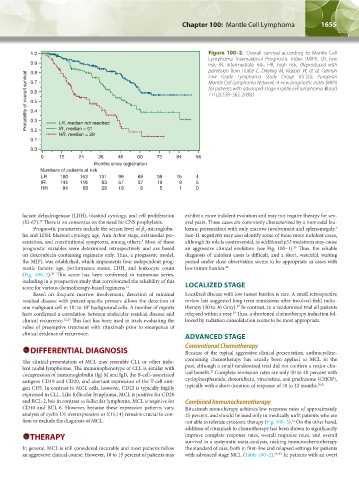
                     1.0                                                        Figure 100–2.  Overall survival according to Mantle Cell
                                                                                Lymphoma International Prognostic Index (MIPI). LR, low
                     0.9                                                        risk; IR, intermediate risk; HR, high risk.  (Reproduced with
                                                                                permission from Hoster E, Dreyling M, Klapper W, et al: German
                     0.8
                   Probability of overall survival  0.7                         Mantle Cell Lymphoma Network: A new prognostic index (MIPI)
                                                                                Low Grade Lymphoma Study Group (GLSG); European
                                                                                for patients with advanced-stage mantle cell lymphoma. Blood
                     0.6
                                                                                111(2):558–565, 2008.)
                     0.5
                     0.4
                     0.3
                              LR, median not reached
                              IR, median = 51
                     0.2
                              HR, median = 29
                     0.1
                     0.0
                        0     12     24    36     48    60     72    84     96
                                          Months since registration
                        Numbers of patients at risk
                        LR    180    153   131    99     69    39     15    4
                        IR    145    116    83    57     37    19     9     5
                        HR     84     58    29    19     8      5     1     0


                  lactate dehydrogenase (LDH), blastoid cytology, and cell proliferation     exhibit a more indolent evolution and may not require therapy for sev-
                  (Ki-67).  There is no consensus on the need for CNS prophylaxis.  eral years. These cases are commonly characterized by a nonnodal leu-
                        19
                     Prognostic parameters include the serum level of β -microglobu-  kemic presentation with only marrow involvement and splenomegaly.
                                                                                                                           4
                                                           2
                  lin and LDH, blastoid cytology, age, Ann Arbor stage, extranodal pre-  Sox-11 negativity may also identify some of these more indolent cases,
                  sentation, and constitutional symptoms, among others.  Most of these   although its role is controversial, as additional p53 mutations may cause
                                                          5
                  prognostic variables were determined retrospectively and are based   an aggressive clinical evolution (see Fig. 100–1).  Thus, the reliable
                                                                                                             25
                  on doxorubicin-containing regimens only. Thus, a prognostic model,   diagnosis of indolent cases is difficult, and a short, watchful, waiting
                  the MIPI, was established, which implements four independent prog-  period under close observation seems to be appropriate in cases with
                  nostic factors: age, performance status, LDH, and leukocyte count    low tumor burden. 26
                  (Fig. 100–2).  This score has been confirmed in numerous series,
                           20
                  including in a prospective study that corroborated the reliability of this
                  score for various chemotherapy-based regimens. 21     LOCALIZED STAGE
                     Based on frequent marrow involvement, detection of minimal   Localized disease with low tumor burden is rare. A small retrospective
                  residual disease with patient-specific primers allows the detection of   review has suggested long-term remissions after involved-field radio-
                  one malignant cell in 10  to 10  background cells. A number of reports   therapy (30 to 36 Gray).  In contrast, in a randomized trial all patients
                                                                                          27
                                        6
                                   5
                                                                                        28
                  have confirmed a correlation between molecular residual disease and   relapsed within a year.  Thus, a shortened chemotherapy induction fol-
                  clinical recurrence. 22,23  This fact has been used in trials evaluating the   lowed by radiation consolidation seems to be most appropriate.
                  value of preemptive treatment with rituximab prior to emergence of
                  clinical evidence of recurrence.                      ADVANCED STAGE
                     DIFFERENTIAL DIAGNOSIS                             Conventional Chemotherapy
                                                                        Because of the typical aggressive clinical presentation, anthracycline-
                  The clinical presentation of MCL may resemble CLL or other indo-  containing chemotherapy has usually been applied to MCL in the
                  lent nodal lymphomas. The immunophenotype of CLL is similar with   past, although a small randomized trial did not confirm a major clin-
                                                                                 29
                  coexpression of immunoglobulin (Ig) M and IgD, the B-cell–associated   ical benefit.  Complete remission rates are only 30 to 40 percent with
                  antigens CD19 and CD20, and aberrant expression of the T-cell anti-  cyclophosphamide, doxorubicin, vincristine, and prednisone (CHOP),
                  gen CD5. In contrast to MCL cells, however, CD23 is typically highly   typically with a short duration of response of 10 to 12 months. 30,31
                  expressed in CLL. Like follicular lymphoma, MCL is positive for CD20
                  and BCL-2, but in contrast to follicular lymphoma, MCL is negative for   Combined Immunochemotherapy
                  CD10 and BCL-6. However, because these expression patterns vary,   Rituximab monotherapy achieves low response rates of approximately
                  analysis of cyclin D1 overexpression or t(11;14) remains crucial to con-  25 percent, and should be used only in medically unfit patients who are
                  firm or exclude the diagnosis of MCL.                 not able to tolerate cytotoxic therapy (Fig. 100–3).  On the other hand,
                                                                                                            32
                                                                        addition of rituximab to chemotherapy has been shown to significantly
                    THERAPY                                             improve complete response rates, overall response rates, and overall
                                                                        survival in a systematic meta-analysis, making immunochemotherapy
                  In general, MCL is still considered incurable and most patients follow   the standard of care, both in first-line and relapsed settings for patients
                  an aggressive clinical course. However, 10 to 15 percent of patients may   with advanced stage MCL (Table 100–2). 33–43  In patients with an overt


          Kaushansky_chapter 100_p1653-1662.indd   1655                                                                 9/18/15   5:06 PM

