


Page 1682 - Williams Hematology ( PDFDrive )
P. 1682
1656  Part XI:  Malignant Lymphoid Diseases                           Chapter 100:  Mantle Cell Lymphoma             1657


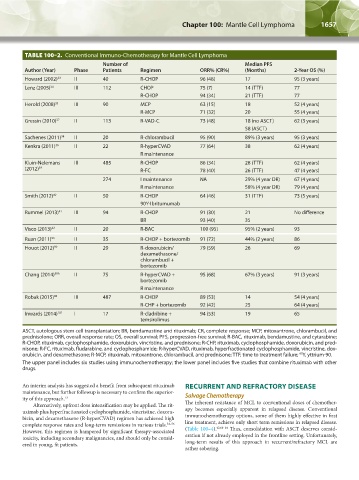
                   TABLE 100–2.  Conventional Immuno-Chemotherapy for Mantle Cell Lymphoma
                                             Number of                                      Median PFS
                   Author (Year)   Phase     Patients    Regimen             ORR% (CR%)     (Months)         2-Year OS (%)
                   Howard (2002) 33  II      40          R-CHOP              96 (48)        17               95 (3 years)
                   Lenz (2005) 34  III       112         CHOP                75 (7)         14 (TTF)         77
                                                         R-CHOP              94 (34)        21 (TTF)         77
                   Herold (2008) 35  III     90          MCP                 63 (15)        18               52 (4 years)
                                                         R-MCP               71 (32)        20               55 (4 years)
                   Gressin (2010) 37  II     113         R-VAD-C             73 (48)        18 (no ASCT)     62 (3 years)
                                                                                            58 (ASCT)
                   Sachenes (2011) 38  II    20          R-chlorambucil      95 (90)        89% (3 years)    95 (3 years)
                   Kenkra (2011) 36  II      22          R-hyperCVAD         77 (64)        38               62 (4 years)
                                                         R maintenance
                   Kluin-Nelemans   III      485         R-CHOP              86 (34)        28 (TTF)         62 (4 years)
                   (2012) 39                             R-FC                78 (40)        26 (TTF)         47 (4 years)
                                             274         I maintenance       NA             29% (4 year DR)  67 (4 years)
                                                         R maintenance                      58% (4 year DR)  79 (4 years)
                   Smith (2012) 40  II       50          R-CHOP              64 (46)        31 (TTF)         73 (5 years)
                                                         90Y-Ibritumumab
                   Rummel (2013) 41  III     94          R-CHOP              91 (30)        21               No difference
                                                         BR                  93 (40)        35
                   Visco (2013) 42  II       20          R-BAC               100 (95)       95% (2 years)    93
                   Ruan (2011) 93  II        35          R-CHOP + bortezomib  91 (72)       44% (2 years)    86
                   Houot (2012) 99  II       29          R-doxorubicin/      79 (59)        26               69
                                                         dexamethasone/
                                                         chlorambucil +
                                                         bortezomib
                   Chang (2014) 59A  II      75          R-hyperCVAD +       95 (68)        67% (3 years)    91 (3 years)
                                                         bortezomib
                                                         R maintenance
                   Robak (2015) 98  III      487         R-CHOP              89 (53)        14               54 (4 years)
                                                         R-CHP + bortezomib  92 (42)        25               64 (4 years)
                   Inwards (2014) 101  I     17          R-cladribine +      94 (53)        19               65
                                                         temsirolimus

                  ASCT, autologous stem cell transplantation; BR, bendamustine and rituximab; CR, complete response; MCP, mitoxantrone, chlorambucil, and
                  prednisolone; ORR, overall response rate; OS, overall survival; PFS, progression-free survival; R-BAC, rituximab, bendamustine, and cytarabine;
                  R-CHOP, rituximab, cyclophosphamide, doxorubicin, vincristine, and prednisone; R-CHP, rituximab, cyclophosphamide, doxorubicin, and pred-
                  nisone; R-FC, rituximab, fludarabine, and cyclophosphamide; R-hyperCVAD, rituximab, hyperfractionated cyclophosphamide, vincristine, dox-
                  orubicin, and dexamethasone; R-MCP, rituximab, mitoxantrone, chlorambucil, and prednisone; TTF, time to treatment failure;  Y, yttrium-90.
                                                                                                               90
                  The upper panel includes six studies using immunochemotherapy; the lower panel includes five studies that combine rituximab with other
                  drugs.

                  An interim analysis has suggested a benefit from subsequent rituximab   RECURRENT AND REFRACTORY DISEASE
                  maintenance, but further followup is necessary to confirm the superior-
                  ity of this approach. 53                              Salvage Chemotherapy
                     Alternatively, upfront dose intensification may be applied. The rit-  The inherent resistance of MCL to conventional doses of chemother-
                  uximab plus hyperfractionated cyclophosphamide, vincristine, doxoru-  apy becomes especially apparent in relapsed disease. Conventional
                  bicin, and dexamethasone (R-hyperCVAD) regimen has achieved high   immunochemotherapy options, some of them highly effective in first
                  complete response rates and long-term remissions in various trials. 54–56    line treatment, achieve only short term remissions in relapsed disease.
                  However, this regimen is hampered by significant therapy-associated   (Table 100–4). 42,60–64  Thus, consolidation with ASCT deserves consid-
                  toxicity, including secondary malignancies, and should only be consid-  eration if not already employed in the frontline setting. Unfortunately,
                  ered in young, fit patients.                          long-term  results  of  this  approach  in  recurrent/refractory  MCL  are
                                                                        rather sobering.


          Kaushansky_chapter 100_p1653-1662.indd   1657                                                                 9/18/15   5:06 PM

