


Page 1765 - Williams Hematology ( PDFDrive )
P. 1765
1740           Part XI:  Malignant Lymphoid Diseases                                                                                                                                             Chapter 107:  Myeloma           1741


               monoclonal immunoglobulins, osteolytic lesions, suppression of bone   TABLE 107–3.  Symptomatic Myeloma 247
               formation near myeloma foci and angiogenesis. 224,225  Studies propose
               novel xenogeneic models, where three-dimensional bone-like scaffolds   Symptoms and Laboratory Features  Frequency (%)
               are used instead of human fetal bone or rabbit bone. 226,227  Specifically,   Bone pain (spine, chest, less common in   58
               these  scaffolds  are  internally  coated  with  murine/human  BMSCs  or   long bones)
               human mesenchymal stromal cells and then implanted in SCID or   Weakness and fatigue    32
               RAG2–/–γc–/– mice, to recapitulate the autologous marrow microen-
               vironment in vivo. Myeloma cells are then loaded directly inside the   Anemia           73
               scaffold  or  injected  intracardiac  to  mimic  myeloma  homing.  These   Elevated creatinine  48
               models are more suitable for studying the microenvironment and also   Hypercalcemia     28
               for drug testing, affording the opportunity to evaluate different stages or
               type of disease. Syngeneic tumor models include transplantable murine   Serum monoclonal immunoglobulin (Ig)  82
               models like 5T33, 228,229  which are mostly representative of aggressive   peak on standard electrophoresis
               late-stage disease, as well as genetically engineered mouse models, such   Weight loss  24 (one-half of whom
               as the Vk*MYC mouse,  generated from the C57BL/6 mouse strain,                          had lost ≥9 kg)
                                 230
               which has a high incidence of spontaneous monoclonal gammopathy   Monoclonal Ig peak on immunofixation   97
               with  aging,  after activation-induced cytidine deaminase–dependent   of serum or urine
               MYC activation in germinal center B-cells. This model exhibits high   Monoclonal IgG    52
               penetrance, clonal malignant plasma cells, which produce isotype class-
               switched immunoglobulins, a similar histology and immunophenotype   Monoclonal IgA      21
               to human myeloma, and delayed onset of renal failure, bone lesions,   Monoclonal light chains only  16
               and anemia. The Vk*MYC mouse model has been used for drug testing,
               strongly paralleling the drug activity observed in myeloma patients. 230  Monoclonal IgD  2
                                                                       Biclonal                        2
                  CLINICAL AND LABORATORY FEATURES                     Monoclonal IgM                  0.5

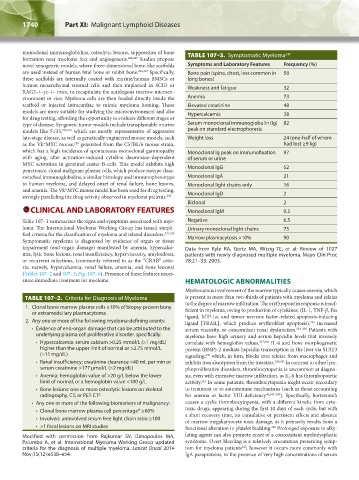
               Table  107–1 summarizes the signs and symptoms associated with mye-  Negative           6.5
               loma. The International Myeloma Working Group has issued simpli-  Urinary monoclonal light chains  75
               fied criteria for the classification of myeloma and related disorders. 231,232    Marrow plasmacytosis >10%  90
               Symptomatic  myeloma  is  diagnosed  by  evidence  of  organ  or  tissue
               impairment (end-organ damage) manifested by anemia, hypercalce-  Data from Kyle RA, Gertz MA,  Witzig  TE, et al: Review of 1027
               mia, lytic bone lesions, renal insufficiency, hyperviscosity, amyloidosis,   patients with newly diagnosed multiple myeloma. Mayo Clin Proc
               or recurrent infections, (commonly referred to as the “CRAB” crite-  78:21–33, 2003.
               ria; namely, hypercalcemia,  renal failure,  anemia, and  bone lesions)
               (Tables 107–2 and 107–3; Fig. 107–6). Presence of these features neces-
               sitate immediate treatment for myeloma.                HEMATOLOGIC ABNORMALITIES
                                                                      Myelomatous involvement of the marrow typically causes anemia, which
                TABLE 107–2.  Criteria for Diagnosis of Myeloma       is present in more than two-thirds of patients with myeloma and relates
                                                                      to the degree of marrow infiltration. The erythropoietin response is insuf-
                1.   Clonal bone marrow plasma cells ≥10% of biopsy-proven bony   ficient in myeloma, owing to production of cytokines, (IL-1, TNF-β, Fas
                   or extramedullary plasmacytoma                     ligand, MIP-1α, and tumor necrosis factor– related apoptosis-inducing
                2.   Any one or more of the following myeloma-defining events:   ligand [TRAIL], which produce erythroblast apoptosis),  increased
                                                                                                                233
                   •   Evidence of end-organ damage that can be attributed to the   serum viscosity, or concomitant renal dysfunction. 234–236  Patients with
                    underlying plasma cell proliferative disorder, specifically:   myeloma have high urinary and serum hepcidin levels that inversely
                    •   Hypercalcemia: serum calcium >0.25 mmol/L (>1 mg/dL)   correlate with hemoglobin values. 237,238  IL-6 and bone morphogenetic
                     higher than the upper limit of normal or >2.75 mmol/L    protein (BMP)-2 mediate hepcidin transcription in the liver via STAT3
                     (>11 mg/dL)                                      signaling,  which, in turn, blocks iron release from macrophages and
                                                                             239
                    •   Renal insufficiency: creatinine clearance <40 mL per min or   inhibits iron absorption from the intestine. 240,241  In contrast to other lym-
                     serum creatinine >177 µmol/L (>2 mg/dL)          phoproliferative disorders, thrombocytopenia is uncommon at diagno-
                    •   Anemia: hemoglobin value of >20 g/L below the lower   sis, even with extensive marrow infiltration, as IL-6 has thrombopoietic
                     limit of normal, or a hemoglobin value <100 g/L   activity.  In some patients, thrombocytopenia might occur secondary
                                                                           242
                    •   Bone lesions: one or more osteolytic lesions on skeletal   to treatment or to autoimmune mechanisms (such as those accounting
                                         Δ
                     radiography, CT, or PET-CT                       for anemia or factor VIII deficiency 46,243–245 ). Specifically, bortezomib
                   •  Any one or more of the following biomarkers of malignancy:   causes a cyclic thrombocytopenia, with a different kinetic from cyto-
                    •  Clonal bone marrow plasma cell percentage* ≥60%   toxic drugs, appearing during the first 10 days of each cycle, but with
                    •  Involved: uninvolved serum free light chain ratio ≥100   a short recovery time, no cumulative or persistent effects and absence
                                                                      of marrow megakaryocyte toxic damage, as it primarily results from a
                    •  >1 focal lesions on MRI studies                functional alteration in platelet budding.  Prolonged exposure to alky-
                                                                                                   246
               Modified with permission from Rajkumar SV, Dimopoulos MA,   lating agents can also promote onset of a concomitant myelodysplastic
               Palumbo A, et al: International Myeloma Working Group updated   syndrome. Overt bleeding is a relatively uncommon presenting symp-
                                                                                         247
               criteria for the diagnosis of multiple myeloma.  Lancet Oncol 2014   tom for myeloma patients ; however it occurs more commonly with
               Nov;15(12):e538–e54.                                   IgA paraproteins, in the presence of very high concentrations of serum


          Kaushansky_chapter 107_p1733-1772.indd   1740                                                                 9/21/15   12:34 PM

