


Page 1766 - Williams Hematology ( PDFDrive )
P. 1766
1740  Part XI:  Malignant Lymphoid Diseases                                         Chapter 107:  Myeloma            1741


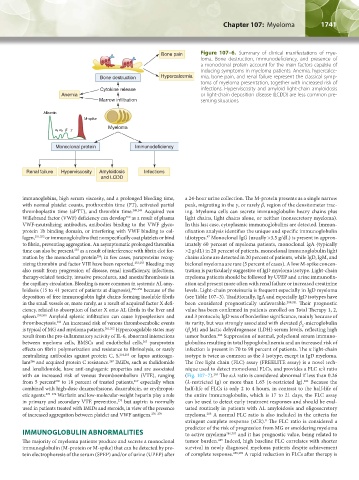
                                                                Bone pain     Figure  107–6.  Summary of clinical manifestations of mye-
                                                                              loma. Bone destruction, immunodeficiency, and presence  of
                                                                              a monoclonal protein account for the main factors capable of
                                                                              inducing symptoms in myeloma patients. Anemia, hypercalce-
                                            Bone destruction    Hypercalcemia  mia, bone pain, and renal failure represent the classical symp-
                                                                              toms of myeloma presentation, together with increased risk of
                                            Cytokine release                  infections. Hyperviscosity and amyloid light-chain amyloidosis
                               Anemia                                         or light-chain deposition disease (LCDD) are less common pre-
                                            Marrow infiltration               senting situations.
                         Albumin
                                       M-spike
                                               Myeloma


                             Monoclonal protein         Immunodeficiency


                   Renal failure  Hyperviscosity  Amyloidosis  Infections
                                            and LCDD


                  immunoglobins, high serum viscosity, and a prolonged bleeding time,   a 24-hour urine collection. The M-protein presents as a single narrow
                  with normal platelet counts, prothrombin time (PT), activated partial   peak, migrating in the γ, or rarely β, region of the densitometer trac-
                  thromboplastin time (aPTT), and thrombin time. 248,249  Acquired von   ing. Myeloma cells can secrete immunoglobulin heavy chains plus
                  Willebrand factor (VWF) deficiency can develop  as a result of plasma   light chains, light chains alone, or neither (nonsecretory myeloma).
                                                     250
                  VWF-neutralizing antibodies, antibodies binding to the VWF glyco-  In this last case, cytoplasmic immunoglobulins are detected. Immun-
                  protein 1b binding domain, or interfering with VWF binding to col-  ofixation analysis identifies the unique and specific immunoglobulin
                  lagen, 251,252  or immunoglobulins that nonspecifically coat platelets or bind   idiotypes.  Monoclonal IgG (usually >3.5 g/dL) is present in approx-
                                                                                47
                  to fibrin, preventing aggregation. An asymptomatic prolonged thrombin   imately 60 percent of myeloma patients, monoclonal IgA (typically
                  time can also be present,  as a result of interference with fibrin clot for-  >2 g/dL) in 20 percent of patients, monoclonal immunoglobulin light
                                   253
                  mation by the monoclonal protein ; in few cases, paraproteins recog-  chains alone are detected in 20 percent of patients, while IgD, IgM, and
                                           254
                  nizing thrombin and factor VIII have been reported. 253,255  Bleeding may   biclonal myeloma are rare (5 percent of cases). A low M-spike concen-
                  also result from progression of disease, renal insufficiency, infections,   tration is particularly suggestive of IgD myeloma isotype. Light-chain
                  therapy-related toxicity, invasive procedures, and anoxia/thrombosis in   myeloma patients should be followed by UPEP and urine immunofix-
                  the capillary circulation. Bleeding is more common in systemic AL amy-  ation and present more often with renal failure or increased creatinine
                  loidosis (15 to 41 percent of patients at diagnosis), 256–258  because of the   levels. Light-chain proteinuria is frequent especially in IgD myeloma
                  deposition of free immunoglobin light chains forming insoluble fibrils   (see Table  107–3). Traditionally, IgA and especially IgD isotypes have
                  in the small vessels or, more rarely, as a result of acquired factor X defi-  been considered  prognostically  unfavorable. 280,281   Their  prognostic
                  ciency, related to absorption of factor X onto AL fibrils in the liver and   value has been confirmed in patients enrolled on Total Therapy 1, 2,
                  spleen. 259,260  Amyloid splenic infiltration can cause hyposplenism and   and 3 protocols; IgD was of borderline significance, mainly because of
                  thrombocytosis.  An increased risk of venous thromboembolic events   its rarity, but was strongly associated with elevated β -microglobulin
                             260
                                                                                                                2
                  is typical of MG and myeloma patients. 261,262  Hypercoagulable states may   (β M) and lactic dehydrogenase (LDH) serum levels, reflecting high
                                                                          2
                  result from the pro-inflammatory activity of IL-6, abnormal interactions   tumor burden.  Suppression of normal, polyclonal serum immuno-
                                                                                   282
                  between  myeloma cells,  BMSCs and endothelial cells,  paraprotein   globulins resulting in total hypoglobulinemia and an increased risk of
                                                          263
                  effects on fibrin polymerization and resistance to fibrinolysis, or rarely   infection is present in 70 to 90 percent of patients. The κ light-chain
                  neutralizing antibodies against protein C, S, 264,265  or lupus anticoagu-  isotype is twice as common as the λ isotype, except in IgD myeloma.
                  lant  and acquired protein C resistance.  IMiDs, such as thalidomide   The free light chain (FLC) assay (FREELITE assay) is a novel tech-
                                               267
                    266
                  and lenalidomide, have anti-angiogenic properties and are associated   nique used to detect monoclonal FLCs, and provides a FLC κ:λ ratio
                  with an increased risk of venous thromboembolism (VTE), ranging   (Fig. 107–7).  The κ:λ ratio is considered abnormal if less than 0.26
                                                                                  283
                  from 5 percent  to 18 percent of treated patients,  especially when   (λ-restricted Ig) or more than 1.65 (κ-restricted Ig).  Because the
                                                                                                                284
                                                       269
                             268
                  combined with high-dose dexamethasone, doxorubicin, or erythropoi-  half-life of FLCs is only 2 to 4 hours, in contrast to the half-life of
                  etic agents. 270–274  Warfarin and low-molecular-weight heparin play a role   the entire immunoglobulin, which is 17 to 21 days, the FLC assay
                  in primary and secondary VTE prevention,  but aspirin is normally   can be used to detect early treatment responses and should be eval-
                                                  275
                  used in patients treated with IMiDs and steroids, in view of the presence   uated routinely in patients with AL amyloidosis and oligosecretory
                  of increased aggregation between platelet and VWF antigens. 276–279  myeloma.  A normal FLC ratio is also included in the criteria for
                                                                                285
                                                                        stringent complete response (sCR).  The FLC ratio is considered a
                                                                                                   8
                                                                        predictor of the risk of progression from MG or smoldering myeloma
                  IMMUNOGLOBULIN ABNORMALITIES                          to active myeloma 286,287  and it has prognostic value, being related to
                                                                                   285
                  The majority of myeloma patients produce and secrete a monoclonal   tumor burden.  Indeed, high baseline FLC correlates with shorter
                  immunoglobulin (M-protein or M-spike) that can be detected by pro-  survival in newly diagnosed myeloma patients despite achievement
                  tein electrophoresis of the serum (SPEP) and/or of urine (UPEP) after   of complete response. 288,289  A rapid reduction in FLCs after therapy is
          Kaushansky_chapter 107_p1733-1772.indd   1741                                                                 9/21/15   12:34 PM

