


Page 1777 - Williams Hematology ( PDFDrive )
P. 1777
1752           Part XI:  Malignant Lymphoid Diseases                                                                                                                                             Chapter 107:  Myeloma           1753


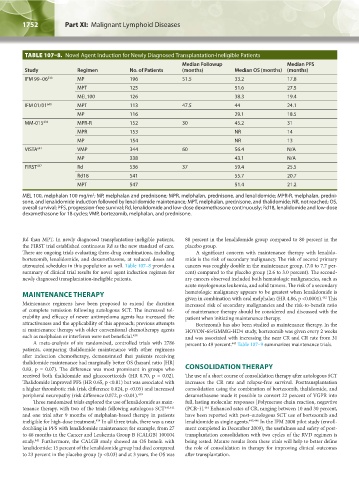
                TABLE 107–8.  Novel Agent Induction for Newly Diagnosed Transplantation-Ineligible Patients
                                                                     Median Followup                    Median PFS
                Study             Regimen          No. of Patients   (months)          Median OS (months) (months)
                IFM 99–06 538     MP               196               51.5              33.2             17.8
                                  MPT              125                                 51.6             27.5
                                  MEL100           126                                 38.3             19.4
                IFM 01/01 640     MPT              113               47.5              44               24.1
                                  MP               116                                 29.1             18.5
                MM-015 434        MPR-R            152               30                45.2             31
                                  MPR              153                                 NR               14
                                  MP               154                                 NR               13
                VISTA 641         VMP              344               60                56.4             N/A
                                  MP               338                                 43.1             N/A
                FIRST 437         Rd               536               37                59.4             25.5
                                  Rd18             541                                 55.7             20.7
                                  MPT              547                                 51.4             21.2
               MEL 100, melphalan 100 mg/m ; MP, melphalan and prednisone; MPR, melphalan, prednisone, and lenalidomide; MPR-R, melphalan, predni-
                                       2
               sone, and lenalidomide induction followed by lenalidomide maintenance; MPT, melphalan, prednisone, and thalidomide; NR, not reached; OS,
               overall survival; PFS, progression-free survival; Rd, lenalidomide and low-dose dexamethasone continuously; Rd18, lenalidomide and low-dose
               dexamethasone for 18 cycles; VMP, bortezomib, melphalan, and prednisone.


               Rd than MPT. In newly diagnosed transplantation-ineligible patients,   88 percent in the lenalidomide group compared to 80 percent in the
               the FIRST trial established continuous Rd as the new standard of care.   placebo group.
               There are ongoing trials evaluating three-drug combinations, including   A significant concern with maintenance therapy with lenalido-
               bortezomib,  lenalidomide,  and dexamethasone,  at  reduced  doses  and   mide is the risk of secondary malignancy. The risk of second primary
               attenuated schedules in this population as well. Table 107–8 provides a   cancers was roughly double in the maintenance group, (7.0 to 7.7 per-
               summary of clinical trial results for novel agent induction regimen for   cent) compared to the placebo group (2.6 to 3.0 percent). The second-
               newly diagnosed transplantation-ineligible patients.   ary cancers observed included both hematologic malignancies, such as
                                                                      acute myelogenous leukemia, and solid tumors. The risk of a secondary
               MAINTENANCE THERAPY                                    hematologic malignancy appears to be greatest when lenalidomide is
                                                                      given in combination with oral melphalan (HR 4.86, p <0.0001).  This
                                                                                                                    442
               Maintenance regimens have been proposed to extend the duration   increased risk of secondary malignancies and the risk-to-benefit ratio
               of complete remission following autologous SCT. The increased tol-  of maintenance therapy should be considered and discussed with the
               erability and efficacy of newer antimyeloma agents has increased the   patient when initiating maintenance therapy.
               attractiveness and the applicability of this approach; previous attempts   Bortezomib has also been studied as maintenance therapy. In the
               at maintenance therapy with older conventional chemotherapy agents   HOVON-65/GMMG-HD4 study, bortezomib was given every 2 weeks
               such as melphalan or interferon were not beneficial. 438  and was associated with increasing the near CR and CR rate from 31
                   A meta-analysis of six randomized, controlled trials with 2786   percent to 49 percent.  Table 107–9 summarizes maintenance trials.
                                                                                      443
               patients, comparing thalidomide maintenance with other regimens
               after induction chemotherapy, demonstrated that patients receiving
               thalidomide maintenance had marginally better OS (hazard ratio [HR]
               0.83, p = 0.07). The difference was most prominent in groups who   CONSOLIDATION THERAPY
               received both thalidomide and glucocorticoids (HR 0.70, p = 0.02).   The use of a short course of consolidation therapy after autologous SCT
               Thalidomide improved PFS (HR 0.65, p <0.01) but was associated with   increases the CR rate and relapse-free survival. Posttransplantation
               a higher thrombotic risk (risk difference 0.024, p <0.05) and increased   consolidation using the combination of bortezomib, thalidomide, and
               peripheral neuropathy (risk difference 0.072, p <0.01). 439  dexamethasone made it possible to convert 22 percent of VGPR into
                   Three randomized trials explored the use of lenalidomide as main-  full, lasting molecular responses [Polymerase chain reaction, negavtive
               tenance therapy, with two of the trials following autologous SCT 440,441    (PCR–)].  Enhanced rates of CR, ranging between 10 and 30 percent,
                                                                            444
               and one trial after 9 months of melphalan-based therapy in patients   have been reported with post–autologous SCT use of bortezomib and
                                        434
               ineligible for high-dose treatment.  In all three trials, there was a near   lenalidomide as single agents. 445,446  In the IFM 2008 pilot study (enroll-
               doubling in PFS with lenalidomide maintenance; for example, from 27   ment completed in December 2009), the usefulness and safety of post-
               to 46 months in the Cancer and Leukemia Group B (CALGB) 100104   transplantation consolidation with two cycles of the RVD regimen is
               study.  Furthermore, the CALGB study showed an OS benefit with   being tested. Mature results from these trials will help to better define
                    441
               lenalidomide: 15 percent of the lenalidomide group had died compared   the role of consolidation in therapy for improving clinical outcomes
               to 23 percent in the placebo group (p <0.03) and at 3 years, the OS was   after transplantation.


          Kaushansky_chapter 107_p1733-1772.indd   1752                                                                 9/21/15   12:35 PM

