


Page 1772 - Williams Hematology ( PDFDrive )
P. 1772
1746  Part XI:  Malignant Lymphoid Diseases                                         Chapter 107:  Myeloma            1747


                  chemotherapy to avoid permanent deficits. Specifically, local radiother-  osteopenia, and impending fractures of long bones and pelvis. MRI and
                  apy using less than 30 Gy is potentially curative, in the presence of a   PET-CT are more sensitive than the bone survey, and better capture
                  solitary plasmacytoma; in patients with systemic disease, the DT-PACE   early bone disease, the extent of bone disease, and EMD. Both MRI and
                  regimen, which combines high-dose dexamethasone pulsing, as part   PET-CT findings have important prognostic implications. 209,364  These
                  of the combination with oral dexamethasone, daily thalidomide, and 4   tests are now being used more frequently specifically in smoldering
                  days of continuous-infusion cisplatin, doxorubicin, cyclophosphamide,   multiple myeloma (SMM) patients. Assessment of the heart by echocar-
                  and etoposide, can provide effective treatment and should be followed   diogram and electrocardiogram is useful in the right clinical context to
                  by local radiation in the absence of symptom relief and lack of tumor   detect cardiac amyloidosis and/or LCDD, and, in selected cases, cardiac
                  shrinkage. If a singular vertebral collapse is evident without plasmacy-  MRI may be helpful to demonstrate myocardial infiltration. Measure-
                  toma, decompressive laminectomy is the treatment of choice.  ment of brain natriuretic peptide and N-terminal prohormone B-type
                                                                        natriuretic peptide are useful screening tests to detect cardiac dysfunc-
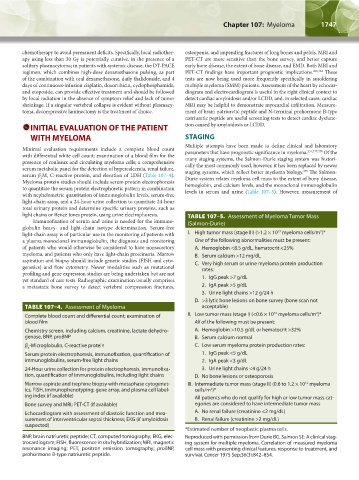
                       INITIAL EVALUATION OF THE PATIENT                tion caused by amyloidosis or LCDD.
                     WITH MYELOMA                                       STAGING
                                                                        Multiple attempts have been made to define clinical and laboratory
                  Minimal evaluation requirements include a complete blood count   parameters that have prognostic significance in myeloma. 231,377,378  Of the
                  with differential white cell count; examination of a blood film for the   many staging systems, the Salmon-Durie staging system was histori-
                  presence of rouleaux and circulating myeloma cells; a comprehensive   cally the most commonly used, however, it has been replaced by newer
                  serum metabolic panel for the detection of hypercalcemia, renal failure,   staging systems, which reflect better myeloma biology.  The Salmon-
                                                                                                                379
                  serum β M, C-reactive protein, and elevation of LDH (Table 107–4).   Durie system relates myeloma cell mass to the extent of bony disease,
                        2
                  Myeloma protein studies should include serum protein electrophoresis   hemoglobin, and calcium levels, and the monoclonal immunoglobulin
                  to quantitate the serum protein electrophoretic pattern in combination   levels in serum and urine (Table 107–5). However, measurement of
                  with nephelometric quantitation of immunoglobulin levels, serum-free
                  light-chain assay, and a 24-hour urine collection to quantitate 24-hour
                  total urinary protein and determine specific urinary proteins, such as
                  light chains or Bence Jones protein, using urine electrophoresis.  TABLE 107–5.  Assessment of Myeloma Tumor Mass
                     Immunofixation of serum and urine is needed for the immuno-  (Salmon-Durie)
                  globulin  heavy-  and  light-chain  isotype  determination.  Serum-free
                                                                                                       12
                                                                                                                      2
                  light-chain assay is of particular use in the monitoring of patients with   I.  High tumor mass (stage III) (>1.2 × 10  myeloma cells/m )*
                  a plasma monoclonal immunoglobulin, the diagnosis and monitoring   One of the following abnormalities must be present:
                  of patients who would otherwise be considered to have nonsecretory   A.  Hemoglobin <8.5 g/dL, hematocrit <25%
                  myeloma, and patients who only have light-chain proteinuria. Marrow   B.  Serum calcium >12 mg/dL
                  aspiration and biopsy should include genetic studies (FISH and cyto-  C.  Very high serum or urine myeloma protein production
                  genetics)  and flow cytometry. Newer modalities such as mutational   rates:
                  profiling and gene expression studies are being undertaken but are not
                  yet standard of care tests. Radiographic examination usually comprises   1.  IgG peak >7 g/dL
                  a metastatic bone survey to detect vertebral compression fractures,   2.  IgA peak >5 g/dL
                                                                              3.  Urine light chains >12 g/24 h
                                                                            D.  >3 lytic bone lesions on bone survey (bone scan not
                   TABLE 107–4.  Assessment of Myeloma                        acceptable)
                                                                                                                    2
                                                                                                      12
                   Complete blood count and differential count; examination of   II.  Low tumor mass (stage I) (<0.6 × 10  myeloma cells/m )*
                   blood film                                               All of the following must be present:
                   Chemistry screen, including calcium, creatinine, lactate dehydro-  A.  Hemoglobin >10.5 g/dL or hematocrit >32%
                   genase, BNP, proBNP                                      B.  Serum calcium normal
                   β -Microglobulin, C-reactive protein                     C.  Low serum myeloma protein production rates:
                    2
                   Serum protein electrophoresis, immunofixation, quantification of   1.  IgG peak <5 g/dL
                   immunoglobulins, serum-free light chains                   2.  IgA peak <3 g/dL
                   24-Hour urine collection for protein electrophoresis, immunofixa-  3.  Urine light chains <4 g/24 h
                   tion, quantification of immunoglobulins, including light chains  D.  No bone lesions or osteoporosis
                                                                                                                 12
                   Marrow aspirate and trephine biopsy with metaphase cytogenet-  III.  Intermediate tumor mass (stage II) (0.6 to 1.2 × 10  myeloma
                   ics, FISH, immunophenotyping; gene array, and plasma cell label-  cells/m )*
                                                                                 2
                   ing index (if available)                                 All patients who do not qualify for high or low tumor mass cat-
                   Bone survey and MRI; PET-CT (if available)               egories are considered to have intermediate tumor mass
                   Echocardiogram with assessment of diastolic function and mea-  A.  No renal failure (creatinine ≤2 mg/dL)
                   surement of interventricular septal thickness; EKG (if amyloidosis   B.  Renal failure (creatinine >2 mg/dL)
                   suspected)
                                                                        *Estimated number of neoplastic plasma cells.
                  BNP, brain natriuretic peptide; CT, computed tomography; EKG, elec-  Reproduced with permission from Durie BG, Salmon SE: A clinical stag-
                  trocardiogram; FISH, fluorescence in situ hybridization; MRI, magnetic   ing system for multiple myeloma. Correlation of measured myeloma
                  resonance imaging; PET, positron emission tomography; proBNP,   cell mass with presenting clinical features, response to treatment, and
                  prohormone B-type natriuretic peptide.                survival. Cancer 1975 Sep;36(3):842–854.


          Kaushansky_chapter 107_p1733-1772.indd   1747                                                                 9/21/15   12:34 PM

