


Page 1773 - Williams Hematology ( PDFDrive )
P. 1773
1748           Part XI:  Malignant Lymphoid Diseases                                                                                                                                             Chapter 107:  Myeloma           1749


                TABLE 107-6.  International Staging System
                Stage I:                  β M <3.5
                                           2
                                          ALB ≥3.5
                Stage II:                 β M <3.5
                                           2
                                          ALB <3.5
                                          or
                                          β M 3.5 to 5.5
                                           2
                Stage III:                β M >5.5
                                           2
               ALB, serum albumin in g/dL; β M, serum β -microglobulin in mg/L. 231
                                      2        2
               Data from Greipp PR, San Miguel J, Durie BG, et al: International
               staging system for multiple myeloma.  J  Clin  Oncol 2005 May
               20;23(15):3412–3420.                                     A                B                C

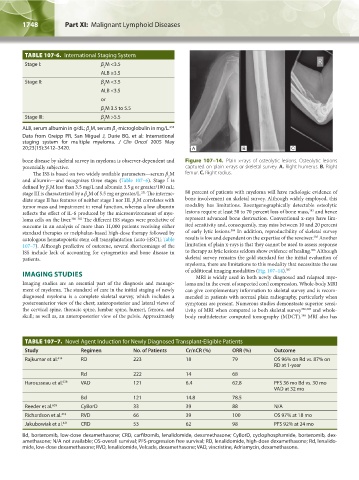
               bone disease by skeletal survey in myeloma is observer-dependent and   Figure 107–14.  Plain x-rays of osteolytic lesions. Osteolytic lesions
               potentially subjective.                                captured on plain x-rays or skeletal survey. A. Right humerus. B. Right
                   The ISS is based on two widely available parameters—serum β M   femur. C. Right radius.
                                                                2
               and albumin—and recognizes three stages (Table 107–6). Stage I is
               defined by β M less than 3.5 mg/L and albumin 3.5 g or greater/100 mL;
                        2
               stage III is characterized by a β M of 5.5 mg or greater/L.  The interme-  80 percent of patients with myeloma will have radiologic evidence of
                                                       231
                                     2
               diate stage II has features of neither stage I nor III. β M correlates with   bone involvement on skeletal survey. Although widely employed, this
                                                     2
               tumor mass and impairment in renal function, whereas a low albumin   modality has limitations. Roentgenographically detectable osteolytic
                                                                                                                383
               reflects the effect of IL-6 produced by the microenvironment of mye-  lesions require at least 50 to 70 percent loss of bone mass,  and hence
               loma cells on the liver. 380–382  The different ISS stages were predictive of   represent advanced bone destruction. Conventional x-rays have lim-
               outcome in an analysis of more than 11,000 patients receiving either   ited sensitivity and, consequently, may miss between 10 and 20 percent
                                                                                     384
               standard therapies or melphalan-based high-dose therapy followed by   of early lytic lesions.  In addition, reproducibility of skeletal survey
                                                                                                                 385
               autologous hematopoietic stem cell transplantation (auto-HSCT; Table   results is low and dependent on the expertise of the reveiwer.  Another
               107–7). Although predictive of outcome, several shortcomings of the   limitation of plain x-rays is that they cannot be used to assess response
                                                                                                                386
               ISS include lack of accounting for cytogenetics and bone disease in   to therapy as lytic lesions seldom show evidence of healing.  Although
               patients.                                              skeletal survey remains the gold standard for the initial evaluation of
                                                                      myeloma, there are limitations to this modality that necessitate the use
               IMAGING STUDIES                                        of additional imaging modalities (Fig. 107–14). 387
                                                                          MRI is widely used in both newly diagnosed and relapsed mye-
               Imaging studies are an essential part of the diagnosis and manage-  loma and in the event of suspected cord compression. Whole-body MRI
               ment of myeloma. The standard of care in the initial staging of newly   can give complementary information to skeletal survey and is recom-
               diagnosed myeloma is a complete skeletal survey, which includes a   mended in patients with normal plain radiography, particularly when
               posteroanterior view of the chest; anteroposterior and lateral views of   symptoms are present. Numerous studies demonstrate superior sensi-
               the cervical spine, thoracic spine, lumbar spine, humeri, femora, and   tivity of MRI when compared to both skeletal survey 388,389  and whole-
               skull; as well as, an anteroposterior view of the pelvis. Approximately   body multidetector computed tomography (MDCT).  MRI also has
                                                                                                             390

                TABLE 107–7.  Novel Agent Induction for Newly Diagnosed Transplant-Eligible Patients
                Study              Regimen           No. of Patients  Cr/nCR (%)      ORR (%)       Outcome
                Rajkumar et al. 414  RD              223              18              79            OS 96% on Rd vs. 87% on
                                                                                                    RD at 1-year
                                   Rd                222              14              68
                Harousseau et al. 638  VAD           121              6.4             62.8          PFS 36 mo Bd vs. 30 mo
                                                                                                    VAD at 32 mo
                                   Bd                121              14.8            78.5
                Reeder et al. 639  CyBorD            33               39              88            N/A
                Richardson et al. 418  RVD           66               39              100           OS 97% at 18 mo
                Jakubowiak et al. 421  CRD           53               62              98            PFS 92% at 24 mo

               Bd, bortezomib, low-dose dexamethasone; CRD, carfilzomib, lenalidomide, dexamethasone; CyBorD, cyclophosphamide, bortezomib, dex-
               amethasone; N/A not available; OS-overall survival; PFS-progression free survival; RD, lenalidomide, high-dose dexamethasone; Rd, lenalido-
               mide, low-dose dexamethasone; RVD, lenalidomide, Velcade, dexamethasone; VAD, vincristine, Adriamycin, dexamethasone.


          Kaushansky_chapter 107_p1733-1772.indd   1748                                                                 9/21/15   12:34 PM

